Ruling party calls supplementary budget a 'measure to stabilize livelihoods,' opposition slams it as 'pre-election handout'
- Input
- 2026-03-11 16:54:18
- Updated
- 2026-03-11 16:54:18
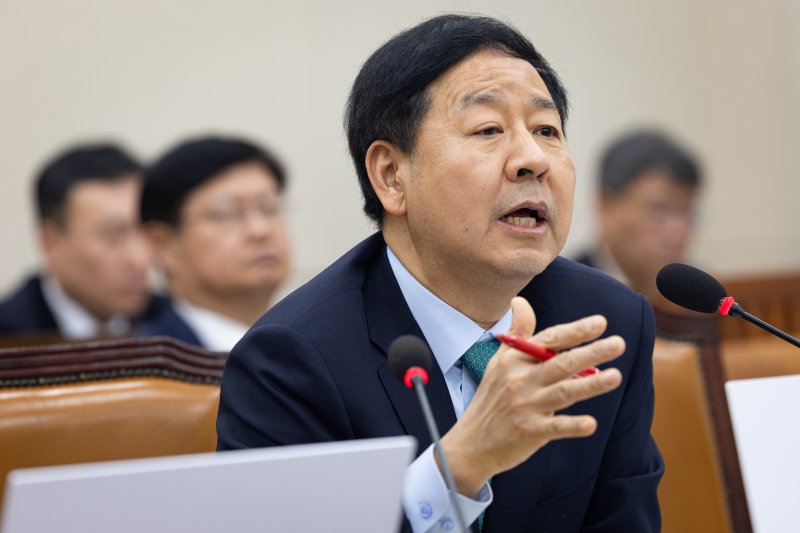
The Financial News reported that as the government and the ruling party have put forward the option of a supplementary budget to prepare for economic deterioration stemming from the Middle East, the People Power Party has criticized it as a "pre-election, vote-buying supplementary budget" ahead of the local elections. Sharp disagreement also emerged between the ruling and opposition parties over the government’s planned maximum oil price system.
The Strategy and Finance Committee of the National Assembly of the Republic of Korea held a session on the 11th to question the Ministry of Finance and Economy on measures to address economic risks arising from the Iran war in the Middle East.
Park Seong-hoon, a People Power Party lawmaker on the Strategy and Finance Committee, raised concerns during the session over growing talk within the government and ruling party about drawing up a supplementary budget. He noted, "There is talk that this supplementary budget is a 'cherry blossom budget' to spray money around ahead of the local elections," and criticized it as a "fiscal policy aimed at winning votes."
He went on, "There is a fundamental question as to whether handing out cash right before an election really helps our economy," adding, "Many experts are worried that distributing cash to the entire population will push up prices, and that this could lead to stagflation, where inflation rises while the economy remains in recession."
Koo Yun-cheol, Deputy Prime Minister and Minister of Finance and Economy, explained, "The reason we are pursuing a supplementary budget now is that, as oil prices rise due to the current situation in the Middle East, we want to focus on easing the difficulties of specific groups that are being hit, such as freight truck operators."
Park also continued his criticism of the maximum oil price system. He said, "There are voices saying this is an unfair measure that forces ordinary people who take the subway to subsidize owners of luxury cars," adding, "People who commute by public transportation and have nothing to do with gas stations are pointing out that this is a measure for the benefit of gas stations and refiners."
Yoo Sang-bum, another People Power Party lawmaker, said, "The maximum oil price system is an extreme measure that runs counter to the market principle of supply and demand," and pressed further, asking, "You, Deputy Prime Minister Koo, are asserting that this is profiteering. Has that been empirically verified?"
In response, Deputy Prime Minister Koo countered, "Crude oil itself has never entered the country at such a high price," and added, "Yet at some point prices shot up to over 2,000 won per liter, and that is excessive profiteering."
The ruling Democratic Party of Korea strongly defended both the need for a supplementary budget and the implementation of the maximum oil price system.
Ahn Do-geol, a Democratic Party of Korea lawmaker, said, "We decided on the supplementary budget to overcome the energy crisis and stabilize people’s livelihoods," and pointed out, "As the economy recovers, tax revenues are improving. We need to return part of those tax receipts to the private sector to support the potential growth rate we are aiming for."
Democratic Party of Korea lawmaker Jin Sung-joon joined in, saying, "Bold policy measures such as the maximum oil price system in response to high oil prices send a clear signal to the market while addressing the problem," giving a positive assessment.
He continued, "The oil products currently being sold at higher prices were imported at prices from before the Iran war, so they cannot legitimately be sold at the new, higher prices," while also arguing, "Some of the price hikes were made by individual gas stations, but more fundamentally it was the refiners that raised prices. Strong action must be taken against the refiners."
[email protected] Kim Hyeong-gu Reporter