"A 900,000-won ticket jumped to 2.2 million won in five minutes"... the frantic moment when war broke out [Escaping Egypt]
- Input
- 2026-03-12 15:59:41
- Updated
- 2026-03-12 15:59:41
[The Financial News] I set out as a tourist in Egypt and somehow ended up as an evacuee. It all began with what happened on the 28th of last month, local time.
The United States, together with Israel, launched a large-scale military operation against Iran. In retaliation, Iran carried out simultaneous strikes on U.S. military facilities across the Middle East, including in Israel, Dubai in the United Arab Emirates (UAE), Doha in the State of Qatar, and Manama in the Kingdom of Bahrain.
The world was, quite literally, stunned. The Strait of Hormuz was shut down, sending oil prices soaring, and global stock markets swung wildly amid the heightened geopolitical uncertainty.
South Korea was no exception. Korean residents living in Middle Eastern countries suddenly found themselves in the middle of a war zone. Travelers visiting the region, or transiting through it, also became direct victims as air routes were cut off. I, too, was caught on the fringes of that shock.
In Egypt, where I had arrived via a layover in the Middle East, I began to seriously think about a mass escape. Now that I have managed to get out, I want to share that story.
KakaoTalk messages that turned from "jealousy" to "worry"
"Are you okay?" "There’s nothing wrong, right?"
On the second day of my trip, the 28th of last month, KakaoTalk suddenly started filling up with messages asking if I was safe. They were from family and friends.
Egypt, located at the eastern edge of North Africa, is a strategic hub that leads the Arab and Islamic world and the broader Middle East, and it has long served as a key partner of the United States in maintaining regional stability. That alone was enough to make people worry. On top of that, I had flown in on Qatar Airways via Doha, one of Iran’s stated targets, which must have heightened their concern.
But to be honest, I had no idea until those messages arrived. I hadn’t been checking the news, and above all, everything around me felt peaceful. Tourist sites were packed with visitors, and locals were going about their daily lives. It was only on the third day that I realized everyone was trying hard to maintain a sense of normalcy.
Korean tourists I met in Giza, home to the pyramids and the Sphinx, told me their travel agency had hurriedly changed their flights.
One traveler, identified as Mr. A, said, "I came here via Dubai on Emirates. I’m supposed to leave tomorrow, but with the airspace closed, they switched me to Turkish Airlines."
A 900,000-won ticket... 2.2 million won five minutes later
Only then did I start thinking seriously about a Plan B. The moment I joined an open chat room created by Korean residents in Qatar, I realized that I had been the only one feeling at peace.
The chat room already had more than 1,300 people, and messages that felt almost surreal kept popping up: "I just heard a boom," "An alert text just came in." There were also vivid accounts from travelers who had been stranded in Doha when the airspace suddenly closed as they were about to transit.
▶ [Cairo report] "I chose it because it was cheap and ended up stranded"... Middle Eastern airline passengers paying an extra 3 million won to switch carriers (March 3, 2026 edition)https://n.news.naver.com/article/014/0005485683?type=journalists
Even though I was there as a traveler, I felt I had a duty to report what was happening on the ground. During my reporting, I learned that Korean residents and tourists who had been in Israel were crossing into Egypt with assistance from the embassy. I confirmed the details through the Korean Association in Egypt and the Korean Association in Israel and filed my story.
After I filed the article, a question suddenly hit me: "What about me?" Around that time, the United States Department of State (State Department) urged its citizens in 14 Middle Eastern countries to leave immediately. Egypt was one of those countries.
From that moment, I began planning a full-fledged exodus from Egypt. According to the tips being shared in the open chat rooms on how to get out of the Middle East, the first step was to reach a country where planes were still taking off. The immediate options were the Republic of Türkiye, the People's Republic of China (China), and various destinations in Europe that had direct flights to South Korea.
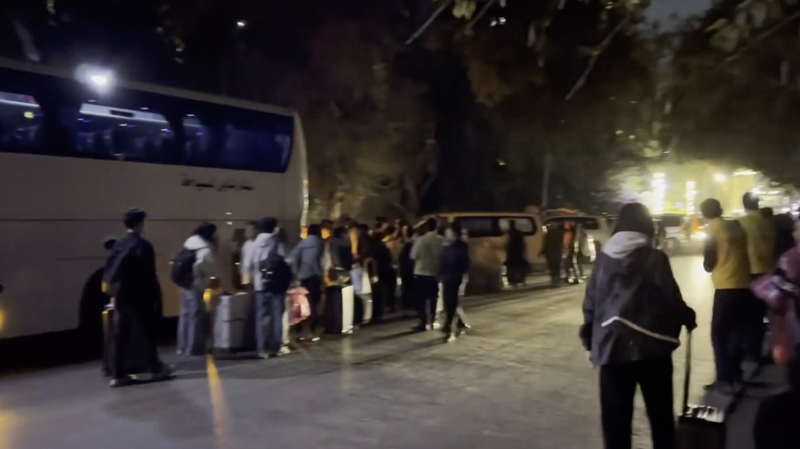
In a way, I was fortunate simply to be in Egypt, where flights to those places still existed. People stuck in Doha or Dubai, where the airspace had been closed, were even considering overland routes just to reach a country with operating airports. Koreans who had come from Israel into Egypt had to endure nearly 20 hours on a bus to cross the border.
Then began the ticketing war. I had to juggle a limited travel budget and the pressure of sticking to my vacation dates, among many other factors.
Direct flights from Cairo to Shanghai or Beijing in China were well over 4 million won, and Turkish Airlines flights to the Republic of Türkiye were fully booked as well.
That left Europe as the only viable option. I quickly ruled out full-service carriers like Korean Air and Asiana Airlines because the fares were simply too high.
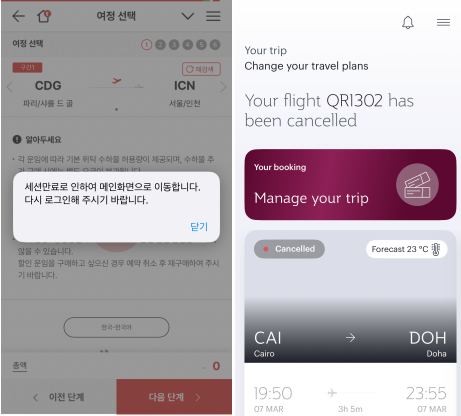
So I searched for foreign airlines that fly directly to Incheon. I checked KLM, Air France, Lufthansa in Germany, and LOT Polish Airlines in Poland, but none of them had flights that met my needs.
Then I remembered that some Korean low-cost carriers (LCCs) operate actively on routes to Europe. When I searched flights from Paris Charles de Gaulle Airport, the nearest dates were already sold out, but there were still seats left on the 9th. The price was attractive too: 900,000 won.
Extending my vacation by just one extra day until arrival in Incheon on the 10th seemed manageable, and the cost was reasonable, so it felt like the best option I could hope for. I hurried to pay. The payment page was working fine at first, then suddenly froze.
Once, twice... There were only three seats left, so I was getting anxious, but the payment just wouldn’t go through. On the third attempt—five minutes later—all three seats were gone. The price for the same seats had jumped to 2.2 million won. An increase of 1.3 million won in an instant.
There was a 1.2 million-won ticket available on the 12th, but with my limited vacation days, I decided to give it up.
Next, I checked flights to Barcelona in Spain. A ticket departing on the same day, the 9th, was just under 2 million won. After seeing a 2.2 million-won fare, even that felt like a relief.
To avoid another payment failure, I asked my family back in South Korea to buy the ticket for me. As you’d expect from an online powerhouse, the transaction went through in no time.
Two days after the purchase, Qatar Airways announced that its flights to South Korea had been canceled.
An exodus, each in their own way
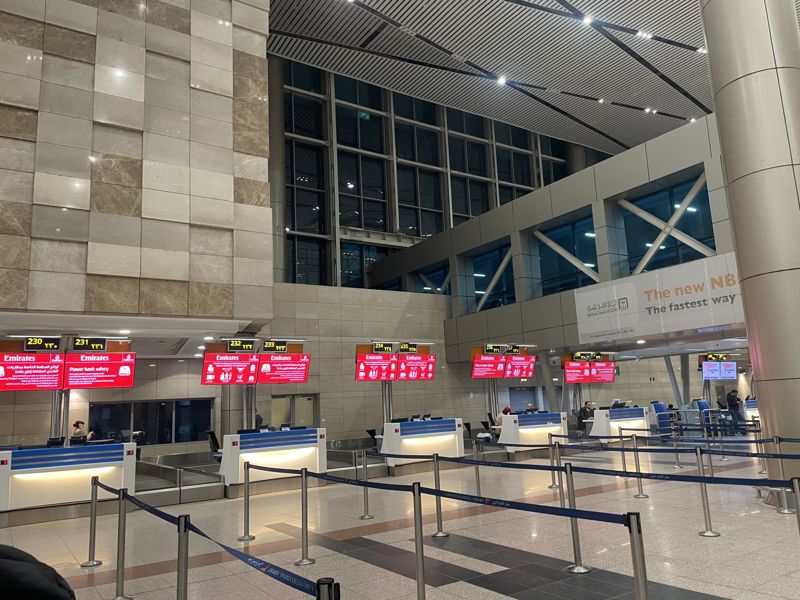
Finally, at 11:45 p.m. on March 7, I arrived at Cairo International Airport in Egypt. I was there to board a Vueling Airlines flight to Spain. Right next to it, the Emirates counter for the 11:50 p.m. flight to Dubai was deserted.
After getting my boarding pass and entering the duty-free area, I noticed quite a few Koreans. While chatting with a Korean man in his 30s at a café, I learned where they were headed. He said he and his wife had come to Egypt on a private trip using Etihad Airways, and were now on their way to Abu Dhabi.
He also told me how they would get from Abu Dhabi to South Korea. The South Korean government had arranged a chartered flight for its citizens staying in the UAE amid the fallout from the crisis in the Middle East.
The chartered flight, operated by Etihad Airways, departed Abu Dhabi Airport at 5:35 p.m. on the 8th, Korea time, and landed at Incheon International Airport at around 1:29 a.m. on the 9th. It reportedly carried 203 Korean nationals and three foreign spouses holding British, French, and Canadian citizenship, for a total of 206 passengers. Priority was given to those in serious medical condition, people with severe disabilities, pregnant women and the elderly, infants and young children, and their essential companions.
The Ministry of Foreign Affairs stated that it would later charge passengers a reasonable level of airfare comparable to normal rates, but the price already seemed to be widely known.
He said, "As far as I know, the fare is 1.5 million won. After selecting priority passengers, the remaining seats were allocated by lottery," adding, "I was lucky enough to be chosen, and my wife was able to come along because she’s family."
He added, "There are about 50 people in the tour group traveling with us, but only five of them managed to get on the chartered flight," and went on, "Some people are just waiting in Abu Dhabi with no clear plan, and others are flying home with four layovers."
We said our goodbyes and headed to our respective gates for our own exodus from Egypt. At 5 p.m. on the 10th, I arrived at Incheon International Airport, bringing my exodus to a successful end.
So what about Middle Eastern carriers?
Even after this trip, the question remains: can I really keep using Middle Eastern carriers that transit through such an unpredictable region? It is not an easy question to answer.
For one thing, they are cheap. Even now, if you sort by price on portals or airfare comparison sites, these airlines are usually at the top of the list.
To be honest, using a Korean low-cost carrier this time only highlighted for me how competitive Middle Eastern airlines are. On the way from Incheon to Cairo via Doha, I never had a dull moment. I watched movies I had missed using the provided headset, browsed the internet with in-flight Wi-Fi, and was served meals and snacks at regular intervals.
When I got tired, I put on the eye mask and earplugs provided by the airline and slept comfortably.
On the low-cost carrier I took home, none of that existed. There was no Wi-Fi, no headset, and no in-flight entertainment. The only thing on the screen was a control for the reading light and a call button for the flight attendants.
It left me with one wish: that we might someday live in a world free from the threat of war, and one in which we can travel to any country with an easy mind.
y27k@fnnews.com Seo Yoon-kyung Reporter