"Nearly 20 Million Foreign Tourists Are Coming, but Seoul Has Nowhere for Them to Sleep"
- Input
- 2026-03-12 06:30:00
- Updated
- 2026-03-12 06:30:00
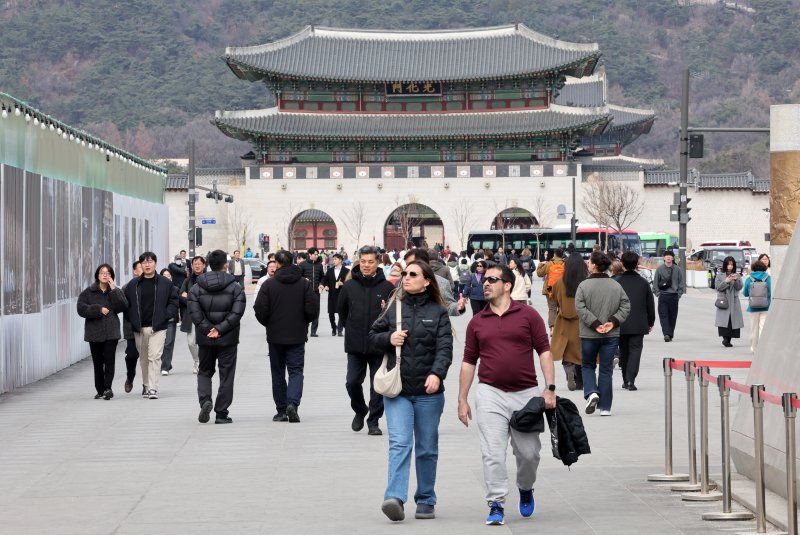
[Financial News] As the number of foreign tourists visiting Korea continues to rise, Seoul’s hotel market is booming. Over the past four years, the surge in inbound visitors has sharply pushed up room occupancy rates at hotels in Seoul. However, critics warn that because foreign tourism demand is becoming increasingly concentrated in the capital, Korea will need policies that disperse visitors to regional areas and revitalize tourism outside Seoul over the long term.
Foreign share of Seoul hotel guests jumps
According to industry data released on the 11th, the number of foreign tourists plummeted during the COVID-19 period but has rebounded steeply since the pandemic. Inbound visitors fell to 967,003 in 2021, then jumped 230.7% year-on-year to 3,198,017 in 2022. The figure climbed again to 11,031,665 in 2023 (up 245%), 16,369,629 in 2024 (up 48.4%), and is projected to reach 18,936,562 in 2025 (up 15.7%). Spending by foreign tourists has also soared, from 4.3072 trillion won in 2022 to 17.4089 trillion won last year—about a fourfold increase.
Hotels in Seoul are the biggest beneficiaries of this influx. As the proportion of foreign guests at major properties in the capital rises, room occupancy remains at very high levels. Lotte City Hotel Myeongdong and L7 Myeongdong by LOTTE both recorded foreign guest ratios of around 70–80% as of February this year. At The Shilla Seoul, more than half of all guests were foreigners over the same period. Josun Hotels & Resorts has maintained an average occupancy rate above 80% this year, and the share of foreign guests in February was about 18% higher than a year earlier.
Seoul cannot keep up with demand, making regional dispersal urgent
Despite the surge in visitors, hotel supply remains limited because building new properties requires massive investment. Industry insiders say Seoul is already in a state of "excess demand," where the pace of growth in tourist numbers far outstrips the supply of hotel rooms.
Even with recent headwinds such as rising oil prices, demand for travel to Seoul and average spending per visitor are expected to keep growing, driven by global interest in K-culture and the weaker won. Jeong Ran-su, a professor in the Department of Tourism at Hanyang University, noted, "The government has set a goal of attracting 23 million foreign tourists this year, but in reality, even around 19 million would leave Seoul’s tourism market virtually saturated." He warned, "If this saturation of tourists in Seoul continues, it could become a serious problem in the future." He went on, "The solution is either to disperse tourism demand or to increase accommodation supply, but expanding hotel capacity quickly is difficult because of zoning rules and other regulations." He added, "Government policies to support facility upgrades at general lodging businesses such as motels, and easing the primary-residence requirement for home-sharing, could serve as realistic alternatives."
The structural concentration of tourism demand in Seoul is another concern. According to the Korea Tourism Organization (KTO), about 70% of foreign tourists’ spending in Korea last year took place in Seoul. Busan Metropolitan City and Incheon Metropolitan City ranked second and third, but each accounted for only around 7%. Jeju Island’s share was just in the 3% range, and all other regions combined failed to reach even 1%. In effect, the growth in tourist numbers has become locked into a pattern that funnels spending into central Seoul commercial districts.
Professor Lee Young-ae of Incheon National University’s Department of Consumer Science explained, "Foreign tourists are concentrated in Seoul because tourism content such as K-culture is heavily clustered there." She suggested, "For visitors who come to Korea multiple times, we need to expand programs that allow them to experience cultural and tourism resources in regions outside Seoul." She added, "We also have to think about ways to naturally connect foreign tourists who have already visited Seoul with travel to regional destinations."
localplace@fnnews.com Kim Hyun-ji Reporter