"Even if we have to wait three hours" Chinese franchises rake in cash at a K-food hotspot [On-site]
- Input
- 2026-03-17 05:30:00
- Updated
- 2026-03-17 05:30:00
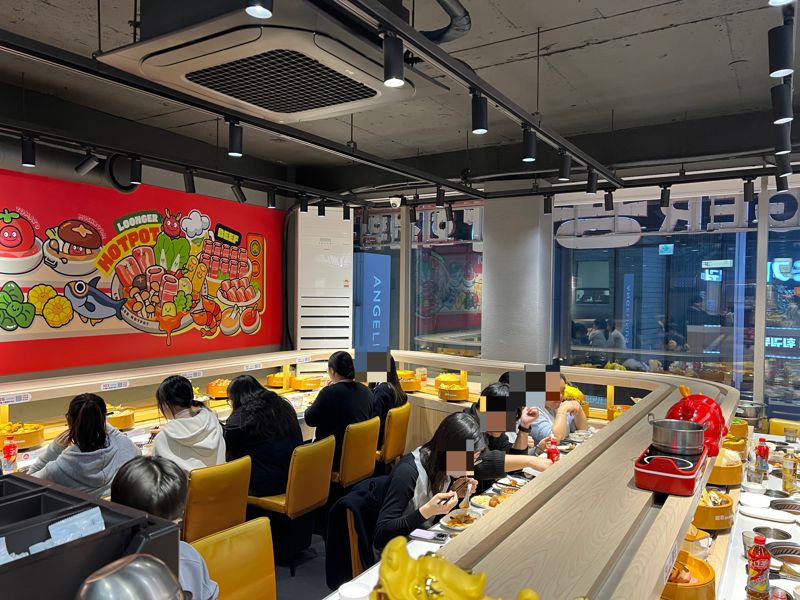
[The Financial News]On the evening of the 9th, more than 50 customers were waiting in line in front of the Haidilao Myeong-dong branch, a hotpot restaurant in Jung District, Seoul. When this reporter entered a phone number to register for the waitlist, the screen showed waiting number 102. A text message informed us that we would have to wait about three hours to be seated. You could occasionally hear Chinese being spoken, but most of the people in line were Korean. Loonger Hotpot, a solo hotpot brand also located in Jung District, Seoul, was similarly crowded that day, with students, tourists, and office workers all packed into the restaurant despite it being a weekday evening.A high school student surnamed Park, who was waiting to get into Haidilao, said, "I really like malatang, so I come here often," adding, "The price is a bit of a burden, but whenever exams are over, my friends and I always come to Haidilao."An office worker surnamed Oh commented, "I recently traveled to Shanghai in China and became completely hooked on Chinese food," and added, "Hotpot, malatang and other Chinese dishes are hugely popular among people around me."According to industry sources on the 16th, Chinese franchise brands are accelerating their expansion into the Korean market. First-generation Chinese franchises that entered Korea in the 2010s, such as hotpot chain Haidilao and malatang chain Tanghuo Kungfu, have seen sharp growth in both sales and store numbers. In fact, Haidilao’s sales in Korea were only 19.8 billion won in 2021. However, thanks to a premium positioning strategy and the viral popularity on social media of its so-called "Naruto dance," sales surged to 41.2 billion won in 2022, 58.3 billion won in 2023, and 78 billion won in 2024.
Tanghuo Kungfu had 329 stores in 2022, but that number rose to 423 in 2023 and 494 in 2024, reflecting an aggressive expansion drive. Over the same period, its sales jumped from 8.7 billion won to 22.2 billion won, an increase of 13.5 billion won, or 155%, in just two years.
Buoyed by the popularity of Chinese cuisine in Korea, second-generation Chinese franchises are also speeding up their entry into the Korean market. A mutual visa-free policy between the two countries—limited to group tourists on the Korean side—has led to more active consumer exchanges. On top of that, the growing number of Chinese students in Korea has driven explosive demand for Chinese franchises.
Heytea, a milk tea brand that started in 2012 in Guangdong Province, now operates around 3,400 stores across China, the Hong Kong Special Administrative Region of the People's Republic of China, Singapore and other markets. Since entering Korea in 2024, it has opened six directly managed stores. Tea-focused brand Cha Baidao entered Korea last year and currently operates around 20 stores.
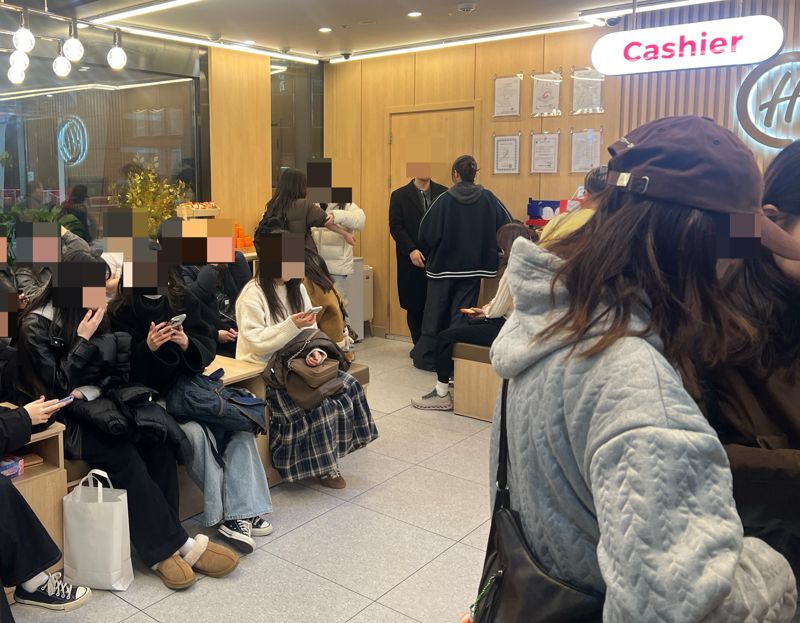
A third wave of Chinese franchises is also lining up to enter Korea. Chagee, a milk tea brand better known by its Chinese name CHAGEE and nicknamed "Jang Won-young milk tea"—a drink many say you must try when visiting China—is planning to open standalone stores on Gangnam-daero and at I'PARK Mall Yongsan in the first half of this year. Haidilao recently opened the first global outlet of its lamb skewer brand, HAIHAI Charcoal Skewers, in Myeong-dong in Jung District, Seoul. Luckin Coffee, a leading Chinese coffee chain that has overtaken Starbucks in China, has acquired global coffee brand Blue Bottle. Since Blue Bottle already operates 23 stores in major commercial districts in Korea, Luckin Coffee’s acquisition is expected to have a significant impact on the domestic market as well.
Kim Tae-hwang, a professor in the Department of International Trade at Myongji University, said, "As China struggles with sluggish domestic demand, Chinese companies are accelerating their overseas expansion," and analyzed, "Excluding Chinese-speaking regions such as the Hong Kong Special Administrative Region of the People's Republic of China, Taiwan and Singapore, the Korean market serves as a test bed to gauge global success or failure, making it an ideal location for Chinese franchises."security@fnnews.com Park Kyung-hosecurity@fnnews.com Park Kyung-ho Reporter