Kang Hyo-sang, who leaked South Korea–US presidential call, files constitutional petition: "Vague scope of 'diplomatic secrets' could be abused"
- Input
- 2026-03-11 12:57:43
- Updated
- 2026-03-11 12:57:43
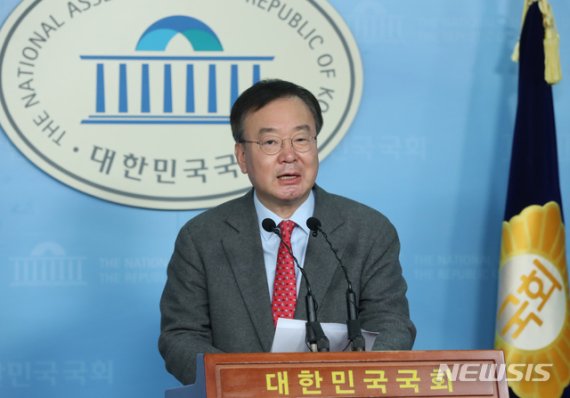
According to Financial News, Kang Hyo-sang, who was recently given a suspended prison sentence by the Supreme Court of Korea for leaking diplomatic secrets, has filed a constitutional petition. He argues that in the offense of "leaking diplomatic secrets" applied to him, the concept of diplomatic secrets is so abstract and vague that it violates the principle of clarity in criminal law. Kang has stated that if the Constitutional Court of Korea finds the provisions unconstitutional, he will seek a retrial to argue his innocence.
According to the legal community on the 11th, Kang recently submitted a constitutional complaint to the Constitutional Court of Korea on February 26, claiming that the phrase "diplomatic secrets" in Article 111(1) and Article 113(2) of the Criminal Act is unconstitutional.
In a post on his Facebook page the same day, Kang wrote, "This is in response to the Supreme Court's final conviction against me for partially disclosing the contents of a phone call between former President Moon Jae-in and US President Donald Trump," adding, "Once again, I found this ruling unreasonable and therefore filed a constitutional complaint with the Constitutional Court."
At the end of January, the Supreme Court of Korea upheld the lower court ruling that sentenced Kang to six months in prison, suspended for one year, in the final appeal over the charge of leaking diplomatic secrets. A former diplomat, identified only as A, who passed the contents of the call between the two leaders to Kang, also received a finalized sentence of four months in prison with a stay of execution for leaking official secrets.
In relation to Kang's leak of confidential information, the lower courts ruled that his actions fell outside the scope of parliamentary immunity, and the Supreme Court accepted that view. The court of first instance held, "Given the standing committee to which Kang belonged and other circumstances, his press conference and the distribution of press releases cannot be regarded as having been conducted within the National Assembly, nor were they related to his official duties." Addressing the argument that the call between the two presidents did not constitute a diplomatic secret, the court stated that it was "a matter that must be protected and maintained as confidential until the agreed content is officially announced."
Explaining why he filed the constitutional complaint, Kang stated, "Article 113 of the Criminal Act provides no definition whatsoever of the scope or content of diplomatic secrets. The concept is excessively abstract and vague, making it impossible for an ordinary person with sound common sense and a normal legal understanding to determine what specific conduct is prohibited."
Article 113(2) of the Criminal Act stipulates that "a person who leaks diplomatic secrets shall be punished by imprisonment for not more than five years or by a fine not exceeding 10 million won."
In his petition, Kang also pointed out that the prospect of a visit to South Korea by President Trump had already been anticipated in many media reports. He cited the fact that in April 2019, Moon Chung-in, then Special Advisor to the President for Unification, Foreign Affairs and National Security, said, "President Trump may visit Seoul when he travels to Japan in late May and late June." He further noted media reports stating that "President Trump is understood to have accepted President Moon's invitation to visit South Korea during the South Korea–United States summit on April 11."
Kang continued, "Regarding similar military secrets, the Constitutional Court in 1997 acknowledged that there was a possibility of violating the principle of clarity and issued a partial decision of unconstitutionality," arguing, "In the same way, the current provision on diplomatic secrets in Article 113 of the Criminal Act carries the risk that the scope of secrets can be expanded indefinitely at the discretion of the authority designating them, which runs counter to the principle of clarity in criminal law (nullum crimen sine lege)."
He added, "In particular, in light of the public's right to know and freedom of the press, it is impossible to avoid an unconstitutional outcome," and went on, "If the Constitutional Court rules the diplomatic secrets portion of Article 113 of the Criminal Act unconstitutional, I will seek a retrial and contest my conviction to be found not guilty."
[email protected] Lee Hwan-joo Reporter