"Bring out the real boss"... Companies hit by a wave of bargaining demands on first day of Yellow Envelope Act
- Input
- 2026-03-10 18:27:35
- Updated
- 2026-03-10 18:27:35
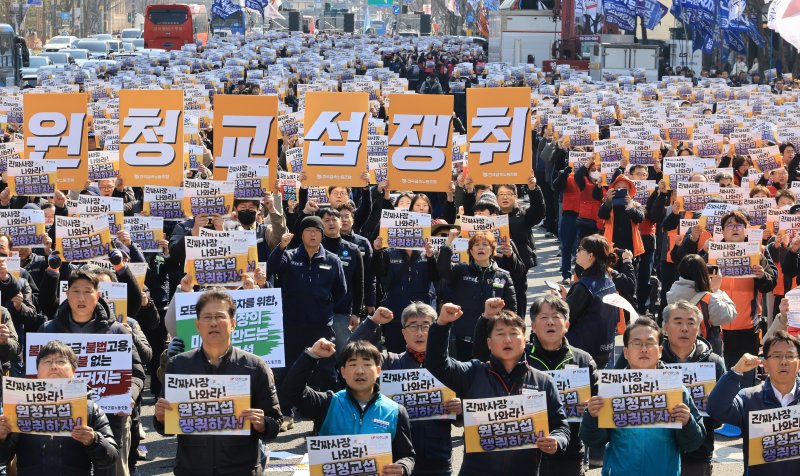
■ Wave of bargaining demands from subcontracting unions
According to industry sources on the 10th, industry-wide unions such as the Federation of Metal Workers' Trade Unions, the Korean Construction Workers Union, the Korean Public Service and Transport Workers’ Union (KPTU), and the Korean Health and Medical Workers' Union (KHMU) sent official letters to principal contractors that day, requesting collective bargaining on behalf of subcontracting unions.
In its letter demanding collective bargaining sent to POSCO, the Federation of Metal Workers' Trade Unions stated, "We have been delegated the authority to conduct and conclude collective bargaining, and to ensure implementation of the results, by 34 unions including the only subcontractor union at POSCO and the Gwangyang Regional Machinery and Metal Armed Workers' Union." POSCO, in response, posted a "notice of bargaining request" on its internal bulletin board. With the enforcement of the Yellow Envelope Act, demands for bargaining directly with principal employers have become a reality.
The Korean Construction Workers Union also sent official letters to major principal construction firms that day, requesting talks to conclude a collective agreement, and personally delivered written demands to some companies. The letters explicitly cited Article 2 of the Trade Union and Labor Relations Adjustment Act as the legal basis for requesting bargaining to conclude a collective agreement. Key bargaining agendas included strengthening industrial safety, preventing serious industrial accidents, protecting workers in the context of climate crisis responses, and preventing illegal multi-layer subcontracting.
An official at a large construction company said, "Because it is the first day of enforcement, we are still internally reviewing the scope of the bargaining demands and their specific content." Another construction company official noted, "We are trying to understand the nature of the union's demands and how far the scope of bargaining extends."
The National Airport Labor Union demanded principal-level bargaining with Korea Airports Corporation (KAC), representing indirectly employed workers in 23 job categories at 14 airports nationwide operated by KAC. Union leader Won Heung-taek warned, "If the corporation continues to evade responsibility by insisting it is not the employer, we will respond with immediate industrial action."
In the case of KHMU, more than 1,200 members from 25 branches and chapters, including Asan Medical Center, Ewha Womans University Medical Center (EUMC), The Catholic University of Korea Eunpyeong St. Mary's Hospital, and Korea University Guro Hospital, plan to file a joint bargaining request for subcontractor branches starting on the 17th.
Subcontracting unions directly requesting bargaining are also emerging one after another. Ahead of the sale of Hyundai Mobis's lamp division, unions at subsidiaries such as Hyundai IHL and UNITUS demanded bargaining with the principal employer that day, citing job insecurity. These subsidiaries, which belong to the lamp division, conveyed their opposition to the sale and expressed concern over potential workforce restructuring.
Subcontracting unions at HD Hyundai Heavy Industries and Hyundai Motor Company (the Hyundai Motor Irregular Workers’ Chapter) have also stepped up pressure on the principal employers by preparing a third round of bargaining requests.
■ "We need actual cases... for now, we just watch"
As bargaining demands from subcontracting unions poured in from day one of the Yellow Envelope Act, industry circles appeared visibly unsettled. There is a growing sense that the traditional principal–subcontractor structure is being upended, which could destabilize labor relations and affect on-site operations across the board.
A construction company official commented, "We understand the intent behind the new system, but many of the bargaining demands from subcontracting unions fall outside the principal contractor's decision-making authority or belong to the management decisions of partner firms." The official added, "In such cases, it may be difficult for the purpose of the law to translate into tangible outcomes in the field." In particular, the company expressed concern that labor issues at individual worksites could escalate into bargaining matters or management risks at the head office level.
Although the enforcement decree and interpretive guidelines have been issued, many still see them as ambiguous, which adds to the uncertainty. The scope of who qualifies as an employer, what managerial decisions can be the subject of industrial action, and how to unify bargaining channels between principal contractors and subcontractors all remain sources of confusion.
A representative of the business community said, "Until we see actual cases where the Yellow Envelope Act is applied, tensions between labor and management will continue at worksites," adding, "There is still considerable confusion over the scope of who is considered an employer, so for now we can only wait and see."
[email protected] Jong-bae Lee, In-seo Jang, Hak-jae Kim, Dong-ho Kim Reporter