Construction Starts Delayed Amid Historic Slump... January Output Falls Below 10 Trillion Won
- Input
- 2026-03-10 18:24:43
- Updated
- 2026-03-10 18:24:43
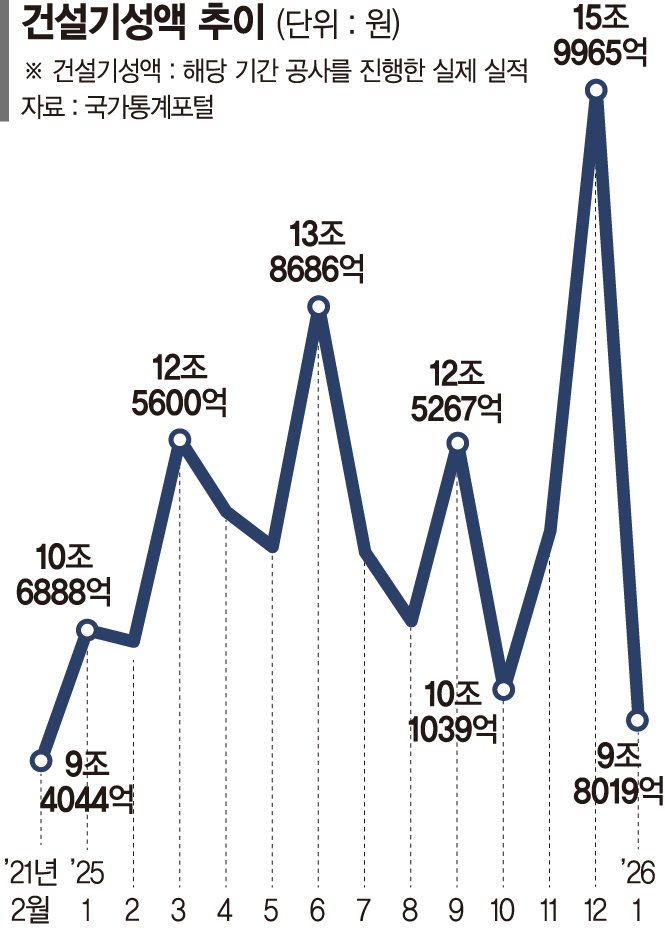
■ January construction output at 9.8 trillion won, lowest in five years
According to the Korean Statistical Information Service (KOSIS) on the 10th, construction output in January came to 9.8019 trillion won, the lowest level since February 2021, when it stood at 9.4044 trillion won. Construction output represents the actual value of work carried out during a given period. Even during last year’s so-called "historic construction downturn," the lowest monthly figure was 10.1039 trillion won in October.
The simultaneous weakness of building and civil engineering, which together constitute construction output, is particularly striking. In January, building work totaled 7.2808 trillion won, the lowest since February 2021 (6.9244 trillion won), while civil engineering came to 2.5212 trillion won, the smallest amount since February 2022 (2.4114 trillion won).
The main reason January’s construction performance hit a five-year low is the slowdown in the real estate market. Construction output typically increases as previously awarded projects move into the construction phase, but when the property market freezes, new starts decline and, in turn, overall performance falls. In many regional areas, it is easy to find sites where the start of construction has been postponed, or where work began but was later suspended due to rising labor and material costs. There are also numerous projects that have stopped because the contractor went bankrupt.
■ Tight project financing and Middle East risks: "This year could be the worst yet"
The tightening of project financing (PF) is another major factor. Ji-Hye Lee, a research fellow at the Korea Research Institute for Construction Policy, noted, "Recently, because of the PF crunch, lenders are conducting much more conservative credit reviews," and explained, "As it becomes harder to secure financing, new projects are simply not getting off the ground." She added, "Construction orders have been recovering slightly, but most of them are concentrated in redevelopment and reconstruction projects," and pointed out, "In reality, these are volumes that are still a long way from the actual start of construction."
Some observers warn that the construction industry could face its worst year on record. On top of the property market slowdown, the war in the Middle East shows no sign of ending, and the sector must also contend with the upcoming full implementation of the Yellow Envelope Act and the already enforced Serious Accidents Punishment Act. A real estate industry official said, "Because of the fallout from the war in the Middle East, raw material prices are bound to rise further," and predicted, "Construction costs will inevitably increase as well." Higher construction costs lead to weaker profitability, fewer project starts, and ultimately slower construction output.
Yoon-Hong Lee, a professor in the Department of Architectural Engineering, Hanyang University, commented, "The only projects that still make money are redevelopment and reconstruction in popular areas of Seoul," and forecast, "The construction industry’s situation this year will be even worse than last year."
[email protected] Kwon Jun-ho Reporter