Soaring crude oil price plunges 8% in a day on strategic petroleum reserves and ceasefire hopes [U.S.–Iran War]
- Input
- 2026-03-10 18:21:11
- Updated
- 2026-03-10 18:21:11
■ Growing expectations for strategic petroleum reserves release and ceasefire
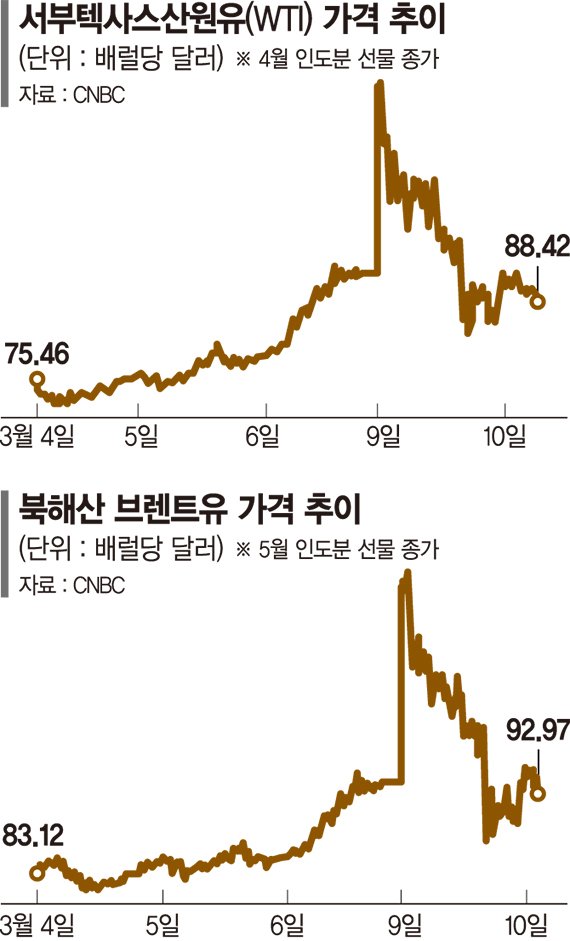
On the 9th (local time), April futures for West Texas Intermediate (WTI) traded in the United States and May futures for Brent Crude Oil in Europe closed at $94.77 and $98.96 per barrel, respectively. After the U.S. market closed, both benchmarks fell further in Asian trading, dropping into the $80 range during intraday trading on the 10th—down 7–8% from the previous close—before rebounding. By the end of the day, WTI was hovering in the high $80 range and Brent Crude Oil in the low $90 range, about 6% lower than the previous session. The two benchmarks had climbed above $110 per barrel on the 8th, marking their highest levels since 2022, but then plunged during trading on the 9th.
On the same day, the finance ministers of the Group of Seven (G7) held a virtual meeting led by France, which currently holds the G7 presidency, to discuss responses to the crude oil price surge triggered by Iran’s blockade of the Strait of Hormuz and attacks on Middle Eastern oil facilities. In a statement issued after the meeting, the ministers said they were "ready to take necessary measures, including the release of strategic petroleum reserves," and pledged to closely monitor the situation. That day, Christopher Allen Wright, U.S. Secretary of Energy, also told reporters that G7 countries were "discussing a coordinated release of the strategic petroleum reserve (SPR)." In addition, President of the United States Donald Trump said at a press conference that the war with Iran "will end soon." In a separate interview, he added that the United States was "considering taking control" of the Strait of Hormuz, through which about 20% of the world’s seaborne oil shipments pass.
U.S. stock markets moved in the opposite direction of the crude oil price and finished higher. On the 9th, the Dow Jones Industrial Average (DJIA), the Standard & Poor's 500 Index (S&P 500), and the NASDAQ Composite Index rose 0.5%, 0.83%, and 1.38%, respectively, from the previous close. Stock markets in South Korea, Japan, and China also opened higher on the 10th as fears of an energy crisis stemming from the Middle East eased.
Cable News Network (CNN) reported that day, citing officials, that the Trump administration was very surprised by how quickly the crude oil price had risen. The administration is said to be discussing a range of measures to curb the crude oil price, including boosting domestic oil distribution, tax cuts, and price controls. However, Angie Gildea, head of U.S. energy strategy at KPMG International Limited (KPMG), stressed in comments to The Washington Post (WP) on the 9th that "there is no substitute for the Strait of Hormuz." She argued that "releasing the strategic petroleum reserve (SPR) or redirecting export-bound oil back to the domestic market are only stopgap measures, not structural solutions."
■ Early end to the war is the real solution... Russia stands to gain
The United States is currently holding 415 million barrels of oil in its strategic petroleum reserves, an amount equivalent to roughly four days of global consumption. On the 9th, Fatih Birol, executive director of the International Energy Agency (IEA), told the G7 finance ministers that IEA member states collectively hold more than 1.2 billion barrels of public emergency reserves, and that industry holds an additional 600 million barrels under government-mandated stockholding requirements. According to the Center on Global Energy Policy at Columbia University, China’s strategic reserves are estimated to be much larger, at about 1.4 billion barrels. Data from the U.S. Energy Information Administration (EIA) show that more than 7 billion barrels of oil pass through the Strait of Hormuz each year. U.S. media outlets reported on the 9th that even if Washington moves ahead with a large-scale release of the SPR, it will not be able to flood the market at will, because once the reserves are drawn down, there is not enough budget to refill them.
Meanwhile, Wright of the United States Department of Energy (DOE) said in an interview on the 9th that Washington is also considering "other options," including allowing more sales of Russian oil currently stranded on tankers anchored in Asian waters. Trump spoke by phone with President of Russia Vladimir Putin for about an hour that same day. Trump also said that, to stabilize the crude oil price, he would "lift sanctions on certain countries until the situation is resolved."
[email protected] Park Jong-won Reporter