Global central banks haunted by 'inflation trauma'... Will they pivot from rate cuts back to hikes? [2026 Iran War]
- Input
- 2026-03-10 18:19:47
- Updated
- 2026-03-10 18:19:47
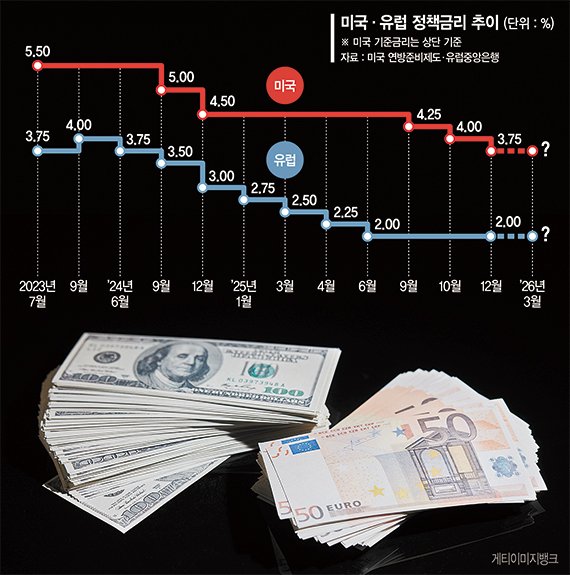
The Financial Times (FT) reported on the 9th, local time, that as international oil prices surged on fears that Iran might move to "block the Strait of Hormuz" and attack oil fields in neighboring countries, talk of rate cuts has faded and markets are now on high alert over possible hikes. Forecasts are no longer centered on a pause, but increasingly on outright rate increases.
Until recently, the odds were seen as roughly even that the ECB would continue cutting rates this year. Now, however, expectations have shifted toward at least one 0.25 percentage point rate hike. Markets had also anticipated that the Federal Reserve System (Fed) would cut rates two to three times this year, but those hopes have been scaled back to one or two cuts of 0.25 percentage point each.
Based on pricing in the swap market, the Bank of Canada is now seen as more likely to raise rates by 0.25 percentage point than to cut. The Swiss National Bank (SNB), which only a few months ago was discussed as a candidate for negative rates, is also tilting toward a 0.25 percentage point hike. The previous consensus that the Bank of England (BoE) would deliver two rate cuts has effectively disappeared.
The Bank of Japan (BOJ) is likewise expected to prioritize price stability and maintain a tightening stance. As of the 9th, the overnight index swap (OIS) market was pricing in roughly an 84% chance that the BOJ will raise rates by its June policy meeting. Markets also no longer expect the BOJ to behave as a "dovish central bank" that immediately cuts rates whenever downside risks to growth emerge. A recent report by Mitsubishi UFJ Morgan Stanley Securities noted, "If higher oil prices persist, the BOJ and others will have little choice but to place greater weight on medium- to long-term price stability than on supporting the business cycle." In fact, the BOJ is already assuming that inflation will remain elevated and is sticking to a rate-hike bias.
The core driver behind this renewed tightening bias is the spike in oil prices. In electronic trading the previous day, crude briefly broke above 100 dollars per barrel, and although it closed below 100 dollars in regular trading thanks to coordinated action by the Group of Seven (G7), the situation remains fragile. Concerns are mounting that any calm may be short-lived and that prices could even surge toward 200 dollars.
Frederik Ducrozet, head of macroeconomic research at Pictet Asset Management, said, "A global repricing of risk is under way," adding, "The bond market has woken up to the possibility that oil prices might not stop at 100 dollars a barrel, but could climb to 150 dollars, or even 200 dollars."
Central banks traditionally respond to oil-price spikes by waiting and watching before they act. They monitor conditions closely and then decide on policy moves. While higher oil prices do push up inflation, they can also erode consumers’ purchasing power and curb spending, which in turn may ease price pressures over the longer term.
However, many experts believe that the Fed and other central banks may move more quickly this time. They came under fire for failing to respond in a timely manner to the inflation that followed the 2022 supply-chain disruptions, which many argue amplified the surge in prices.
Michael Saunders, an economic adviser at Oxford Economics and a former member of the BoE’s Monetary Policy Committee, said, "Central banks are traumatized by their experiences over the last few years," and added, "This time, they are trying to react more immediately to shifts in inflation expectations."
[email protected] Reporter