BOK: "$40,000 Per Capita Income Depends on Exchange Rate"
- Input
- 2026-03-10 18:19:00
- Updated
- 2026-03-10 18:19:00
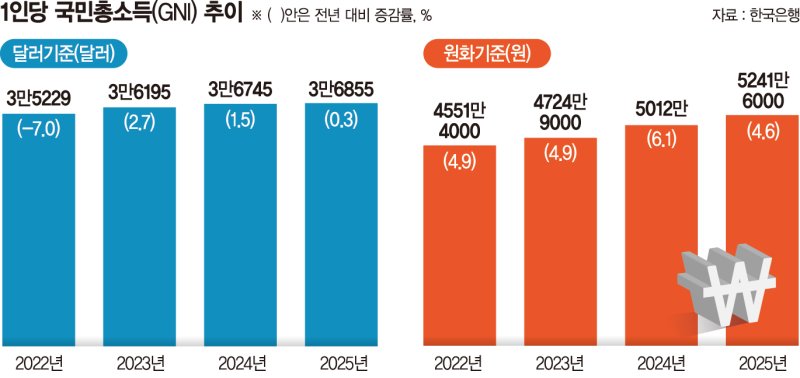
According to the Bank of Korea (BOK) on the 10th, last year’s per capita nominal GNI was 36,855 United States dollars (USD). This was an increase of only 0.3% from the previous year’s 36,745 dollars. In Korean won (KRW) terms, it rose 4.6% to 52.416 million won, but this gain was offset as the US Dollar–South Korean Won exchange rate climbed.
Kim Hwayong, Director General for National Income Statistics at Economic Statistics Department 2, said, "The exchange rate rose 4.3% last year due more to supply‐demand factors than to our economy’s underlying economic fundamentals, and this acted as a drag on the figures."
Per capita GNI first surpassed 30,000 dollars in 2014 at 30,798 dollars, but it has remained stuck in the 30,000‐dollar range for 11 consecutive years through last year. When the exchange rate rises, the amount expressed in Korean won increases, but when converted into dollars, part of that gain is lost. In 2022 as well, the figure rose 4.9% in won terms, yet it fell 7.0% when measured in USD.
As of 2024, South Korea ranked sixth among countries with populations of 50 million or more. The United States of America (USA), Germany, the United Kingdom of Great Britain and Northern Ireland (UK), France, and Italy ranked ahead of Korea. For last year, some countries have not yet released statistics, so a complete global ranking is not available, but the data show that Korea lagged behind Taiwan and Japan.
Kim noted, "Last year, Taiwan’s per capita GNI was 40,585 dollars. Its IT manufacturing industry accounts for a share three times larger than ours, and it benefited greatly from the semiconductor boom." He added, "Japan’s figure is estimated to be in the low 38,000‐dollar range, which reflects an expansion in its measured economic size following the revision of the base year in December last year." He went on to say, "If we assume the exchange rate has zero impact and per capita GNI grows 4.3% this year and next year, then in 2027 it will exceed 40,000 dollars," stressing that "the impact of the exchange rate is crucial." If the exchange rate rises, the value calculated in USD inevitably declines.
Last year, annual nominal gross domestic product (nominal GDP) grew 4.2% from a year earlier to 2,663.3 trillion won. However, in dollar terms it came to 1.8727 trillion dollars, a decline of 0.1%. The GDP deflator rose 3.1%, slowing from the previous year’s 4.1% increase.
[email protected] Kim Tae-il Reporter