President Lee: "We Need an Early Supplementary Budget... Direct Support for Consumers Is Necessary" [U.S.–Iran War]
- Input
- 2026-03-10 18:18:31
- Updated
- 2026-03-10 18:18:31
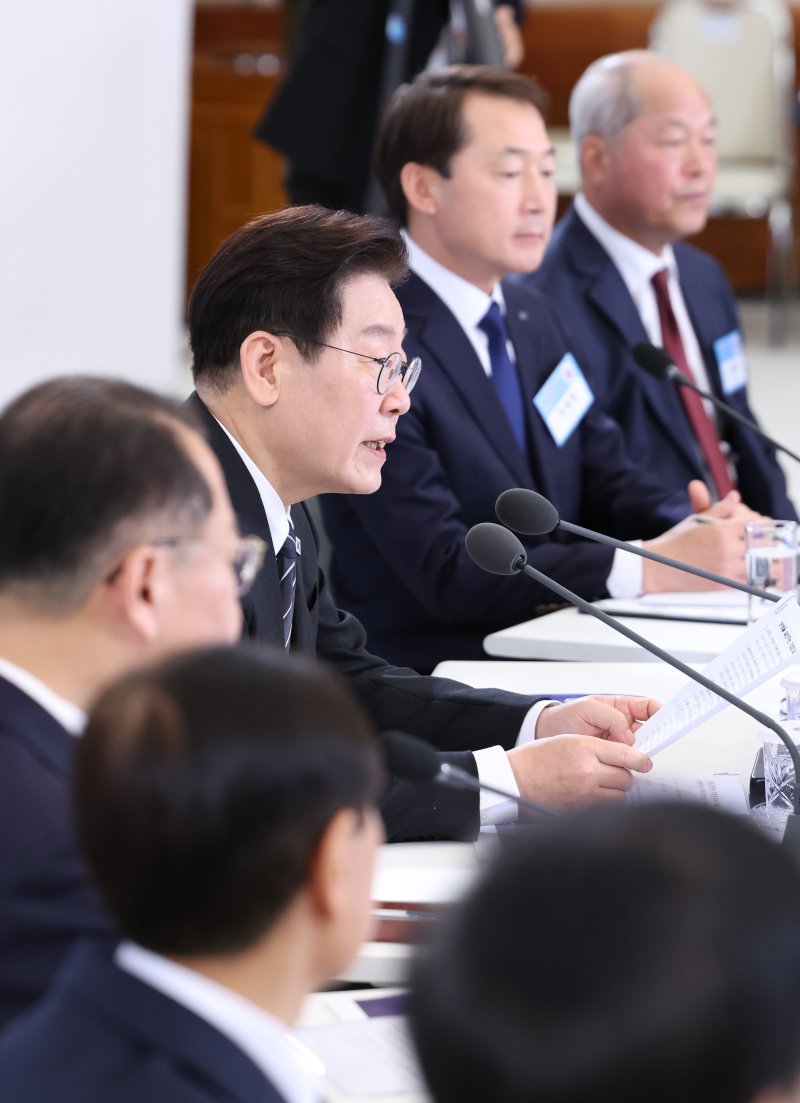
■ "Additional fiscal resources needed for support"
Presiding over a meeting of the State Council of South Korea at Cheong Wa Dae on the same day, Lee Jae Myung underscored the need to expand support in light of the recent instability in the Middle East. "In any case, it seems we will have to adopt a supplementary budget early," he said. "Even if we want to provide fiscal support, assistance to micro enterprises, or support for marginal firms right now, additional fiscal resources are required."
Lee Jae Myung particularly noted, "The future depends on how well we take advantage of a crisis situation. We should use this opportunity to push through the transition to alternative energy at full speed." With this, he suggested that measures such as formulating a supplementary budget are necessary to advance the energy transition and related policies.
In response, Koo Yun-cheol, Deputy Prime Minister and Minister of the Ministry of Finance and Economy, replied, "The existing budget will likely be insufficient." He added, "The semiconductor sector has been improving recently, and with resources generated by revitalizing the stock market, we should be able to implement a supplementary budget of an appropriate size without issuing government bonds."
Initially, Cheong Wa Dae and the government had tried to minimize public references to a supplementary budget. However, as uncertainty has grown with heightened tensions in the Middle East, they now appear to be moving toward a more agile response. On the 9th, Kim Yong-beom, Chief Presidential Secretary for Policy of the Republic of Korea, was asked at a briefing at the Chunchugwan Press Center at the Blue House about the possibility of an early supplementary budget to respond to developments in the Middle East. He said, "We will need to have some serious discussions." With Lee Jae Myung emphasizing the need for a supplementary budget on this day, observers expect the follow-up procedures to accelerate.
In practice, additional fiscal resources are needed to support the petroleum industry and fuel consumers, who are expected to suffer inevitable losses from the introduction of the fuel price cap system.
Lee Jae Myung said, "The primary principle of fiscal execution is the secondary distribution of wealth, which serves to adjust excessive polarization among members of society." He went on, "In the end, if we are to support consumers directly, we must adopt a supplementary budget." He added, "If the actual production cost of crude oil rises going forward, the economic burden will be substantial, so we will ultimately need to inject fiscal resources to make a temporary adjustment."
From the perspective of direct support for consumers, Lee Jae Myung also pointed out that "when a crisis hits, those who are already struggling become worse off, while those at the top tend to benefit more." He called for differentiated measures to address this. "For example, we could slightly reduce the fuel tax and combine that with fiscal support for low-income households in a differentiated way," he said. "If we have the same amount of resources, I am inclined to think that, as far as possible, we should use them in a differentiated manner that helps ease polarization, rather than applying them uniformly."
■ "Speed up fuel price cap system and related measures"
At the State Council of South Korea meeting, Lee Jae Myung said, "We must mobilize all national capabilities to minimize the impact of external shocks on people’s livelihoods, the economy, and industry." He continued, "We should swiftly review additional financial and fiscal support, including implementation of the fuel price cap system, adjustments to the energy taxation system, and direct support for consumers."
Lee Jae Myung identified price stability as the top priority. "The most urgent task is stabilizing prices," he said. "As the sharp rise in fuel cost is increasing difficulties in areas directly tied to people’s daily lives—such as freight transport, parcel delivery service, and greenhouse farm operations—I ask you to actively devise policies that can substantially ease the burden on people on the ground and to implement them swiftly." He added, "Given that this is an extraordinary situation, we must calm market anxiety with measures and speed that go beyond existing manuals and policies," stressing, "I urge agile and preemptive responses so that people’s lives are not shaken under any circumstances."
[email protected] Choi Jong-geun and Sung Seok-woo Reporter