ETFs Swell to 32 Trillion Won in Daily Trading, Fueling Wild Market Swings
- Input
- 2026-03-10 18:14:29
- Updated
- 2026-03-10 18:14:29
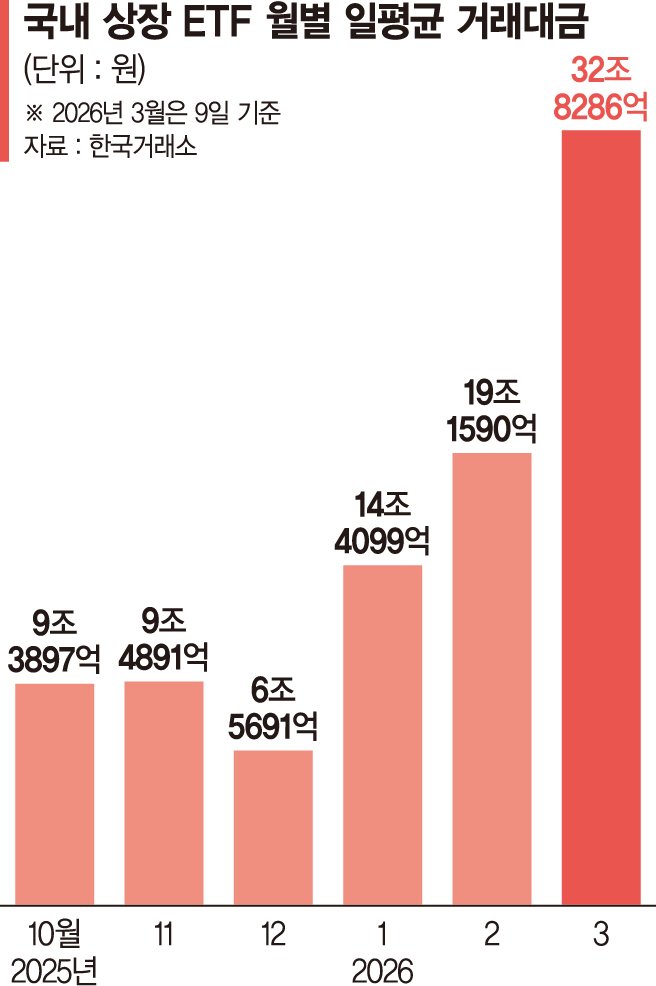
According to the Korea Exchange on the 10th, trading in ETFs listed on the domestic stock market has exploded this year. As of the 9th, the average daily trading value this month was close to 32.8286 trillion won. That is more than five times the 6.5691 trillion won recorded in December last year, achieved in just three months.
Market participants believe a large portion of this turnover comes from retail investors. In fact, the net purchases of ETFs by individual investors jumped from 4.6582 trillion won in December last year to 9.8657 trillion won in February this year, more than doubling. Retail investors rushed into ETFs to ride the rally that began early this year, and when the market started to wobble sharply this month, they ramped up trading to respond to the heightened volatility.
Trading in index ETFs in particular has risen sharply this year. The combined average daily trading value this month of KODEX 200 ETF and Mirae Asset TIGER 200 ETF, the main products tracking the KOSPI 200 Index, reached 4.5679 trillion won. This is roughly six times the 793.1 billion won recorded in December last year.
Experts say the massive inflow of funds into ETFs has increased market volatility. When individuals buy an ETF, the liquidity provider, typically a securities firm, must purchase the underlying stocks in the same proportion to create and supply the ETF units. When money pours into index ETFs, the provider buys the constituent stocks in bulk according to their market-cap weights. The resulting rise in those individual stocks is then reflected back into the index, and as the index trends upward, it attracts even more capital, creating a feedback loop.
This "chain inflow" effect through ETFs can translate into additional gains in a rising market, but in a sharp downturn it can also magnify losses. When blanket sell orders hit a particular sector or index, all the bundled stocks are sold together, which can deepen the decline in their share prices.
Jeong Hyeonggi, a researcher at DS Investment & Securities, stated, "The more stocks are held within ETFs and the higher their ETF weightings, the more their individual returns tend to move in line with the overall market." He added, "Stocks with a high ETF ownership ratio show a stronger tendency to move in sync with market returns."
In a situation where the Middle East crisis is rapidly shifting market direction, increased stock trading via ETFs can become another factor that heightens volatility.
Jeong noted, "This greater co-movement works as an advantage in a sustained rally like we saw in January and February, when most stocks rise together. But if the market plunges, the magnitude of the decline can also expand simultaneously," adding, "If short-term trading such as arbitrage linked to ETFs increases, it can intensify short-term price reversals within the stock market."
Some analysts also argue that the concentration of funds in leverage ETFs has further amplified market volatility this month. Individual investors were net sellers of 605.9 billion won in KODEX Leverage ETF, which tracks twice the daily return of the KOSPI index, in December last year. But they turned net buyers, purchasing 264.4 billion won last month and 624.7 billion won so far this month. Leverage ETFs, which combine futures and cash equities, rebalance their portfolios daily to maintain the target leverage ratio. They buy in rising markets but mechanically dump shares in falling markets, which can widen the market’s price swings.
[email protected] Park Ji-yeon Reporter