Are “free consultations” also subject to discipline? In a fiercely competitive legal market, strict regulation clashes with freedom of expression
- Input
- 2026-03-10 15:54:58
- Updated
- 2026-03-10 15:54:58

[The Financial News]"Attorney certified by OOO Broadcasting Station" and "Handled OO cases as the best lawyer in the country during my time on the bench."As the number of attorneys has climbed to around 38,000, disciplinary cases related to advertising have also increased. Many ads highlight "free consultations" or "low-cost representation," or display phrases claiming better performance than other lawyers. The Korean Bar Association (KBA), the statutory body for the legal profession, treats such practices as grounds for discipline. However, opinions are divided on whether these measures are appropriate.
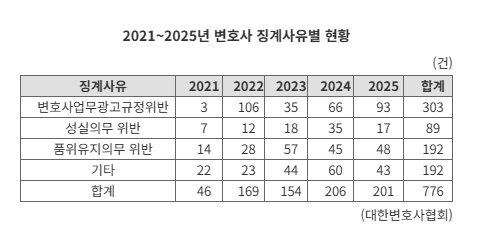
According to KBA data on disciplinary cases by cause, there were a total of 201 disciplinary actions against attorneys last year. This is similar to the previous year’s 206 cases, marking two consecutive years in the 200s. Before that, the highest annual number of disciplinary cases had been 169.
The most common ground for discipline was violations of advertising rules, with 93 cases, accounting for 46% of the total. This was followed by 48 cases (23%) of violating the duty to maintain dignity, 43 cases (21%) categorized as other, and 17 cases (8%) of violating the duty of diligence. In other words, advertising violations alone made up nearly half of all disciplinary actions.
The Regulations on Attorney Advertising prohibit lawyers from advertising in ways that undermine professional dignity or by using false or exaggerated content. Ads that create unjustified expectations about a case—such as by citing win rates, release rates, or predicting outcomes—are also banned. Former judges or prosecutors are further barred from advertising in a way that could mislead clients into believing they can exert influence over cases based on their prior positions.
According to KBA disciplinary records, Attorney A, a former judge who was fined 5 million won in January for exaggerated advertising, promoted himself by listing the number of cases he handled while on the bench without any objective supporting data. He also used the phrase, "The 'most competent attorney' is not one who has only argued cases or has investigative experience, but an attorney who is a former judge," which became a problem. The KBA stated that this language "creates unjustified expectations and contains content that compares and disparages other attorneys." Last month, a lawyer at a law firm received a similar level of discipline for using phrases such as "former high-ranking official" and "the highest win rate" in advertisements.
Ads that emphasize "free consultations" or "low-cost representation" are also subject to sanctions. In September last year, Attorney B was fined 7 million won for including the phrases "free consultations" and "the best in Korea" in an advertisement. Attorney C had to pay a 3 million won fine for advertising that stressed low fees. The KBA based its decision on the view that such ads "undermined fair order in fee arrangements." Attorney D, who used the phrase "attorney certified by OOO broadcasting company," received a reprimand on the grounds that it was "an advertisement likely to mislead consumers." Observers note that advertising rules are strict in part because there are many cases where actual representation falls far short of what the ads promise.
Some in the legal community point to the increasingly fierce legal market as the backdrop for the rise in exaggerated advertising. Jin-woo Kim, ethics director at the KBA, argued, "Because the impact of artificial intelligence (AI) has reduced new hiring, more lawyers are being forced into opening their own practices," adding, "Under this structural pressure, more attorneys are engaging in aggressive promotion and crossing the line." He went on to note, "There is also a growing amount of provocative YouTube and social networking service (SNS) content designed to stand out—what is often called noise marketing."
Opinions differ on how necessary such regulation is. One attorney who runs a law firm said, "Some ads make it seem as if a famous lawyer will personally handle the case, but after the client signs, the work is handed off to the most junior lawyer and the famous attorney is barely involved." The lawyer added, "Regulation should be strengthened so that exaggerated advertising does not lead to distrust of the entire industry."
By contrast, a lawyer at a mid-sized law firm commented, "There are cases where people are disciplined just for using words like 'the best' or 'doing our utmost' in a company introduction," and warned, "If regulation goes so far as to restrict this level of wording, it could infringe on freedom of expression." The lawyer further pointed out, "If it becomes difficult to highlight areas of specialization or background, advertising will become uniform, and smaller, distinctive law firms may lose the ability to express their unique character."
[email protected] Choi Eun-sol Reporter