President Lee: "We are in a situation where we need an early supplementary budget"
- Input
- 2026-03-10 11:32:59
- Updated
- 2026-03-10 11:32:59
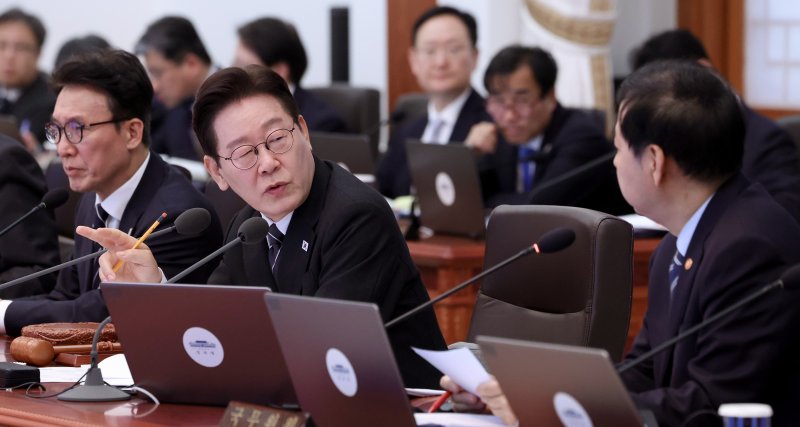
[Financial News] President Lee Jae-myung of South Korea on the 10th stressed the need to expand support in response to recent instability in the Middle East, saying, "In any case, it seems we are in a situation where we will have to implement an early supplementary budget (extra budget)."
President Lee emphasized during the 9th meeting of the State Council of South Korea held at Cheong Wa Dae (the Blue House) that morning, "To provide fiscal support now, whether for small business owners or for companies on the brink, we need additional fiscal resources." In response, Deputy Prime Minister and Minister of Economy and Finance Koo Yun-cheol replied, "The existing budget alone will likely be insufficient." He added, "The semiconductor sector has been improving recently, and with resources generated by revitalizing the stock market, we may be able to implement a supplementary budget of an appropriate size without issuing government bonds."
President Lee particularly noted, "The most important principle of fiscal execution is the secondary distribution of wealth, and through this we adjust excessive polarization and similar problems among members of society," adding, "In the end, if we want to support consumers directly, we need to pass a supplementary budget."
Regarding rising oil prices caused by escalating tensions in the Middle East, President Lee said, "We must swiftly review additional financial and fiscal support, including implementation of the oil price cap system, adjustments to the energy taxation system, and direct support for consumers." He went on, "If the actual production cost of crude oil rises going forward, the economic burden will be heavy, so we will ultimately need to inject fiscal resources for temporary adjustment."
He continued, "When a crisis hits, those who are already struggling become worse off, while those at the top tend to do even better," explaining, "If we simply reduce the fuel tax across the board to ease the burden, we cannot control that tendency."
He then said, "If we use the same amount of resources that would go into cutting the fuel tax and instead target support at low-income and vulnerable consumers, we can at least block and mitigate polarization," adding, "We can also mix the two approaches. For example, we could slightly lower the fuel tax while providing fiscal support that is differentiated in favor of low-income households."
President Lee stated, "We will conduct working-level reviews, but if possible, I am thinking that, with the same fiscal resources, it would be better to design measures in a more differentiated way rather than applying them uniformly, so that they help ease polarization."
Meanwhile, Chief Presidential Secretary for Policy of the Republic of Korea Kim Yong-beom had also mentioned the previous day that "serious discussions will be needed" when asked at the Chunchugwan Press Center at the Blue House about the possibility of drawing up an early supplementary budget to respond to the situation in the Middle East. Kim said, "This year’s economic outlook had been quite favorable, but things have now changed. We do not know how long the uncertainty stemming from the Middle East will last," adding, "If the situation is not brought under control quickly, it will generate many additional demands."
[email protected] Choi Jong-geun Reporter