"Semiconductors Will Soar Today": Heavily Leveraged Retail Investors Catch a Breather as Nvidia Rebounds 2.7%
- Input
- 2026-03-10 08:22:02
- Updated
- 2026-03-10 08:22:02
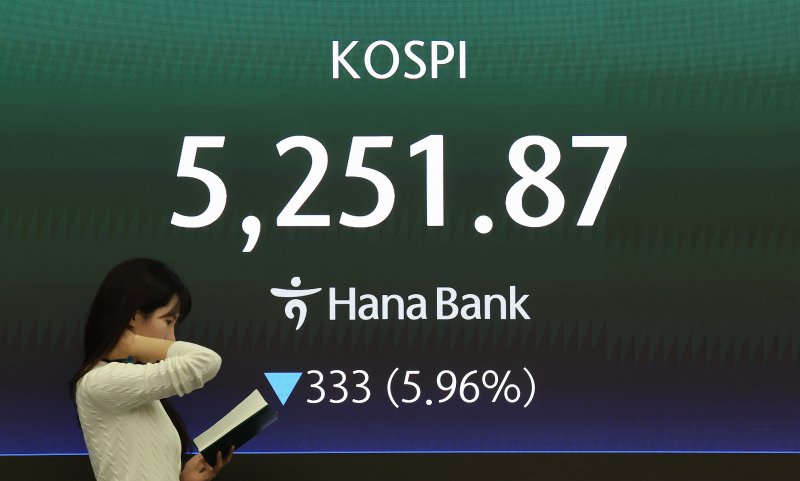
[The Financial News] As the domestic stock market shows heightened volatility following airstrikes by the United States of America and Israel on the Islamic Republic of Iran, leveraged investing using borrowed money, known locally as "bit-too," has hit all-time highs for several days in a row, raising louder warnings about forced liquidation (margin call-driven selling).
However, on the 9th (local time), after United States of America President Donald Trump remarked that the war with the Islamic Republic of Iran would soon be over, all three major indices on the New York Stock Exchange (NYSE) finished higher.
International oil prices also retreated to the 80-dollar-per-barrel range, boosting expectations for a rebound in the domestic stock market. As a result, fears of forced liquidation among leveraged retail investors are expected to ease somewhat.
Forced liquidation reached 77.6 billion won on the 5th and 82.4 billion won on the 8th
According to the Korea Financial Investment Association (KOFIA) on the 10th, the actual amount of forced liquidation relative to unsettled receivables from brokerage transactions stood at 82.4 billion won on the 6th. This surpassed the 77.6 billion won recorded on the 5th, the day immediately after the market plunged on the 3rd and 4th due to the impact of the war.
This was the highest level in two years and five months since 548.7 billion won on October 24, 2023, and the eighth-largest amount since statistics began in 2006.
The sharp increase in forced liquidation is seen as a consequence of the record one-day drop of 12.06% in the KOSPI on the 4th.
On the 5th, the ratio of forced liquidation to unsettled receivables from brokerage transactions jumped to 6.5%, and it was still 3.8% on the 6th. These figures are far above the usual forced liquidation share of around 0.5–1%.
Margin Loan balance tops 30 trillion won, setting new records day after day
The outstanding balance of Margin Loans also surpassed 30 trillion won for the first time on January 29 and has been setting new records day after day. Margin Loan balance refers to the amount investors have borrowed from securities firms for stock trading and have yet to repay.
On the 5th, the Margin Loan balance reached 33.7 trillion won, marking a new all-time high. Although it fell to 32.7898 trillion won on the 6th, it remains on an upward trend.
Margin Loans typically increase when more investors expect stock prices to rise. If they fail to repay within a set period, their stocks are forcibly liquidated, which can lead to heavy losses during a sharp downturn. In fact, immediately after the market crash, 77.6 billion won worth of shares were forcibly sold on the 5th, and 82.4 billion won on the 6th.
With leveraged investing on the rise, there are growing concerns that investor losses and collateral shortfalls in such a falling market could trigger secondary rounds of forced liquidation, further accelerating index declines.
U.S. Big Tech rallies, giving Korean market a breather
However, as the U.S. stock market advanced across the board, expectations for a rebound in the domestic market have revived.
Investor sentiment improved after United States of America President Donald Trump hinted at the possibility of an early end to the war. The Dow Jones Industrial Average (DJIA) rose 239.25 points, or 0.50%, to 47,740.80. The Standard & Poor's 500 (S&P 500) climbed 55.97 points, or 0.83%, to 6,795.99. The Nasdaq Stock Market (NASDAQ) surged 308.27 points, or 1.38%, to 22,965.95.
Big Tech stocks were also strong. Nvidia Corporation jumped 4.83 dollars, or 2.72%, to close at 182.65 dollars, while Alphabet Inc. gained 8.05 dollars, or 2.70%, to finish at 306.36 dollars.
As investor sentiment stabilized significantly, the Cboe Volatility Index (VIX), often called the Wall Street fear gauge, plunged 3.99 points, or 13.53%, to 25.50. Although it has yet to fall below the psychologically important 20 level, investor pessimism has eased rapidly.
[email protected] Kim Su-yeon Reporter