[Unboxing Lab] Making ceramics in just 2 seconds instead of 10 hours in a kiln
- Input
- 2026-03-10 05:56:00
- Updated
- 2026-03-10 05:56:00
Do you remember the excitement of opening a package? Right now, university labs are producing discoveries that could transform our lives. The problem is that they are wrapped in thick layers of academic papers. In Unboxing Lab, we skip the complicated formulas and theories, and pull out only the essentials you want to know. So, shall we open the box? The research we are unboxing today is this one.
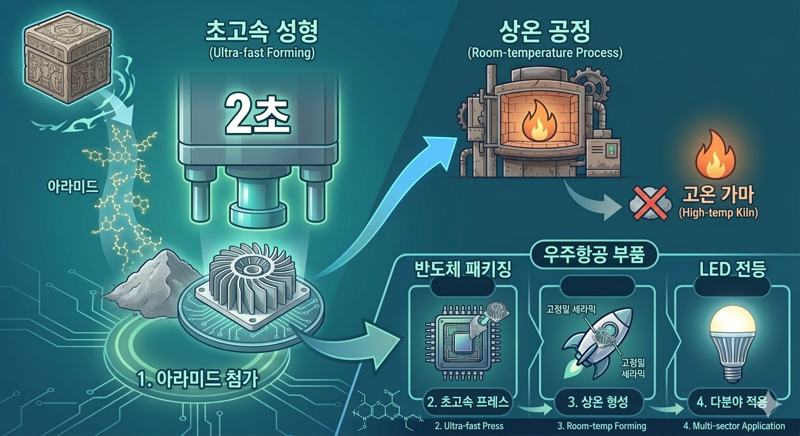
Ceramics are naturally heat-resistant and hard, but they are notoriously difficult to shape. Unlike metals, they cannot simply be melted and poured into a mold, and once hardened, they can shatter like glass from even a small impact. Until now, manufacturers had to pack ceramic powder into a mold and go through a long “sintering” process in kilns heated to over 1,000 degrees Celsius. This consumed enormous amounts of energy, and the parts shrank while firing, making it very hard to maintain precise shapes.
■ A custom-made shield to cool semiconductors and spacecraft
The technology developed by Professor Yongho Choa’s team is expected to be widely used to manufacture key components for electronic devices and future mobility systems. The first areas of application will likely be the semiconductor and aerospace industries. As electronic products become more powerful, it has become crucial to remove heat from inside devices through thermal management. Next-generation power semiconductors and LED lights, in particular, generate enormous heat, and the team’s ceramic technology is ideal for producing custom-designed heat sinks that dissipate this heat.
The material also offers strong durability, withstanding temperatures from minus 50 degrees Celsius up to plus 200 degrees. This makes it an excellent candidate for components in satellites and launch vehicles that must operate in extreme environments. Previously, it could take hours to make such parts with 3D printing, but now, in a mass-production line, precise ceramic components can be stamped out in just a few seconds.
■ A hint from modeling clay: the magic of forming in just 2 seconds
The researchers took inspiration from the modeling clay many of us played with as children. Just as the fibers mixed into that clay make the dough tough and stretchy, they mixed extremely strong aramid fiber into ceramic powder. Aramid fiber is so robust that it is used in bulletproof vests. The team implemented a “bridging” technique in which nano- and micro-scale fibers connect the gaps between ceramic particles like a mesh.
Thanks to this mesh-like structure, the ceramic mixture behaves like a solid under normal conditions, but when pressed into a mold, it transforms into a highly complex three-dimensional shape in just two seconds. Unlike conventional processes that required firing at over 1,000 degrees Celsius for more than 10 hours, the shape can now be fixed immediately at room temperature. As a result, process energy consumption can be reduced by more than 90%. The team named this mixture “Ceramic Dough.”
■ Precision that drew global attention: ceramics that do not easily break
The results of this study were published in the latest issue of Advanced Materials, a leading journal in materials science, underscoring its innovative nature. Experiments showed that parts stamped out like a seal matched their design drawings with a high fidelity of 89.4%. Because the fibers tightly held the ceramic particles together, the particles did not scatter during pressing and settled exactly into the intended shape.
The developed Ceramic Dough also dramatically improved the chronic problem of brittleness in conventional ceramics. The fibers firmly tie the particles together, giving the material high toughness so that cracks do not easily propagate even under impact. Its thermal conductivity was also preserved. The amount of adhesive, which is commonly used to bind ceramic particles, was minimized to 5.1% of the total volume. With less adhesive, heat transfer efficiency increased by about two to three times compared with existing composite materials.
In effect, this research has transformed ceramic forming from a high-energy, high-temperature process into an ultra-fast process carried out at room temperature. A small lump of this “dough,” born in a university lab, is now poised to become the fastest and most powerful tool for making core components of future industries. It will be exciting to see how the research we unboxed today will make our lives cooler and safer.
[email protected] Kim Man-gi Reporter