Air freight rates from Asia to Europe jump 45% as global supply chains reel [Era of $100 oil]
- Input
- 2026-03-09 18:36:31
- Updated
- 2026-03-09 18:36:31
As Iran strikes back at neighboring countries, the fallout from the war has spread beyond energy shipments through the Strait of Hormuz to air and sea logistics. Missile and drone attacks by Iran have severely disrupted major air and maritime routes linking Asia and Europe. This has triggered a chain reaction across global supply chains.
The closure of several international airports in the Middle East has amplified the shock. With Dubai International Airport (DXB), a major global hub, shut down, roughly 20% of worldwide air cargo traffic has been halted.
Shipments of high‐value goods that rely on air transport—such as pharmaceuticals, precious metals, and semiconductors—are now facing serious disruption. Maersk, the world’s largest shipping company, has suspended most cargo bookings to and from the United Arab Emirates (UAE), the Sultanate of Oman, the Republic of Iraq, the State of Kuwait, Qatar, Bahrain, and Saudi Arabia. Mediterranean Shipping Company (MSC) also announced that container cargo bound for the Persian Gulf will be diverted to the nearest available ports.
Logistics costs are soaring as well. Ryan Petersen, chief executive officer (CEO) of Flexport, said, "Air freight rates from Asia to Europe have risen by 45%." Shipping costs from Asia to the United States have also increased, but the rate of increase is less than half that of routes to Europe. This suggests that Europe and Asia are taking a heavier hit from the Middle East war than the U.S. Observers note that "Europe and Asia are more vulnerable to the macroeconomic shock from the Middle East war because they are highly dependent on imported energy."
Countries most affected by the blockade of the Strait of Hormuz include South Korea, which relies heavily on Middle Eastern energy, as well as Italy, Belgium, China, India, and Japan.
Asian financial markets have also suffered a bigger blow than the U.S. Over the past week, the S&P 500 Index on the New York Stock Exchange (NYSE) fell by about 2%, but stock markets in Asia, including South Korea and Japan, showed far greater volatility. As expectations grew that the war would drag on and international oil prices climbed above $100 per barrel, South Korea’s stock market plunged on the 9th, with the Korea Composite Stock Price Index (KOSPI) dropping more than 7% in early trading. Japan’s Nikkei 225 Stock Average also slid more than 6% at one point during the session. The Indian rupee fell to its lowest level in 50 years.
Not only the energy market but also commodity markets are in turmoil. Production shutdowns at smelters in the Middle East have pushed aluminum prices to their highest levels in years. Norsk Hydro, a major global aluminum producer, warned that it could take up to a year to fully restore production. At a time when the world’s dependence on liquefied natural gas (LNG) has risen sharply, operations at Qatar’s Ras Laffan Gas Complex were halted by an Iranian drone strike, removing about 20% of global LNG supply from the market.
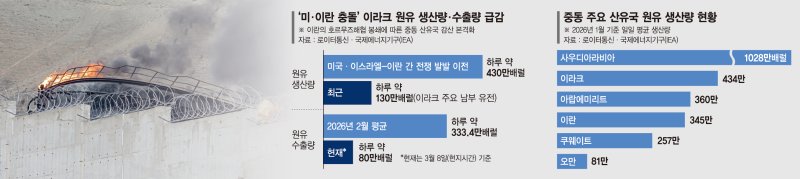
Europe and Asia are now locked in fierce competition to "secure gas," bidding up prices. One LNG carrier that had been heading from the United States to Spain even changed course to Asia after receiving a higher price offer. In South Korea, there are growing concerns that a shortage of helium, a by‐product of natural gas, could disrupt semiconductor manufacturing processes. With export routes blocked, oil‐producing countries are facing an unprecedented crisis. Storage tanks are nearing capacity, forcing countries such as Kuwait and Iraq to implement involuntary production cuts, entering a "shut‐in" phase. Oil fields that have been operating for decades can suffer severe damage when shut down; once closed, it can take months or even years to restore reservoir pressure and return output to previous levels.
[email protected] Reporter