Clashes Drag On Beyond Ten Days as War Widens... U.S. Weighs Deploying Special Forces [U.S.–Iran War]
- Input
- 2026-03-09 18:30:08
- Updated
- 2026-03-09 18:30:08
■ Renewed ‘booms of artillery’ in Iraq and Lebanon
Captain Timothy Hawkins, spokesperson for United States Central Command (CENTCOM), told The Wall Street Journal (WSJ) on the 8th (local time), “We conducted military operations in the Republic of Iraq as part of Operation Epic Fury, and these were defensive operations to protect U.S. service members from militias backed by the Islamic Republic of Iran.” The United States, which invaded Iraq in 2003, continued military activities there while fighting Islamic State (IS), but reduced its troop presence and operational scope after the Iraqi government declared victory over IS in 2017. WSJ noted that U.S. forces stationed in Iraq had avoided full-scale clashes with local militias for several years, but that Iraq has now “once again become a battlefield.”
Some Iran-backed militias operating in the Republic of Iraq struck U.S. facilities in the country after the United States and Israel began bombing the Islamic Republic of Iran under Operation Epic Fury on the 28th of last month. On the 7th, rockets were fired at the U.S. Embassy in Baghdad. Iraqi Foreign Minister Fuad Hussein, speaking at a ministerial meeting of the League of Arab States (Arab League) held by video link on the 8th, called on all warring parties in the Middle East to halt fighting.
Casualties are also mounting in Lebanon, where a second front has opened. Hezbollah, the pro-Iran armed group in Lebanon, broke the 2024 ceasefire and launched attacks on the 2nd of this month in support of the Islamic Republic of Iran, prompting Israel to respond with intense strikes. The Israeli military carried out at least 100 air raids across Lebanon on the 7th alone. According to Lebanese authorities, at least 394 people have been killed and 1,130 wounded in Lebanon this month by Israeli attacks. The number of displaced people is estimated at about 517,000.
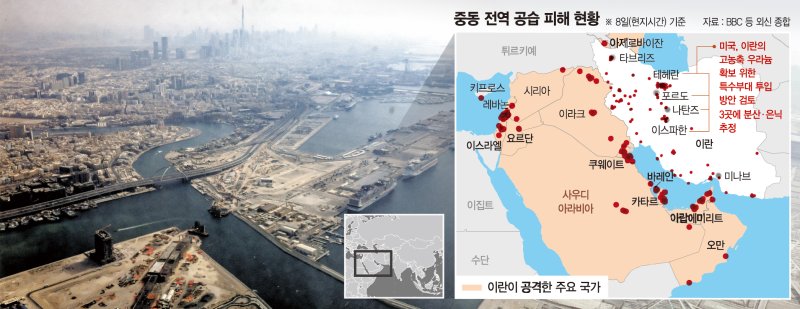
Since the start of Operation Epic Fury, the Islamic Republic of Iran has carried out retaliatory airstrikes not only on Israel but also on U.S.-linked assets in a total of ten Middle Eastern countries, including Saudi Arabia, the United Arab Emirates (UAE) and the State of Kuwait. Outside the region, the Republic of Cyprus and Azerbaijan have also come under Iranian attack. On the 8th, Iran struck a desalination facility in Bahrain, and in the early hours of the 9th it again launched missiles toward Israel. Dubai International Airport, a major global aviation hub in the UAE, was closed on the 7th following an Iranian missile strike, then partially reopened the next day.
■ Shifting U.S. rhetoric: When will the war end?
U.S. President Donald Trump said in an interview on the 28th of last month, “We might stop (the strikes) in two or three days.” Former Army officer and conservative commentator Pete Hegseth said at a press conference on the 2nd about Operation Epic Fury, “This is not Iraq,” adding, “It’s not something that will go on endlessly.”
Trump spoke about the possible end of the war in a telephone interview with English-language daily The Times of Israel (ToI) on the 8th. Asked whether he alone would decide when to end the war, or whether Israeli Prime Minister Benjamin Netanyahu would also have a say, he replied, “Jointly.” He added, “To some extent, we are talking. At the appropriate time I will make the decision, but everything will be taken into account.” Earlier, White House spokesperson Karoline Leavitt had said she expected the war to last four to six weeks.
Speaking to reporters aboard Air Force One on the 7th about how long the war with the Islamic Republic of Iran would continue, Trump said, “I don’t know. We’ll keep going as long as necessary.” Asked whether he was considering sending in troops to secure Iran’s nuclear material, he answered, “At some point, we might. We’re not aiming for that yet. We’re not going to do it right now.” On the same day, U.S. political outlet Axios reported, citing officials, that the United States and Israel are considering deploying special forces to secure 450 kilograms of enriched uranium in Iran. If further enriched, that amount of uranium would be enough to produce 11 nuclear bombs.
[email protected] Park Jong-won Reporter