U.S. expands sweeping controls to Huawei subsidiaries, raising possibility of equipment phase-out in Korea
- Input
- 2026-03-09 18:20:05
- Updated
- 2026-03-09 18:20:05
■ U.S. House urges sanctions on Huawei subsidiary
According to industry sources on the 9th, John Moolenaar, a Republican who chairs the United States House Select Committee on Strategic Competition between the United States and the Chinese Communist Party, and Ro Khanna, the Democratic ranking member, sent a letter on the 5th to Treasury Secretary Scott Bessent, Defense Secretary Pete Hegseth, Commerce Secretary Howard William Lutnick, and Federal Communications Commission (FCC) Chair Brendan Carr. The letter called for sanctions on Futurewei Technologies, Huawei’s research and development (R&D) subsidiary.
In the letter, they wrote, "Huawei exercises financial control and ownership over Futurewei," adding, "Futurewei conducts R&D activities funded by Huawei." Because Futurewei effectively functions as Huawei’s U.S. branch, they argued that it should be subject to the same measures as Huawei, including export controls, designation as a military‐linked company, and financial and securities‐related restrictions.
Huawei is rapidly losing ground in the global telecommunications market. Since 2021, the Federal Communications Commission (FCC) has placed Huawei and ZTE Corporation (ZTE) on its "covered list" of entities deemed threats to national security, banning imports of their equipment into the United States. In January, the European Commission (EC) unveiled a new EU cybersecurity legislative package that effectively mandates the exclusion of Huawei and ZTE. By turning the previously non‐binding EU toolbox for 5G security into law, the EC has given it binding force and formally designated Huawei, ZTE, and others as high‐risk suppliers. In practice, this move is designed to drive their equipment out of telecommunications networks in European Union (EU) member states.
■ Revenue decline at Huawei Korea’s key client
As Washington tightens its regulatory net around Huawei on national security grounds, many expect Huawei to be effectively sidelined from competition in Korea’s telecom equipment market as well. Potential domestic clients are increasingly reluctant to purchase Huawei gear under these circumstances.
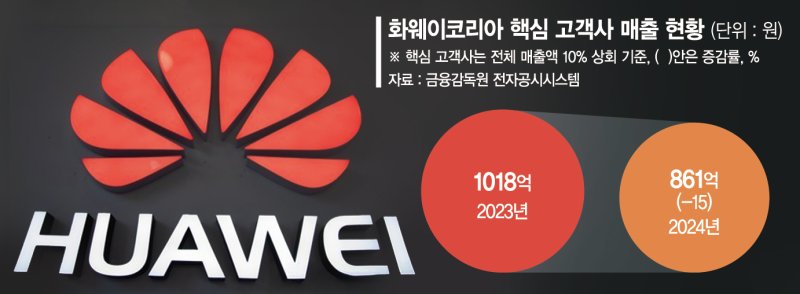
As of the end of 2024, LG Uplus is believed to be Huawei Korea’s only major domestic customer that accounts for more than 10% of its total revenue. Huawei’s 2024 sales from this client are estimated at 86.1 billion won, representing 41% of Huawei Korea’s total 2024 revenue of 208.4 billion won.
Huawei Korea has failed to secure additional core customers in the Korean market, and even sales to its sole large client fell 15% from 101.8 billion won at the end of 2023. Industry observers note that even if companies introduce Huawei Korea’s telecom equipment because of its low price, the business uncertainty surrounding Huawei could cause both tangible and intangible costs to soar exponentially.
Political concern over the security risks of Huawei equipment is already mounting.
At a National Assembly audit of the Science, ICT, Broadcasting, and Communications Committee last October, ruling party lawmaker Kim Jang-gyeom stated, "Huawei’s network equipment can be seen as being linked to security vulnerabilities," and went on, "The United States, the United Kingdom, Germany, Japan, and others have banned the installation of new Huawei equipment, and the United States Department of State (State Department) recognizes companies that do not use Huawei and other insecure Chinese‐made equipment as Clean Carriers."
Kim urged Second Vice Minister Ryu Jemyoung of the Ministry of Science and ICT to prepare government‐level measures to block the use of Chinese‐made telecom equipment. Kim said, "If that is the global trend, the government needs to review a phase‐out of Huawei equipment," adding, "If problems continue to arise in the system, we must examine its security, and study and review whether to remove such equipment."
[email protected] Jang Min-kwon Reporter