Big Money Pours into Leverage and Inverse ETFs as Aggressive Retail Investors Cash In
- Input
- 2026-03-09 18:16:25
- Updated
- 2026-03-09 18:16:25
As the domestic stock market swung sharply in response to the Iran crisis, retail investors have been actively using leveraged and inverse exchange-traded funds (ETFs). Analysts say these aggressive bets in an unprecedented roller-coaster market have delivered short-term gains.
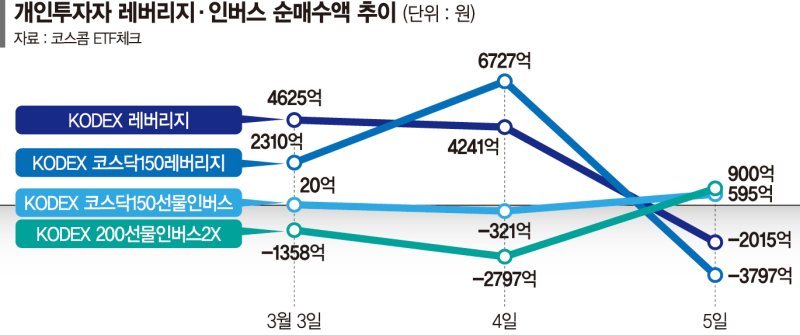
According to Koscom Corporation's ETFCheck data on the 9th, retail investors made net purchases of 886.6 billion won in KODEX Leverage ETF over the two days of the 3rd and 4th, when the Korea Composite Stock Price Index (KOSPI) plunged. When the index rebounded on the 5th, they switched course and booked profits, recording net sales of 201.5 billion won. In contrast, they dumped 415.5 billion won of KODEX 200 Futures Inverse 2X on the 3rd and 4th, then turned around to buy 90 billion won of the product on the 5th.
A similar pattern emerged in the KOSDAQ market, where investors also made active use of leverage and inverse products. On the 3rd and 4th, they bought 903.7 billion won of KODEX KOSDAQ 150 Leverage ETF, while recording net sales of 30.1 billion won in KODEX KOSDAQ150 Inverse Futures ETF. On the 5th, they sold 379.7 billion won of leverage products and, at the same time, made net purchases of 59.5 billion won in inverse products.
This wave of retail investor bets is widely viewed as a short-term success. Both KOSPI and KOSDAQ tumbled for two days and then staged a dramatic rebound in a single session, recovering much of their losses. Between the 3rd and 4th, KOSPI and KOSDAQ fell 18.43% and 17.97%, respectively, but on the 5th they bounced back by 9.63% and 14.10%.
The payoff was clear on the 5th, when retail investors heavily sold leverage products. KODEX Leverage ETF surged 19.84%, while KODEX KOSDAQ 150 Leverage ETF jumped 25.75%. On the 3rd and 4th, when they were unloading inverse products, KODEX 200 Futures Inverse 2X climbed 45.38%, and KODEX KOSDAQ150 Inverse Futures ETF rose 22.20%.
Even so, securities analysts warn that investors should remain cautious, as volatility is likely to persist for some time due to risks stemming from the Middle East. After this short-term correction, however, the market is expected to resume a longer-term upward trend.
Lee Kyung-min, a researcher at Daishin Securities, said, "In the coming weeks, the domestic stock market is likely to digest ongoing geopolitical issues," adding, "Tough rhetoric and shows of force by both the United States of America (U.S.) and the Islamic Republic of Iran, aimed at boosting their bargaining power, could temporarily fuel investor anxiety."
He went on to say, "If the situation does not drag on beyond March, the market is expected to resume its climb as policy and earnings momentum are reaffirmed."
Na Jeong-hwan, a researcher at NH Investment & Securities, noted, "Although the dispute between the U.S. and the Islamic Republic of Iran has not been fully resolved, the market appears to be moving away from extreme pessimism, which increases the likelihood of a rebound led by sectors and stocks that have fallen excessively." He added, "After heavily sold-off sectors such as semiconductors, secondary batteries, automobiles, and power equipment rebound first, the upward trend could spread to financials, holding companies, and the KOSDAQ market, which all have supportive domestic policy momentum."
[email protected] Seo Min-ji Reporter