Khamenei’s son becomes Iran’s Supreme Leader as hardline standoff pushes oil above $100
- Input
- 2026-03-09 10:44:12
- Updated
- 2026-03-09 10:44:12
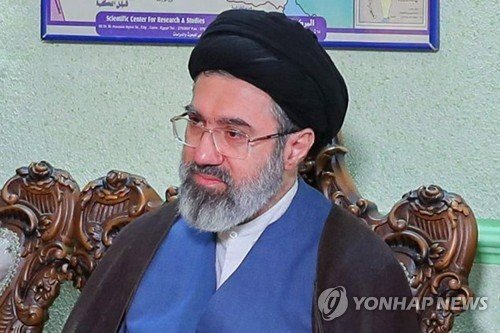
Amid this turmoil, Iran has chosen Mojtaba Khamenei, the second son of the late Supreme Leader Ayatollah Seyyed Ali Hosseini Khamenei, as his successor. Because US President Donald John Trump has already declared, "Khamenei’s son is unacceptable," many observers expect a prolonged hardline, tit-for-tat confrontation in the war.
On the 8th (local time), the Assembly of Experts appointed Mojtaba Khamenei as the next Supreme Leader. In a statement released through Iranian state media, the Assembly said, "At today’s extraordinary session, based on the decisive vote of the Assembly of Experts’ representatives, we have elected Mojtaba Khamenei as the third leader of the sacred system of the Islamic Republic of Iran (IRI)."
Mojtaba Khamenei, 56, has long been regarded as a powerful behind-the-scenes figure who rose on the coattails of his father. He is believed to wield significant influence within the Islamic Revolutionary Guard Corps of Iran (IRGC) and the intelligence services. The IRGC is reported to have quietly pressured the Assembly of Experts, the body that selects the Supreme Leader, to back Mojtaba’s elevation.
Inside Iran, he has often been described as a "shadow power" who exercised enormous clout even before formally assuming the role of Supreme Leader. During his father’s more than 30-year tenure, he became deeply embedded in the core of the regime, exerting strong influence over the Supreme Leader’s office and its affiliated economic networks. This history is fueling expectations that Iran will maintain a hardline stance in its war with the US.
Trump also criticized him in an interview with political outlet Axios on the 5th, saying, "Khamenei’s son is a lightweight," and adding, "Khamenei’s son is not acceptable as the next leader."
As this hardline confrontation continues, international oil prices have climbed above $100 a barrel for the first time in four years. On the New York Mercantile Exchange (NYMEX), April futures for West Texas Intermediate (WTI) crude oil were up 20.00% at $109.17 per barrel as of the morning of the 8th, Korea time. WTI at one point touched $111.24. It is the first time since July 2022 that WTI has traded above $100 a barrel. Brent Crude Oil, the global benchmark, was up 17.92% at $109.30 per barrel on ICE Futures Europe in London at the same time.
The war has also disrupted production in Middle Eastern oil exporters as the Strait of Hormuz remains effectively blocked. Iraq, a key producer within the Organization of the Petroleum Exporting Countries (OPEC), cut output at three major southern oil fields by about 70% on the same day.
According to Reuters, daily production at those three major southern Iraqi fields has fallen to around 1.3 million barrels. Before the war, they were producing roughly 4.3 million barrels per day.
The Financial Times (FT) reported that The Goldman Sachs Group, Inc. (Goldman Sachs) warned, "If crude flows through the Strait of Hormuz remain weak throughout March, prices for crude oil and refined products such as gasoline and diesel could hit all-time highs." Brent Crude Oil previously climbed to $147.50 per barrel just before the 2008 financial crisis; adjusted for inflation, that would be equivalent to about $218 today.
Trump argued the same day, "In the short term, oil prices will fall quickly once the threat of Iran’s nuclear weapons is removed," stressing, "This is a very small price to pay for the safety and peace of the US and the world."
[email protected] Reporter Lee Byung-chul Reporter