Global oil prices break above $100 a barrel, could surge to $150
- Input
- 2026-03-09 08:26:05
- Updated
- 2026-03-09 08:26:05
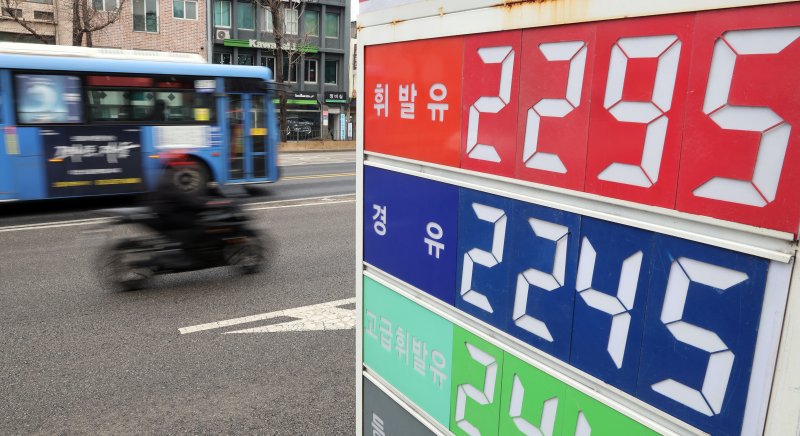
[The Financial News] The war involving the United States and Israel on one side and Iran on the other has severely disrupted crude oil supply chains in the Gulf region, pushing international oil prices above $100 a barrel. As traffic through the Strait of Hormuz, a vital chokepoint for global crude shipments, has come to a halt, anxiety in the global energy market is rising sharply.
According to the international oil market on the 9th, April delivery West Texas Intermediate (WTI) futures on the New York Mercantile Exchange (NYMEX) were trading at $107.54 a barrel as of 7:30 a.m. Korea time, up 14.85% from the previous session. During intraday trading, prices briefly surged to $111.24. This is the first time since July 2022 that WTI has climbed above $100 a barrel.
Brent Crude Oil, the global benchmark, also soared. On the Intercontinental Exchange London futures exchange, Brent futures were quoted at $107.54 a barrel at the same time, up 14.85%. The intraday high reached $111.04.
The main driver of the price spike is the supply shock caused by the blockade of the Strait of Hormuz. The strait is a strategic chokepoint through which about 20% of the world’s seaborne crude oil flows, and most exports from major producers in the Middle East pass through this route.
Shipping traffic through the strait is now reported to be almost completely paralyzed. In the past few days, only tankers linked to Iran and two bulk carriers believed to be owned by Chinese interests have passed through the Strait of Hormuz.
Energy consulting firm Kpler reported that tanker traffic through the Strait of Hormuz plunged by about 90% within a week after U.S. and Israeli airstrikes on Iran on the 28th of last month.
Vessel damage is also mounting. According to the International Maritime Organization (IMO), there have been at least nine attacks on ships in the Strait of Hormuz over the past week, leaving seven people dead.
With export routes cut off, oil-producing countries in the Middle East have begun adjusting output. As storage facilities rapidly approach capacity, some producers have started to curb production. Crude output at major oil fields in southern Iraq has reportedly fallen to about 1.3 million barrels per day, roughly one-third of previous levels. Iraq’s crude exports have also dropped sharply, from around 3.33 million barrels per day last month to about 800,000 barrels per day now.
The likelihood that the war will drag on is also increasing. Iran has chosen Mojtaba Khamenei, the second son of the late Ali Hosseini Khamenei, as the new Supreme Leader. Mojtaba Khamenei is widely regarded as a hard-liner toward the United States.
U.S. President Donald Trump previously declared that he must be involved in shaping Iran’s succession process and that he could not accept a dynastic transfer of power within the Khamenei family. Against this backdrop, many observers expect Washington to further intensify its military and diplomatic pressure on Iran.
Market participants increasingly believe that the upward trend in international oil prices will continue for some time. In a recent note to investors, Goldman Sachs projected that if crude flows through the Strait of Hormuz are not normalized, global oil prices could climb to as high as $150 a barrel by the end of this month.
Goldman Sachs stated, "If crude production and transportation through the Strait of Hormuz remain at depressed levels throughout March, there is a high likelihood that energy prices, including refined products, will surpass their previous peaks in 2008 and 2022."
Clayton Swope, a senior fellow at the Center for Strategic and International Studies (CSIS), assessed that "the grace period the market had granted the Trump administration effectively ended last weekend." He added, "The current supply shortfall of roughly 20 million barrels per day is destabilizing the balance of the global crude market," and noted, "President Trump is demanding unconditional surrender from Iran, but the chances of a swift resolution are low."
[email protected] Kim Kyung-min Reporter