Mojtaba Khamenei Becomes Iran’s New Supreme Leader (Round-up)
- Input
- 2026-03-09 07:24:49
- Updated
- 2026-03-09 07:24:49
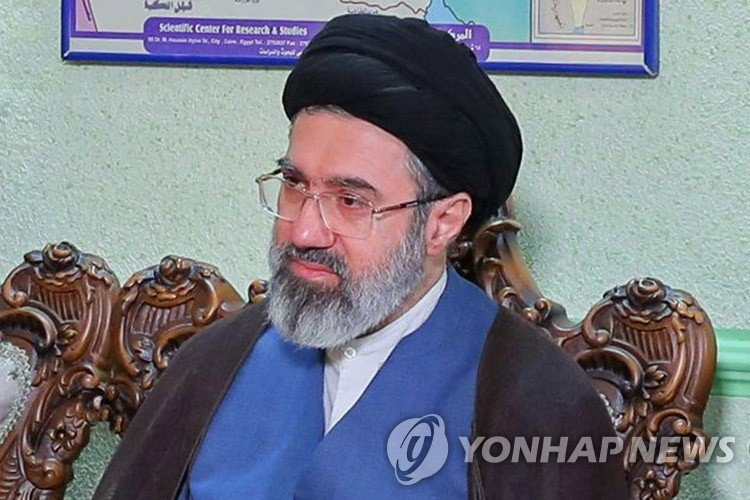
[Financial News] Mojtaba Khamenei, the second son of Ayatollah Ali Khamenei, has been officially selected as Iran’s new Supreme Leader. The succession has been settled in less than a month since Khamenei was killed in U.S. and Israeli airstrikes, signaling a rapid reshaping of Iran’s theocratic system.
On the 9th local time, the Assembly of Experts, the constitutional body that selects the Supreme Leader, announced in a statement carried by the Islamic Republic News Agency (IRNA), "We have officially decided that Ayatollah Seyyed Mojtaba Hosseini Khamenei will be the third Supreme Leader of the Islamic Republic of Iran (IRI)."
The Assembly of Experts stated that it had "chosen the Leader by an overwhelming vote of its representatives, in accordance with religious duty and a sense of responsibility before God."
It also called on all citizens, as well as elites from religious seminaries and universities, to pledge allegiance to the new Leader and to uphold unity within the system.
Mojtaba Khamenei is the second son of Ayatollah Ali Khamenei, who was killed in U.S. and Israeli airstrikes on the 28th of last month. Ali Khamenei had served as Supreme Leader since 1989, holding power at the apex of Iran’s theocratic order for 37 years.
Because he died without formally naming a successor, the authority to choose the new Leader passed to the Assembly of Experts, a body of 88 clerics.
Mohammad Bagher Ghalibaf, speaker of Iran’s parliament, described the Assembly’s decision as "a comforting decision that brings peace of mind," adding, "We do not see the new Leader as any different from the great Imam and the martyred Imam."
In Islam, an "Imam" is a title for a religious leader, and in Iran it is used as an honorific for the leader of the revolution or the highest-ranking cleric. In this context, the "great Imam" refers to Ruhollah Khomeini, the first Supreme Leader of Iran who led the Islamic Revolution, while the "martyred Imam" refers to Ali Khamenei.
Ali Larijani, secretary of the Supreme National Security Council (SNSC) and a key figure in Iran’s security establishment, also commented, "Our enemies expected the system to collapse, but the Assembly of Experts intervened in time and chose Mojtaba Khamenei."
Mojtaba Khamenei has long been known as a figure who wielded influence at the core of power by coordinating military and intelligence operations from his father’s office. He is particularly regarded as having maintained close ties with the Islamic Revolutionary Guard Corps (IRGC).
For this reason, many observers expect the Assembly of Experts’ decision to ensure the continuation of Iran’s hard-line theocratic rule.
Mojtaba Khamenei is reported to have attained the religious qualifications of an ayatollah by the time he assumed the office of Supreme Leader. However, he has made few public statements or official appearances, and his political leanings are widely seen as opaque to the outside world.
As Supreme Leader, he will serve both as the highest religious authority and as commander-in-chief of the armed forces, exercising ultimate power in the state.
Meanwhile, U.S. President Donald John Trump had publicly opposed the prospect of Mojtaba Khamenei’s selection, declaring at the time that such a scenario was "unacceptable."
In an interview with ABC News, Trump also warned, "A leader who does not have the approval of the United States will not last long."
[email protected] Kim Kyung-min Reporter