"Oil Rain" Falls on Tehran as Bombed Oil Storage Tanks Raise Fears of Chemical Disaster
- Input
- 2026-03-09 02:45:09
- Updated
- 2026-03-09 02:45:09
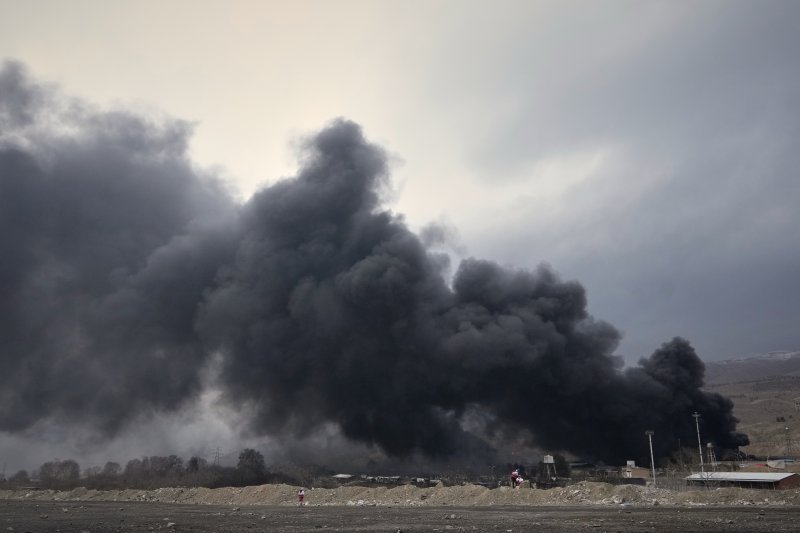
[Financial News] Financial News reports that major oil storage facilities around Tehran, the capital of Iran, exploded after joint airstrikes by the United States and Israel, sharply worsening air pollution and prompting eyewitness accounts of "oil rain." As large oil storage tanks were destroyed in the bombings, toxic chemicals have spread into the atmosphere, and experts are warning that some areas could see highly acidic rain.
According to the Islamic Republic News Agency (IRNA) and other outlets, from the night of the 7th until the early hours of the 8th, the Shahran oil depot in northwestern Tehran, fuel storage tanks at the Rey oil refinery complex in the south, and fuel storage facilities in the western outskirts near Karaj came under successive airstrikes.
Immediately after the bombings, large storage tanks reportedly exploded in a chain reaction, spewing massive amounts of toxic gas along with black smoke. Analysts say that in the process, toxic substances such as hydrocarbon compounds, sulfur oxides, and nitrogen oxides spread into the air and cloud layers.
The Tehran City Government warned that "the explosion of oil tanks is causing large quantities of toxic chemicals to spread through the atmosphere" and added, "If it rains, the precipitation could become highly acidic and extremely dangerous."
In fact, social media posts have been flooding in, showing dark, heavy clouds forming over Tehran and describing rain mixed with a black, oily substance. Local residents are sharing accounts such as "the rain leaves black stains," as they relay the worsening air pollution.
Mohammad-Sadegh Motamedian, governor of Tehran Province, said, "Since the fire at the oil storage facilities, Tehran's air pollution index has risen sharply," urging citizens to stay indoors and take safety precautions.
The Iranian government strongly condemned the airstrikes. Esmail Baghaei, spokesperson for the Iranian Foreign Ministry, wrote on X (formerly Twitter) that "the attack on oil storage tanks is effectively a form of chemical warfare targeting civilians."
He criticized the strikes, saying, "By attacking fuel storage facilities, toxic substances have been released into the atmosphere, exposing citizens to the risk of poisoning," and added, "This constitutes a war crime, a crime against humanity, and an act of mass murder."
The attack has also disrupted fuel supplies. Tehran Province has reduced the per-vehicle fuel purchase limit from 30 liters to 20 liters in response to the shortage.
Governor Motamedian said, "The fuel rationing will be applied only temporarily for about two to three days, and once the situation stabilizes, the limit will be restored to its original level."
[email protected] Reporter Kim Kyung-min Reporter