[Editorial] Exports Hit by Middle East Crisis, Growth Forecast Inevitable to Revise Down
- Input
- 2026-03-08 19:11:11
- Updated
- 2026-03-08 19:11:11
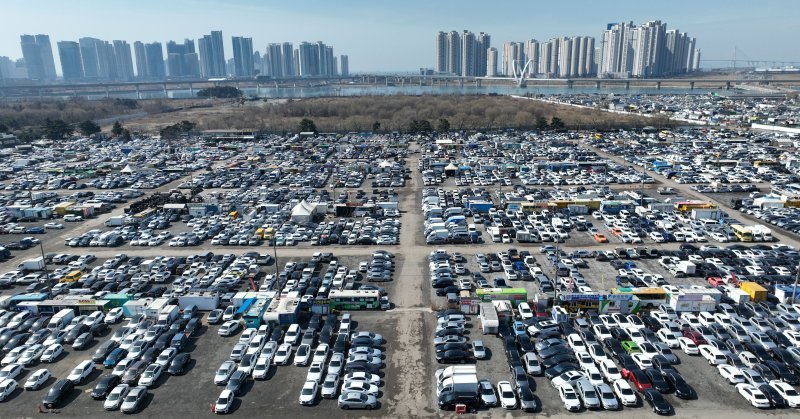
Key export items to the Middle East include automobiles, auto parts, and machinery. The Middle East has recently been one of the regions where South Korean exports have grown rapidly, with shipments of agricultural, fisheries, and food products also on the rise. The biggest concern, however, is automobiles, a core export item. Bernstein Research has warned that Asian automakers are likely to be hit hard.
South Korea, Japan, and China together hold one-third of the Middle East auto market, with Toyota Motor Corporation enjoying the largest share at 17%. Hyundai Motor Company has a 10% share, while China’s Chery Automobile holds 5%. A decline in car sales in the Islamic Republic of Iran, disruptions in vehicle transport and supply chains across the Middle East, and weaker demand for cars due to higher oil prices will inevitably lead to a drop in South Korea’s auto exports.
The Middle East market itself is not particularly large in absolute terms, but export losses in each country could feed into a broader global downturn. The damage is not limited to exports. In Japan, for example, the number of European tourists traveling via the Middle East is expected to fall sharply. Export declines and tourism slumps in neighboring China and Japan, and the resulting economic slowdown there, are bound to spill over to South Korea as well.
The Government of South Korea and the Bank of Korea (BOK) recently raised this year’s economic growth forecast to 2.0%, helped by a boom in the semiconductor industry. Although 2.0% is still not a high rate, it had raised hopes that the country might at least partially escape the low-growth pattern of recent years. If the war in the Middle East continues for more than a month, however, even this forecast will have to be revised down.
The Hyundai Research Institute has projected that if international oil prices were to surge to 150 dollars a barrel, triggering an "oil shock" similar to past crises, South Korea’s economic growth rate could fall by 0.8 percentage points. Researchers at Citi estimate that if prices remain around 82 dollars, this year’s growth rate would still drop by 0.45 percentage points.
The current situation in the Middle East is deteriorating to the point where it is impossible to predict when it will end. Unless the Islamic Republic of Iran, under attack from the United States of America (U.S.) and the State of Israel, stops resisting and comes to the negotiating table, the conflict is likely to drag on for more than a month. The Government of South Korea must assume the worst-case scenario and have emergency response measures ready.
Securing crude oil is the most critical task. It was a wise move for Kang Hoon-sik, Chief of Staff to the President of the Republic of Korea, to arrange the emergency import of more than 6 million barrels of crude from the United Arab Emirates (UAE). But this alone will not be enough to meet demand for oil. South Korea must move quickly to cooperate with oil-producing countries outside the Middle East as well, and lock in additional crude supplies.
At times like this, the public must show maturity and restraint. As President Lee Jae Myung of South Korea has pointed out, the government must strictly crack down on attempts to exploit the crisis by hiking oil prices or engaging in hoarding and cornering, and restore order to the market. Crude oil for industrial activity must be supplied without interruption. At the same time, however, the entire nation should join efforts to cut oil consumption, for example by reducing car use.
Financial institutions and local governments should closely examine the situation of small and medium-sized enterprises (SMEs) that may face liquidity problems due to temporary export disruptions. For companies in difficulty, they must provide timely financing so that problems can be resolved before they worsen. The government has launched a Joint Government Emergency Response Team. It must devote particular attention to coordinating overall policy and do everything possible to manage this crisis.