Biggest Volatility Since the Financial Crisis: ‘Roller-Coaster KOSPI’ Triggers Investor Caution
- Input
- 2026-03-08 18:23:20
- Updated
- 2026-03-08 18:23:20
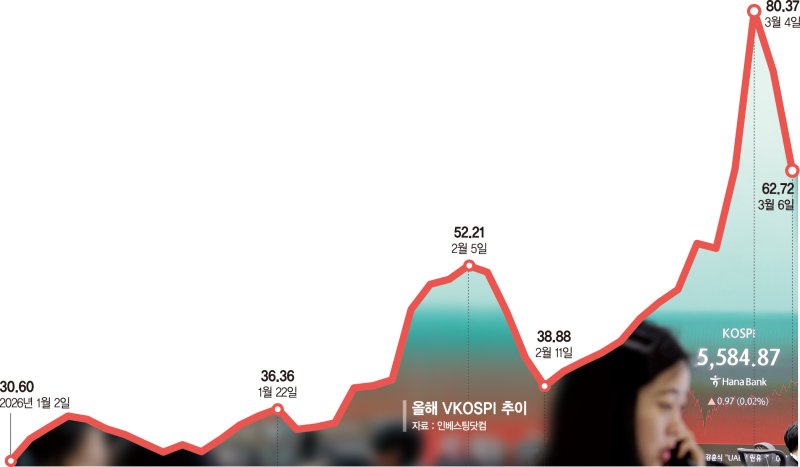
The Korea Composite Stock Price Index (KOSPI) has shown its highest level of volatility this month since the 2008 financial crisis. On some days, the index swung by more than 600 points in a single session, prompting investors to say, "It feels more like a crypto market than a stock market." Analysts warned that volatility could remain elevated until the Middle East conflict is resolved and urged investors to refrain from making aggressive bets.
According to the Korea Exchange (KRX) on the 8th, the KOSPI 200 Volatility Index (VKOSPI), which reflects volatility in the KOSPI, closed at 62.72 on the 6th. The KOSPI 200 Volatility Index (VKOSPI) measures expected future market volatility implied in option prices. It typically rises when the KOSPI plunges and is therefore known as Korea’s fear index.
The VKOSPI, which had been hovering around the 40 level, jumped to 62.98 on the 3rd, when the KOSPI fell 7%. This was the highest reading in six years, since March 24, 2020 (62.13), at the height of the COVID-19 pandemic. On the 4th, when the KOSPI tumbled by more than 10%, the VKOSPI spiked to 80.37. That marked the highest level since the 2008 financial crisis. The all-time high for the VKOSPI was 89.3 on October 29, 2008.
This surge is largely attributed to sharp day-to-day swings in the KOSPI, which has been rising and falling by nearly double digits amid heightened geopolitical uncertainty following the military clash between the United States of America (U.S.) and the Islamic Republic of Iran (Iran). On the 3rd, the first trading day after the Middle East crisis escalated, the KOSPI dropped 7.24%, followed by a 12.06% plunge on the 4th. It then rebounded 9.63% on the 5th, reversing direction in a short span, and on the 6th the index moved more than 200 points intraday but ended almost flat, up just 0.02%. Intraday volatility in the KOSPI has also reached a six-year high. On the 4th, when the index fell 12%, its intraday volatility reached 11.42%, with the gap between the day’s high and low hitting 612.67 points.
This was the highest intraday volatility since March 19, 2020 (12.17%), during the COVID-19 pandemic. Intraday volatility is calculated by dividing the difference between the day’s high and low by the average of the high and low. It shows the size of the day’s price swing relative to the average level of the index.
As market volatility has increased, the number of times the volatility interruption mechanism has been triggered in the KOSPI Market surpassed 3,000 in just four trading days this month (3rd–6th). During this period, it was activated 3,314 times, or an average of 828.5 times per day. This is four to six times higher than in January and February, when the volatility interruption mechanism was triggered an average of 134.3 and 183.4 times per day, respectively, in the KOSPI Market. The volatility interruption mechanism is a cooling-off device that switches trading in a stock to a single-price auction for two minutes when its price moves too sharply.
Exchange-Traded Fund (ETF) and Exchange-Traded Note (ETN) products were particularly volatile. Of all KOSPI Volatility Interruption mechanism (VI) triggers over the four days, more than half—2,172 cases, or 65.54%—occurred in ETF and ETN names. The product with the most VI triggers was the defense-industry-themed leveraged ETN "NE Monthly Leveraged Defense Industry Top 5 ETN," which was halted 83 times.
Experts believe that trading patterns among retail investors, who focus heavily on large-cap stocks and ETFs, have further amplified index volatility.
They point out that ETFs can have an outsized impact on prices because they are often traded through basket trading. Basket trading is a method of placing a single order for a bundle of 10 or more different stocks at once.
When a sell basket targeting a specific sector or an entire index is executed, all the individual stocks in that basket are dumped simultaneously. This leads to a broad-based decline in share prices.
Analysts advise investors to be cautious with their investments in this highly volatile environment.
Lee Sang-heon, head of the research center at iM Securities, stated, "Since the KOSPI had risen 48% from the start of the year through the end of February, the pullback after such a rapid rally naturally involved large swings. On top of that, retail investors’ ETF-focused trading accelerated the index’s decline." He added, "From the second quarter of this year, additional index corrections are likely due to concerns over stagflation, so investors should avoid making large-scale bets. Selective exposure to sectors such as nuclear power plant (NPP), the semiconductor materials, parts and equipment sector, and the space industry is advisable."
nodelay@fnnews.com, Park Ji-yeon
nodelay@fnnews.com Park Ji-yeon Reporter