Container Freight Rates Double, Shipping Profits Rise While Airlines Suffer from Surging Fuel Costs [US–Iran War]
- Input
- 2026-03-08 18:18:14
- Updated
- 2026-03-08 18:18:14
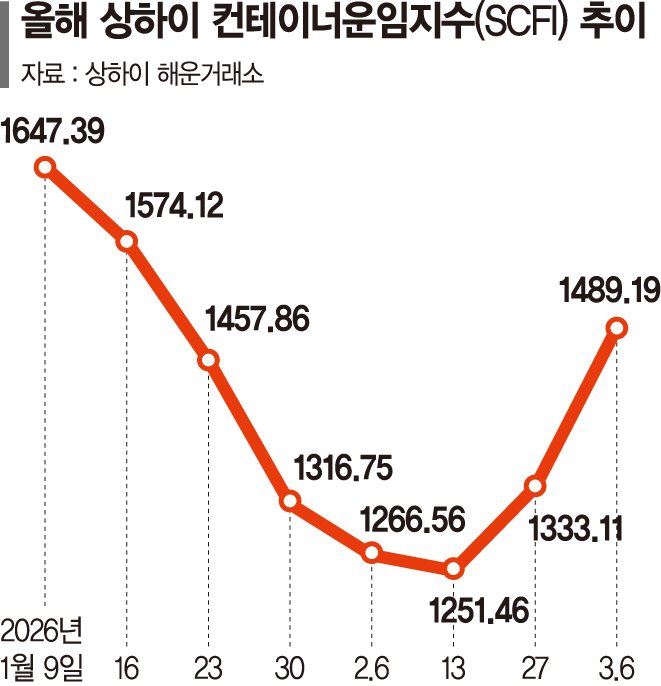
According to the shipping industry on the 8th, the Shanghai Containerized Freight Index (SCFI), which tracks global ocean freight rate levels, stood at 1,489.19 on the 6th, up 156.08 points from the previous week. The increase is roughly double the prior week’s gain of 81.65 points. Analysts attribute the jump to the effective closure of the Strait of Hormuz caused by the war between the US and Iran.
While the industry is wary that global trade could contract, shipping companies are still expected to enjoy a short-term rebound in earnings. In fact, HMM, the country’s largest shipping line, posted an operating profit in the 5 trillion won range in 2021, when container freight rates soared amid post-COVID logistics disruptions, marking the best performance in its history.
Kevin Lee, chief executive of Hyundai Glovis, recently noted, "When the Suez Canal was blocked in the past and container freight rates roughly doubled, shipping and logistics companies benefited. If the blockade of the Strait of Hormuz drags on, we could see a similar effect across vessel types without exception."
The shipping sector now faces an unprecedented situation: the Suez Canal, the shortest sea route linking Europe and Asia, is already effectively closed, and on top of that, the Strait of Hormuz is blocked as well.
A shipping industry official said, "If we use alternative routes, insurance premiums will rise, sailing days will increase, and the number of available vessels will inevitably decline," adding, "If the war and the strait’s closure are prolonged, there is a high likelihood that the upward trend in ocean freight rates will continue for some time."
Airlines, on the other hand, have now moved squarely into the damage zone from the spike in oil prices. They must shoulder not only higher fuel costs but also additional fuel consumption from rerouting around restricted airspace. If higher fuel surcharges are added in April, traditionally a low season for air travel, a deterioration in earnings appears unavoidable.
Industry data show that on the 4th, jet fuel in Singapore jumped about 72% in a single day to 225.44 dollars per barrel. Fuel accounts for roughly 30% of airlines’ operating expenses. Korean Air estimates that every 1-dollar increase per barrel in oil prices adds about 30 million dollars (around 43.8 billion won) in extra costs.
The additional cost burden on airlines is likely to be passed on to consumers as early as April. Fuel surcharges are set by assigning a tier based on the average Singapore composite refining margin from the 16th of the month two months prior to the 15th of the previous month, and then applying the corresponding surcharge level in the following month. Currently, the fuel surcharge on the Incheon–Los Angeles (LA) route ranges from 78,600 to 79,500 won, but from April it could surge to as high as 210,000 won. For a round-trip ticket, that would mean an extra 400,000 won per person.
An airline industry official explained, "A portion of the increase in oil prices is reflected in fuel surcharges, and the part that cannot be passed on is absorbed by the airline, so if the war is prolonged, the burden on carriers will grow," adding, "April is a low season for air travel and base fares are usually lower, so higher fuel surcharges could dampen consumers’ travel demand."
[email protected] Kim Dong-ho Reporter