"A Middle East war must never happen" — China indirectly criticizes U.S. involvement
- Input
- 2026-03-08 18:10:31
- Updated
- 2026-03-08 18:10:31
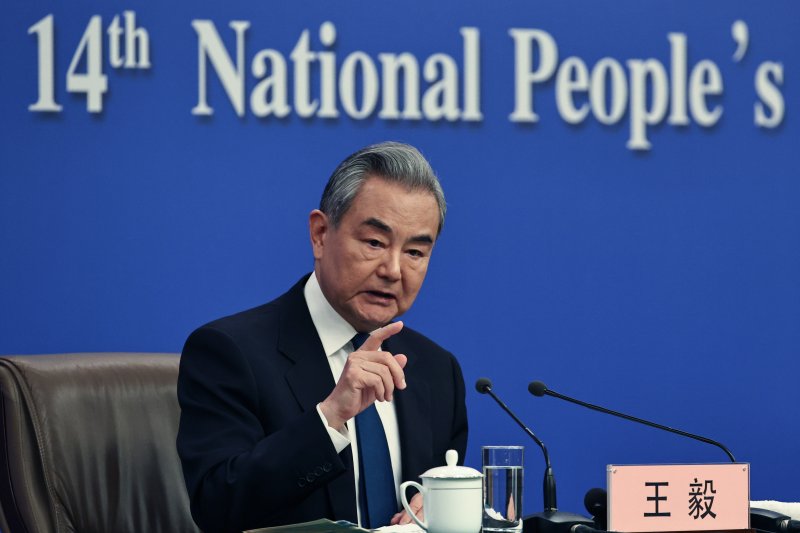
On the 8th, at a foreign policy press conference held during the National People's Congress (NPC), Wang Yi outlined the direction of China’s diplomacy for the year and made these remarks. This was his 12th NPC press conference since 2014.
Wang Yi said, "What I want to say, as the Middle East is engulfed in the flames of war, is that this is a war that should never have happened and a war that benefits no one." He went on to stress that "war is a means that brings disaster and must be approached with extreme caution." His comments amounted to an indirect rebuke of the United States and Israel.
As principles for resolving issues in the Middle East, he cited respect for national sovereignty, opposition to the abuse of force, non-interference in internal affairs, and political solutions, implicitly criticizing U.S. intervention. He added, "Having greater power does not mean having greater moral authority," and argued, "The world must not revert to the law of the jungle where the strong prey on the weak."
Wang Yi warned that "China–United States relations have a major impact on the world, and if the two countries do not engage with each other, misunderstandings and misjudgments will arise and could ultimately lead to conflict and confrontation." He continued, "China and the U.S. are both major powers and cannot change each other, but they can change how they deal with one another," adding that they should "uphold the principle of peaceful coexistence based on mutual respect and pursue cooperation and mutual benefit." He further noted that "high-level exchange schedules are already under discussion, so both sides need to make full preparations and create an appropriate environment." In particular, he said, "The two sides must manage existing differences and eliminate unnecessary interference."
Turning to Japan, where relations have deteriorated following Prime Minister Sanae Takaichi’s remarks hinting at possible involvement in a Taiwan contingency, he issued a strongly worded criticism.
Recalling that this year marks the 80th anniversary of the International Military Tribunal for the Far East (Tokyo Trials), he said, "History gives Japan another opportunity to reflect on itself," and stressed that "the Japanese people must keep their eyes wide open so that the country does not repeat the path of the past." He reiterated that "the Taiwan question is entirely China’s internal affair" and asked, "If problems arise in China’s Taiwan region, in what capacity could Japan exercise the right of self-defense?" He added, "China and the 1.4 billion Chinese people will never tolerate any force that glorifies colonial rule or justifies aggression."
At the press conference, Wang Yi did not take questions from South Korean media and did not state any position on Korea-China relations, the Democratic People's Republic of Korea (DPRK), or broader issues concerning the Korean Peninsula.
[email protected] Lee Seok-woo Reporter