Southeast Asia and India Hit by Fallout from the Islamic Republic of Iran: A ‘Black Week’ for Stocks and Currencies
- Input
- 2026-03-08 18:08:46
- Updated
- 2026-03-08 18:08:46
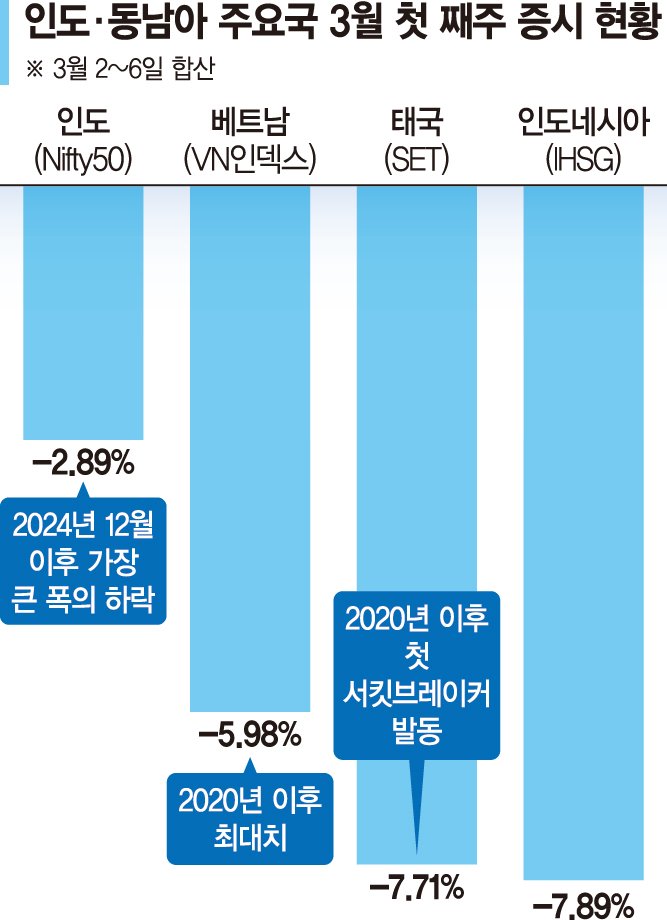
HANOI (Vietnam) — As the Middle East war, sparked by airstrikes by the United States and Israel on the Islamic Republic of Iran, continues to escalate, financial markets in emerging economies such as Southeast Asia and India swung sharply throughout the week. Stock markets in Thailand, Vietnam, and Indonesia plunged about 6–8% over the past week, while foreign capital outflows and resulting currency weakness occurred at the same time. Heightened tensions in the Middle East, including fears of a blockade of the Strait of Hormuz, have driven a surge in global oil prices, prompting international investors to cut exposure to risk assets and move into the US dollar.
Local market participants warn that if the war in the Middle East drags on, the combination of rising oil prices and capital outflows could push emerging-market equities and currencies into a deeper downturn.
■ Thailand plunges 7.71% for the week as circuit breaker mechanism kicks in
According to local media reports on the 8th, stock markets in Southeast Asia and India have shown extreme volatility in the wake of the conflict involving the Islamic Republic of Iran. Thailand has suffered the heaviest blow among Southeast Asian markets. The SET Index in Thailand crashed more than 8% during intraday trading on the 4th, triggering the automatic trading halt known as the circuit breaker mechanism. It still closed down about 5%, marking the steepest daily drop since the COVID-19 pandemic. From the 2nd to the 6th, the SET Index fell about 7.71% for the week, sliding to the 1,410-point range.
Foreign investors also continued their "sell Thailand" trend. Over the week, offshore investors were net sellers of about 13.47 billion baht (approximately 629.4 billion won). The English-language daily The Nation noted, "The Thai stock market has a structure with a high weighting in power generation and energy companies," adding, "Rising Liquefied Natural Gas (LNG) prices and a spike in oil prices triggered panic selling among investors."
Exchange-rate volatility further pressured the equity market. After the Bank of Thailand (BOT) cut its policy rate from 1.25% to 1.00%, the baht continued to weaken. Surachai Pramot, deputy CEO at Kasikorn Securities, said, "Geopolitical tensions combined with changes in interest-rate policy have pushed Thailand’s financial markets into extreme volatility," and added, "A conservative stance is needed until the currency stabilizes."
■ Vietnam tumbles 5.98% amid panic selling as key psychological level breaks
Vietnam’s stock market also went through a black week. The VN Index lost the psychologically important 1,800-point level, causing investor sentiment to cool rapidly. On the 6th, the Vietnam Ho Chi Minh Stock Index (VN Index) on the Ho Chi Minh City Stock Exchange (HOSE) closed at 1,767.84, down 40.67 points (2.25%) from the previous session. On a weekly basis, it dropped 112.49 points (5.98%), giving back most of the gains accumulated in February, when it had hit an all-time high.
Foreign selling also intensified. Over the week, overseas investors recorded net sales of about 1.3 trillion dong (approximately 73.8 billion won) on HOSE. The dong came under upward pressure on the exchange rate as well, with the dollar–dong rate at commercial banks climbing above 26,300 dong per dollar on the ask side. Nguyen The Minh, head of research at Yuanta Securities Korea, said, "The breakdown of the 1,800 level acted as a strong sell signal," and explained, "The conflict in the Middle East has fueled concerns over higher energy prices and inflation, leading to panic selling."
■ Indonesia slumps 7.9% amid credit-rating downgrade; Indian rupee hits record low
Indonesia’s stock market also took a direct hit from the conflict involving the Islamic Republic of Iran. The IDX Composite Index (IHSG) fell about 7.9% over the week. Investor sentiment deteriorated further after Fitch Ratings cut its outlook on Indonesia’s sovereign credit rating from "stable" to "negative."
Rising oil prices added to the strain. As a net oil importer, Indonesia faces a heavier burden on energy subsidies when crude prices climb. Amid large-scale net selling by foreign investors, the rupiah also weakened, with the exchange rate against the dollar threatening to break above 17,000 rupiah. Khairul Adi, chief analyst at Pintraco Securities, commented, "Global geopolitical risks and concerns over domestic fundamentals are emerging at the same time," and predicted, "A rebound in the index will be difficult until the currency stabilizes."
India’s stock market also underwent a correction. The Nifty 50 and the BSE SENSEX Index both fell about 3% for the week, while the rupee, pressured by a stronger dollar, dropped to a record low. Prashant Tapse, vice president at Meta Equities, said, "This downturn is not just a simple correction; it reflects fears over rising energy prices," adding, "As oil approaches $100 a barrel, the pace of foreign capital outflows is accelerating."
■ Experts: "Oil prices will determine the fate of emerging-market financials"
Experts point to oil prices as the key variable that will determine the future direction of emerging-market financial markets. In a recent report, Vietnam-based investment firm VinaCapital analyzed, "Military clashes involving the Islamic Republic of Iran are increasing volatility in financial markets, and if the war becomes protracted, higher oil prices could amplify global inflationary pressures." Southeast Asia and India are particularly vulnerable because they rely heavily on crude oil from the Middle East. Their strategic petroleum reserves are also limited, estimated at only about 25 days of consumption for India and around 45 days for Vietnam.
[email protected] Kim Jun-seok Reporter