Stock Market Split on Middle East Risk: Oil and Defense Surge While Autos and Semiconductors Plunge [ETF Square]
- Input
- 2026-03-08 18:02:32
- Updated
- 2026-03-08 18:02:32
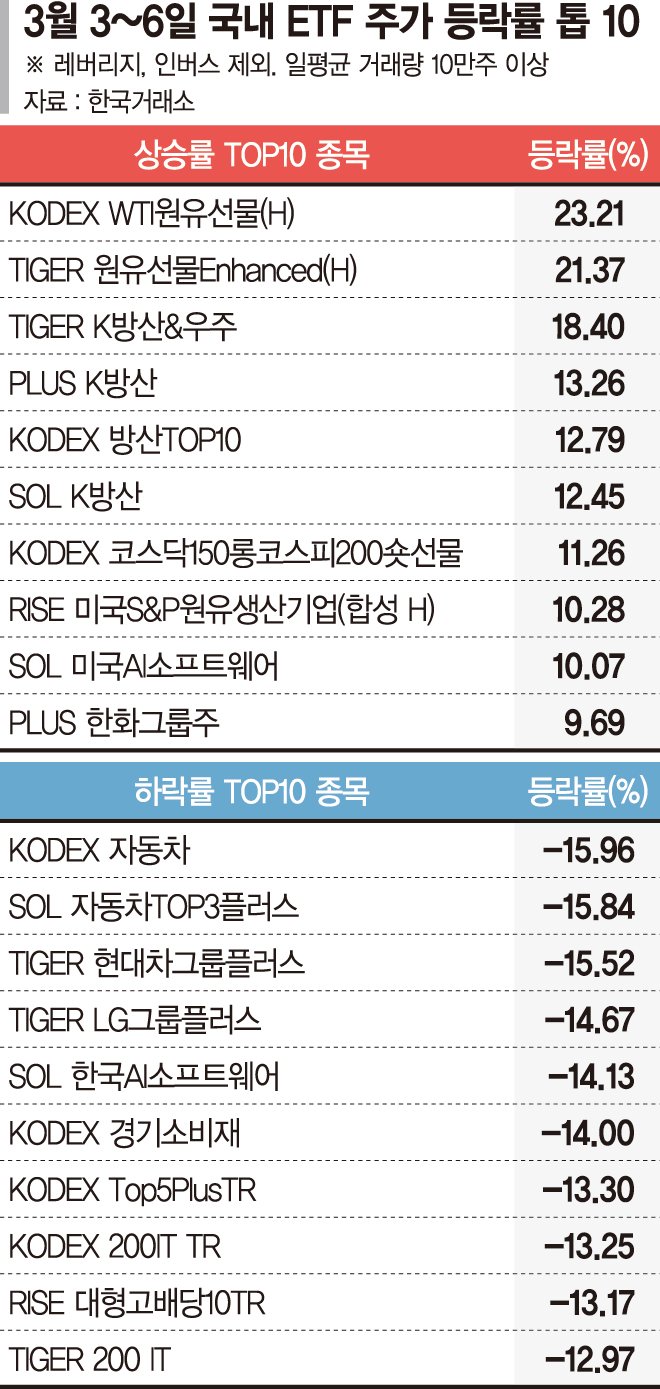
According to the Korea Exchange on the 8th, from the 3rd to the 6th, most of the top-performing domestic ETFs were focused on oil and defense themes. Over the same period, the best performer was the KODEX WTI Crude Oil Futures ETF (Hedged), which jumped 23.21%. It was followed by TIGER Crude Oil Futures Enhanced (H) with a 21.37% gain, TIGER K-Defense Industry & Space ETF at 18.40%, Hanwha PLUS K-Defense ETF at 13.26%, KODEX Defense TOP10 at 12.79%, and Shinhan SOL K Defense Industry ETF at 12.45%.
The strength in oil ETFs was driven by a sharp rise in international oil prices following military clashes in the Middle East. As military tensions escalated between the United States of America (US) and the Islamic Republic of Iran, concerns grew over potential disruptions to oil supply, pushing prices rapidly higher. On the 6th (local time), West Texas Intermediate (WTI) crude oil futures closed at $90.90 per barrel, up 12.21% from the previous session. This spike in international oil prices translated directly into higher returns for oil-related ETFs.
Defense industry ETFs also benefited from the heightened geopolitical risk. Continued missile attacks and military clashes in the Middle East have fueled expectations for increased demand for air defense systems and interceptor missiles, drawing capital into ETFs linked to Korean defense companies. Analysts also point out that the recent deterioration in the global security environment is leading to a structural re-rating of the defense sector, which has supported the rally.
Chae Woon-saem, a researcher at Hana Securities, said, "Due to attacks by the United States and Israel and the subsequent retaliation with ballistic missiles and drones by the Islamic Republic of Iran, shortages of interceptor missiles for air defense systems are emerging as a real constraint." He added, "Given that multiple interceptor missiles can be launched against a single ballistic missile, the consumption of interceptor missiles could accumulate rapidly not only in the US but also in key Middle Eastern countries."
On the other hand, ETFs linked to automobiles and semiconductors made up a large share of the biggest decliners. Over the same period, the KODEX Automobile ETF fell 15.96%, marking the steepest drop. It was followed by the SOL Auto TOP3 Plus ETF, down 15.84%, and the Mirae Asset TIGER Hyundai Motor Group Plus ETF, which declined 15.52%.
The weakness in automobile ETFs is seen as a result of growing concerns over logistics disruptions stemming from geopolitical tensions in the Middle East. If the Strait of Hormuz were to be blocked, some forecasts suggest that sea transport times could increase by roughly 10 to 14 days, raising the prospect of heavier logistics burdens for the auto industry. Analysts warn that if the conflict drags on or a blockade of the strait materializes, it could lead to weaker car sales, higher logistics costs, and delivery delays.
ETFs that include large-cap semiconductor stocks also came under pressure. During the same period, the Samsung KODEX Top 5 Plus Total Return ETF fell 13.30%, the Samsung KODEX 200IT Total Return ETF lost 13.25%, the RISE Large Cap High Dividend 10 TR ETF dropped 13.17%, and the TIGER 200 IT ETF declined 12.97%, all posting double-digit losses.
[email protected] Bae Han-geul Reporter