When Korea’s Gas Price Jumps 200 Won and Japan’s Only 22 Won... Why Is the Hike Nine Times Bigger?
- Input
- 2026-03-09 07:00:00
- Updated
- 2026-03-09 07:00:00
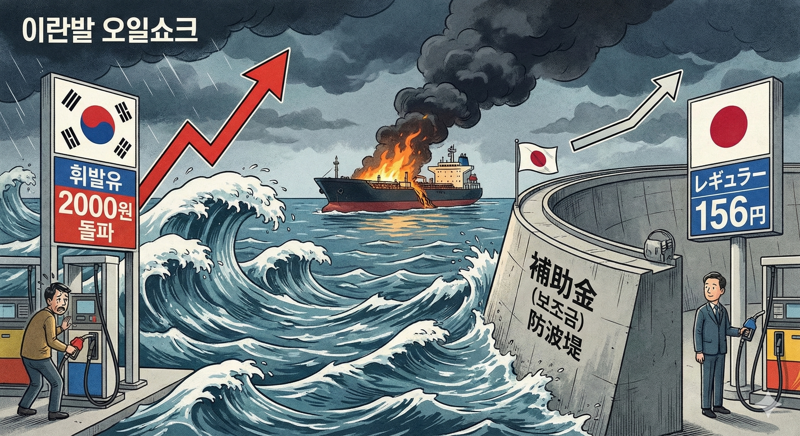
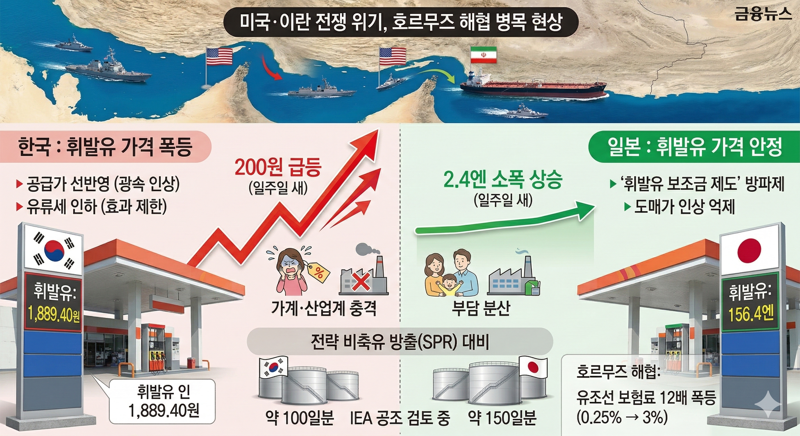
[The Financial News] In the unfolding energy crisis sparked by war between the United States and Iran, Japan’s dependence on crude shipped through the Strait of Hormuz is about 95%, far higher than Korea’s roughly 72%. Structurally, Japan is much more vulnerable to geopolitical risk. Yet right after the war broke out, the prices posted on gas station boards told a different story. Over the past week, Korea’s gasoline price has surged by nearly 200 won per liter, closing in on the 2,000-won mark, while Japan’s increase was limited to 2.4 yen (about 22 won). In other words, despite having the more serious structural weakness, Japan’s gasoline price hike is only about one-ninth of Korea’s. Analysts say this striking gap stems from a combination of factors, including how prices are passed through, government subsidies, tax structures, and exchange rates.
Is Korea entering the 2,000-won era? Upfront pass-through of supply prices rattles consumers
Since the outbreak of the Iran war, domestic gasoline prices in Korea have been tracing a steep upward curve.
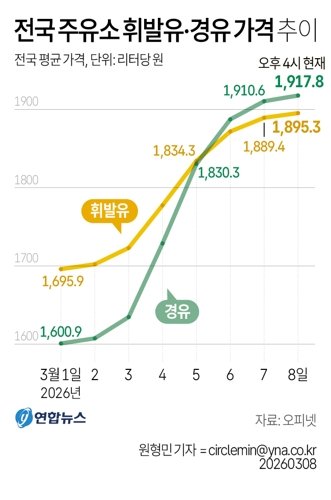
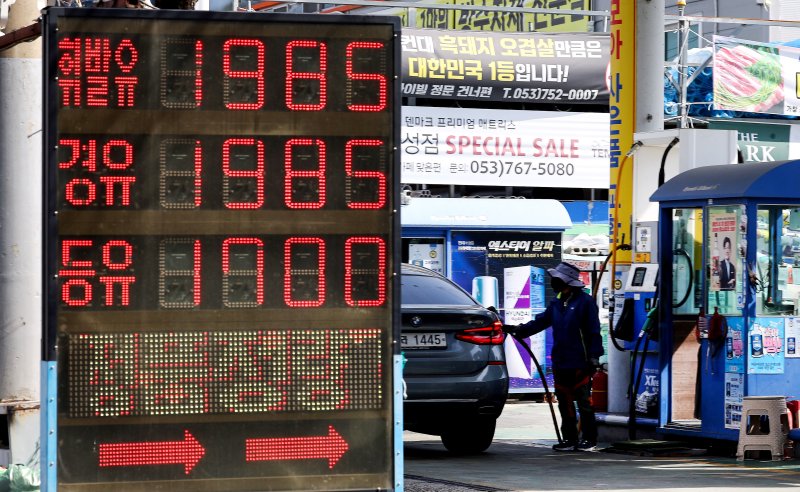
According to Opinet, the oil price information service run by Korea National Oil Corporation (KNOC), the average retail gasoline price at gas stations nationwide stood at 1,889.40 won per liter as of the 7th. Compared with 1,692.9 won on February 28, that is a jump of nearly 200 won in just one week. In Seoul, the average has already climbed past 1,941.71 won, effectively threatening the psychologically important 2,000-won threshold.
The chronic "asymmetry" in how domestic fuel prices are formed has once again come under fire. Korea’s four major refiners—SK Innovation, GS Caltex, S-Oil, and HD Hyundai Oilbank—operate a system that immediately reflects changes in Singapore spot prices in their domestic supply prices. When international oil prices rise, they raise prices right away, citing higher inventory values and opportunity costs. But when prices fall, they routinely slow the pass-through, pointing to stocks purchased at higher prices. This recurring pattern has fueled public criticism that prices go up "at the speed of light" but come down "like a turtle."
The exchange rate is also adding upward pressure. Because crude oil is settled in U.S. dollars, a weaker won directly pushes up import costs. Recently, international oil prices have been rising at the same time as the dollar has strengthened, rapidly increasing Korean refiners’ cost burden.
The government has extended its fuel tax cut measures through April in an attempt to respond, but with global oil prices hovering around 100 dollars per barrel and tax revenue shortfalls mounting, questions are growing over how effective the policy can be. The Ministry of Trade, Industry and Resources (MOTIR) is reportedly reviewing a price cap scheme ordered by President Lee Jae Myung.
Japan keeps prices in the mid-1,400-won range... subsidies act as a breakwater
Japan, often described as an "energy island," has managed to hold the line with a relatively stable price trend.
According to the latest data (as of March 7) from gogo.gs, a real-time gasoline price comparison site in Japan, the nationwide average price for regular gasoline was 156.4 yen per liter, or about 1,471.86 won. That is an increase of roughly 2.4 yen (about 22.59 won) from the previous week. Over the same period, Korea’s gasoline price increase was more than nine times larger than Japan’s.
The key to Japan’s price stability lies in the government’s gasoline subsidy scheme. The Ministry of Economy, Trade and Industry (METI) operates a "fuel price mitigation program" designed to curb wholesale price increases. Under this program, when international oil prices spike, the government pays subsidies to refiners to limit the rise in consumer prices. Despite the surge in import costs caused by the war, Tokyo has poured in massive fiscal resources to create an artificial buffer zone. Observers say these subsidies have acted as a breakwater against price spikes, naturally spreading the cost burden across households and businesses.
Differences in tax structures also play a role. In Korea, gasoline prices include a transportation, energy and environment tax, an education tax, and value-added tax, adding up to about 700 won in taxes per liter. Japan also levies a gasoline tax, local taxes, and a consumption tax, but government subsidies partially offset the tax impact and help minimize price increases.
At the same time, there are growing concerns that maintaining multi-trillion-yen subsidies amid an unprecedentedly weak yen will place severe strain on Japan’s public finances. In fact, the sustainability of Japan’s fuel subsidy policy has already become a subject of ongoing debate domestically.
Hormuz shock sends industry into distress
Recently, war-risk insurance premiums for tankers passing through the Strait of Hormuz have soared to as much as 12 times their pre-war level, from 0.25% to 3%.
Bob McNally, president of energy consulting firm Rapidan Energy Group, warned in an interview, "A prolonged blockade of the Strait of Hormuz has the power to push international oil prices above 150 dollars per barrel in one leap," adding, "If that happens, the energy security systems of Northeast Asian countries will face a fundamental test."
Soaring oil prices are no longer just numbers on gas station price boards; they are taking direct aim at the core export industries of both Korea and Japan. The airline sector, where fuel accounts for more than 30% of costs, has been hit first and hardest. Flag carriers such as Korean Air and Japan Airlines (JAL) have raised fuel surcharges to record levels, but this is already dampening travel demand and sharply eroding profitability. Yuji Saito, vice president of JAL, voiced deep concern, saying, "If the rise in oil prices continues, the burden of fuel costs will be devastating for our profitability."
The petrochemical industry is also on high alert. As naphtha prices extracted from crude oil have surged, operating rates at basic materials production lines have slumped below 70%. This is driving up production costs across the broader manufacturing sector downstream in the supply chain.
In addition, rising diesel prices are pushing up freight transport costs and acting as a detonator that accelerates inflation across consumer prices, from fresh food to everyday goods.
Governments are now toying with the option of releasing strategic oil reserves in coordination with the International Energy Agency (IEA). Japan currently holds reserves equivalent to about 150 days of consumption, while Korea has around 100 days’ worth, giving both countries a last line of defense in the event of a physical supply disruption.
However, some experts argue that while releasing reserves may provide temporary psychological relief to markets, it is ultimately only a stopgap unless the underlying supply chain is restored.
[email protected] Kim Kyung-min Reporter