"I Spend 200,000 Won on Weddings and Funerals Every Weekend, My Wife Is Fed Up"... If You Don’t Earn a Penny, Why Live Like That? [Retiree X’s Plan]
- Input
- 2026-03-21 08:30:00
- Updated
- 2026-03-21 08:30:00
[Financial News] "For a while after I retired, I was really busy. There were so many invitations and so many places to go. It hardly felt any different from when I was still at the company."Recalling his first year of retirement, Lee Dong-cheol (pseudonym, 59), who lives in Seoul, described it this way. Calls came in from school reunions, workplace alumni groups, and hometown associations. He felt grateful to the friends who kept inviting him. "So I’m not someone people have already forgotten," he thought. Even without the company name on his business card, he still felt he belonged among people. He felt alive. He kept up this lifestyle for nearly a year.
Then one day, as he looked over his schedule, a strange sense of emptiness crept in. He still had plenty of appointments, but he found himself wondering, "How many of these gatherings do I actually want to attend?"After much reflection, he concluded that although he met many people, there were oddly many days when he felt empty. So he cut the number of gatherings he attended to less than half.When people talk about relationships after retirement, they usually focus on one concern: that the number of people around them will shrink. In reality, after leaving work, calls often decrease and social gatherings tend to fade quickly.
But the problems retirees face in real life are more complex. They fear losing relationships, yet they also find it burdensome to maintain them. That is why experts say you need to redesign your social life after retirement.
Can you really maintain 150 close contacts?
So how many relationships can a person realistically maintain?
A concept that often comes up when explaining human relationships is "Dunbar's number."
Robin Dunbar, an anthropologist at the University of Oxford,explained that humans can stably maintain social relationships with about 150 people.This figure comes from research comparing primates’ brain size with the size of their social groups. Put simply, there is a limit to how many relationships the human brain can manage.
Dunbar also explained that human relationships are not a single number, but are structured in layers.
△ Core circle: about 5 people: people who are emotionally deeply connected, such as a spouse, immediate family, or your closest friends.
△ Close circle: about 15 people: close friends or relatives you contact frequently and see on a regular basis.
△ Friendly circle: about 50 people: acquaintances you meet from time to time or occasionally exchange greetings with.
△ Social circle: about 150 people: people whose faces and names you know and who recognize you in return.
Your phone may store hundreds or even thousands of contacts, but Dunbar’s explanation is that truly meaningful relationships fit within this layered structure.
On average, people have 4.1 close contacts
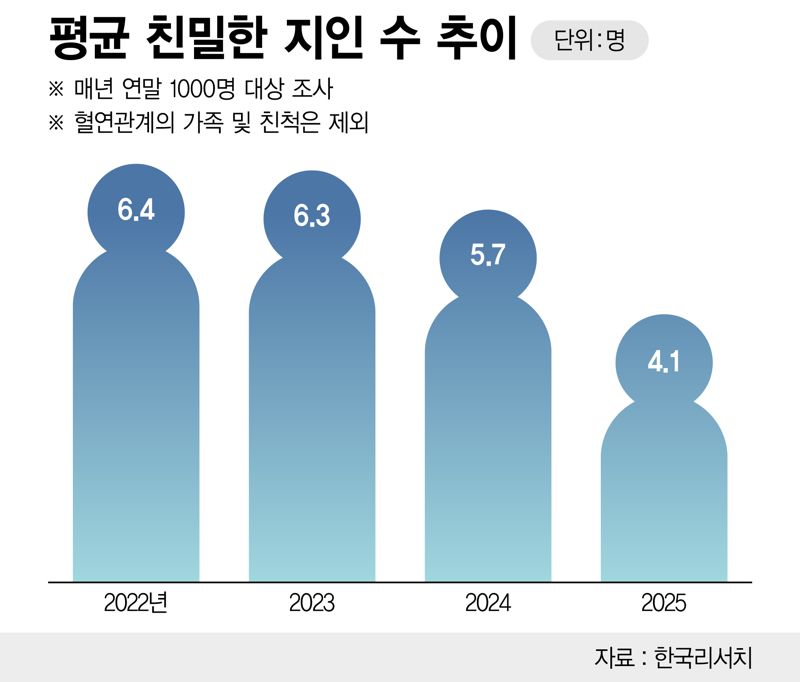
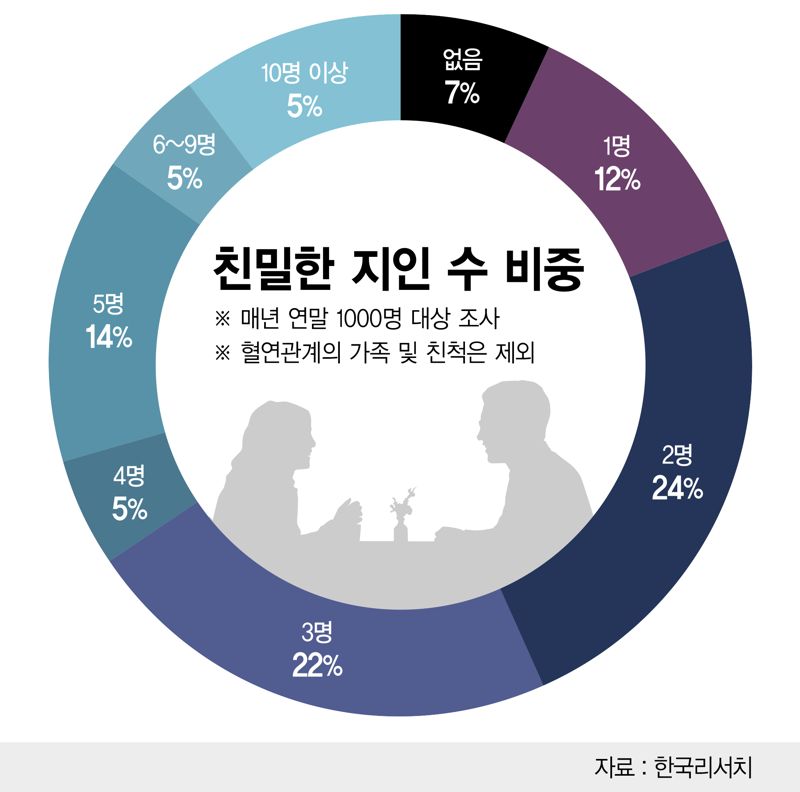
According to data released late last year by Hankook Research, as of 2025the average number of "close contacts" was 4.1, the lowest level on record.it said.
The figure has continued to decline, from 6.4 in 2022 to 6.3 in 2023 and 5.7 in 2024. "Close contacts" were defined as people with whom you can share personal, in-depth conversations and ask for help in difficult situations, excluding family and relatives by blood.
However,satisfaction with personal relationships rose to 6.4 points, up from the previous year,and the share of respondents who said they were satisfied increased by 7 percentage points to 68%. Even though the number of contacts decreased, satisfaction went up. This suggests that the quality of relationships has become more important than the quantity.
Fewer in number, but relationships become clearer
It is a natural change for one’s social circle to shrink after retirement.While you are employed, most of your relationships are formed on the platform of the workplace: colleagues, seniors and juniors, meetings and dinners with clients. Work creates relationships and keeps them going almost automatically.
But that structure disappears the moment you retire. Your title is gone, and the shared topic of work vanishes, so the people you used to meet naturally also begin to fade from your life.
Jung Soondul, a professor of social welfare at Ewha Womans University, said, "It is a natural change that social relationships formed around the workplace decrease after retirement," adding, "At this stage, rather than relying only on existing relationships, it is important to make an effort to form and maintain new social ties."
The reasons relationships feel burdensome after retirement are not simple. While you were working, the costs of maintaining relationships—such as company dinners or attending colleagues’ weddings and funerals—were accepted as part of the job.
After retirement, however, the situation changes. The cost of gatherings, cash gifts for weddings and funerals, travel time, and even emotional energy all become your personal responsibility. Many retirees come to feel this new reality as the "cost of maintaining relationships."
In the past, meeting people was simply part of social life. After retirement, it becomes a conscious choice.
The problem is that, at this point, many people swing to one of two extremes.
On one side are those who are so afraid of losing people that they force themselves to maintain every relationship. On the other are those who cut off most ties and end up isolated. In the end, some become exhausted from keeping up relationships they do not really want, while others withdraw and start avoiding people altogether.What is needed in relationships after retirement is a balance between these two extremes.
In fact, quite a few retirees deliberately streamline their social circles.
Song Jung-hyun (pseudonym, 60), who lives in Daejeon, recently cleaned up the contacts on his mobile phone. His rule was simple: any number he had not contacted in the past six months was a candidate for deletion. At first he hesitated, thinking, "What if I need to call this person someday?"
But when he actually looked through the numbers, he realized there were many people he was unlikely to ever call again.“Even cutting down the number of contacts is work,” Song said. “I used to think that having a lot of phone numbers meant I had a wide network. But when I tried to sort them out, I realized there weren’t that many people I actually stay in touch with.”
Relationships to cut, relationships to keep
The most important question when reorganizing your relationships after retirement is this: "Does meeting this person give me energy, or does it drain me?" If you sort your relationships by this standard, the picture becomes surprisingly clear.Relationships you can afford to reduce usually have the following traits.△ Relationships maintained mainly out of a sense of obligation△ Groups you belong to only as part of a collective, without any real personal closeness△ Relationships where you are always the one who initiates contact and takes care of everything△ Relationships that leave you feeling very tired after each meetingConversely, there are relationships you should definitely keep after retirement.△ People you can call when you are sick or in trouble△ People with whom you can regularly exchange greetings and check in△ People who share hobbies or activities with you△ People, outside of family, with whom you feel an emotional bondAfter retirement, the key criterion for relationships is not breadth but sustainability.
After retirement, "activity-based relationships" last longer
The best way to maintain relationships after retirement is to build ties around doing something together.That is, relationships centered on shared activities.
When you have common activities—such as hiking, reading, exercising, or volunteering—the reason to meet arises naturally.
You never run out of things to talk about. This is why activity-based groups tend to last longer than simple social clubs.That is, relationships centered on shared activities.
In fact, a common trait among people who report high life satisfaction after retirement is that they belong to at least one activity-based group.
Relationships where you walk together, learn together, and move together tend to continue naturally.
Relationships are also a portfolio
When we talk about preparing for retirement, we usually think of money first—pensions, investments, and living expenses.
Butmoney alone does not determine how satisfied you will be with life after retirement.Who you spend your time with matters just as much. Like financial assets, relationships also need a portfolio.Professor Jungsaid, "Relationships are like a kind of 'relationship account'—if you don’t steadily make deposits over time, you won’t have anything to draw on when you need it,"and emphasized, "It is important to keep meeting people and managing your relationships in preparation for life after retirement."
Kang Eun-young, a research fellow at the Institute for the 100-Year Life Era, said, "According to the 'social convoy model' (convoy model) proposed in 1980, an individual’s interpersonal relationships can be described as three concentric circles—an inner circle, a middle circle, and an outer circle." She explained, "The inner circle includes the closest people, such as a spouse or children; the middle circle includes close friends, neighbors you see often, and colleagues; and the outer circle encompasses broader relationships, such as club members or friends on social media." She went on, "After retirement, the role of the inner circle becomes especially important, but to enhance life satisfaction, you also need to actively expand and maintain your middle and outer circles. It is worth reflecting on who makes up your current 'convoy' and thinking about how you will sustain meaningful relationships even after you retire."
The key question about relationships after retirement is not "How many more people can I meet?" but rather "Which people do I want to keep in my life?"
Some experts also advise building new relationships before you retire. After retirement, there are fewer opportunities to form new ties, and doing so requires more energy. In the end, it is important to invest in the relationships you want to keep while you still can.
The old equation "retirement = exit" is breaking down. In an era when average life expectancy is 83, and Generation X is entering full-scale retirement, the very concept of retirement is being redefined. [Retiree X’s Plan] brings you stories of their "second act" in life every Saturday morning. If you subscribe to the reporter’s page, you can receive it more conveniently.
[email protected] Kim Ki-seok Reporter