‘Gasoline Prices Near 2,000 Won’... Government Weighs First Price Ceiling in 30 Years
- Input
- 2026-03-08 10:58:44
- Updated
- 2026-03-08 10:58:44
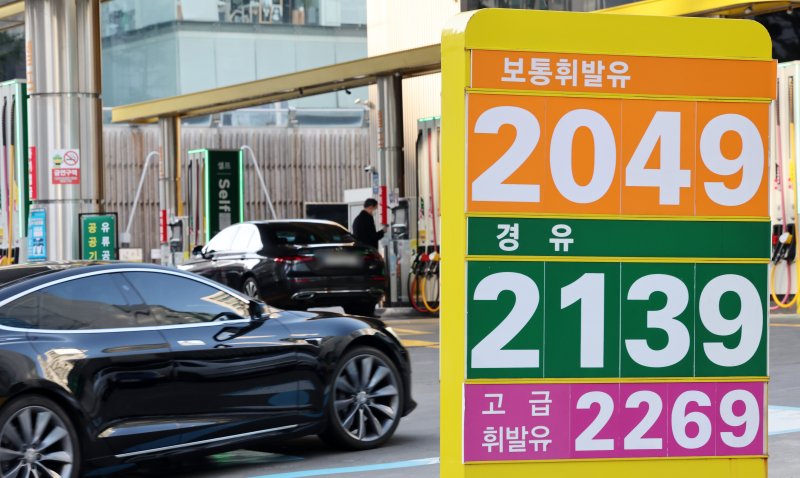
According to government sources on the 8th, officials began reviewing the drastic option of a "maximum price system" because the sharp rise in international oil prices was reflected in domestic petroleum product prices almost immediately, without the usual two-week time lag.
On March 5, President of the Republic of Korea Lee Jae Myung presided over an extraordinary meeting of the State Council of South Korea at Cheong Wa Dae (the Blue House) and ordered a review of setting maximum prices for petroleum products, saying, "There has been no serious disruption in fuel supply, yet suddenly gasoline prices at gas stations have skyrocketed."
The next day, at a senior presidential aides’ meeting at Cheong Wa Dae, the President of the Republic of Korea added, "We must respond very strictly and firmly to antisocial wrongdoing that seeks to exploit the community’s hardship by charging exorbitant fuel prices and reaping unjust windfall profits like a rip-off."
Following the president’s instructions, the government moved immediately into a full-scale response. From March 6, a pan-government joint inspection team began intensive crackdowns on unfair practices such as illegal oil distribution, hoarding, and the sale of fake or blended fuels.
The Korea Fair Trade Commission (KFTC) is investigating whether gas stations have engaged in price collusion, and the Ministry of Justice has instructed the Supreme Prosecutors' Office of the Republic of Korea (SPO) to respond strongly to price-fixing and other market-disrupting behavior. The Ministry of Finance and Economy is reviewing whether to cut fuel taxes. In addition, the government decided to urgently import more than 6 million barrels of crude oil from the United Arab Emirates (UAE) to help stabilize energy supplies.
Under mounting pressure from the government, three major oil-related organizations—the Korea Petroleum Association, whose members include the four domestic refiners; the Korea Oil Distribution Association, which represents oil distributors; and the Korea Oil Station Association, representing gas station operators nationwide—announced on March 6, "We will cooperate to ensure that increases in international oil prices are not reflected too abruptly in gas station prices."
Despite all these measures, the upward trend in fuel prices at domestic gas stations has not been easily contained.
According to Opinet, as of 11 p.m. on March 7 the nationwide average gasoline price at gas stations was 1,890.87 won per liter. In Seoul, which has the highest fuel prices in the country, the average price has already surpassed 1,900 won, reaching 1,942.08 won.
Although the pace of increase slowed somewhat from the previous day, international crude prices have climbed above 90 dollars per barrel, intensifying upward pressure on domestic fuel prices. Some observers say the country is now on the verge of entering an "era of 2,000-won gasoline."
In response, the government has begun practical reviews for issuing a public notice designating maximum prices for petroleum products, based on Article 23 of the Petroleum and Alternative Fuel Business Act.
[email protected] Kim Hyun-jung Reporter