Exclusive: ‘Legal elites’ leave the police after an average of 4 years and 7 months, eightfold increase in five years
- Input
- 2026-03-08 13:59:01
- Updated
- 2026-03-08 13:59:01

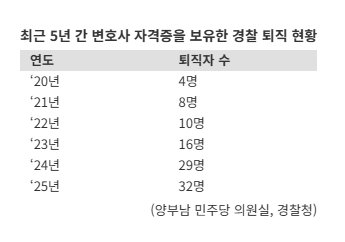
According to The Financial News, as the Korean National Police Agency (KNPA) considers expanding support for active-duty officers to attend Law School (law school), the number of police officers with lawyer qualifications leaving the organization has been rising rapidly. In the context of expanded investigative powers, securing legal expertise is seen as unavoidable, but critics warn that without resolving workload imbalances and personnel management issues, the outflow of specialized talent will continue.
According to data titled “Retirement status of police officers holding lawyer qualifications over the past five years,” submitted by the KNPA to Yang Bu-nam of the Security and Public Administration Committee in the National Assembly on the 8th, the number of officers with lawyer qualifications who left the force increased from 4 in 2020 to 32 last year—an eightfold jump in five years. Since 2020, a total of 99 such officers have resigned.
In particular, the average length of service from the date they obtained their lawyer qualification (or from their date of appointment for those who qualified beforehand) to retirement was just 4 years and 7 months for those who left after 2020. In other words, the data confirm that legal professionals recruited to strengthen investigative expertise are leaving the organization in less than five years on average.
As of December last year, there were 286 police officers with lawyer qualifications. Of these, 201—about 70%—entered through the career lawyer recruitment system in the Korean National Police Agency. Seventy-six were graduates of the Korean National Police University, eight passed the former national bar exam, and one joined through the regular inspector recruitment track.
The career lawyer recruitment system in the Korean National Police Agency, introduced in 2014, hires lawyers with at least two years of legal experience and appoints them at the rank of inspector. The aim was to strengthen the organization’s capacity for legal review and enhance investigative capabilities in major cases. However, given the short average tenure and ongoing outflow, critics argue that the system is functioning less as a way to cultivate long-term specialists and more as a short-term career stepping stone.
The KNPA’s policy push to expand support for law school attendance is also drawing controversy, as it is intertwined with these structural problems. Since prosecutorial investigative powers were curtailed, leading to a concentration of special and serious crime investigations within the police, the agency has emphasized strengthening legal expertise as a key priority.
In line with this, the KNPA increased the number of hires through the career lawyer recruitment system from 30 to 40 this year. It is also reviewing a plan to extend the maximum period of study leave for law school from the current two years to three.
However, many question whether extending study leave will truly enhance expertise when even those who already hold lawyer qualifications are not staying long term. Skeptics warn that, instead of strengthening the organization, the police could effectively become a feeder academy for law schools.
On the ground, officers point to both the heavier workload since the 2021 reallocation of investigative authority between prosecutors and police and the relatively low level of compensation as key reasons why lawyer-qualified officers are leaving. At the same time, law firms increasingly favor lawyers with police investigative experience and strong networks within the force, which analysts say further boosts the likelihood of career moves out of the organization.
Experts advise that, alongside improving pay and working conditions through stronger incentives, institutional safeguards such as temporary employment restrictions in related fields should also be introduced. The current Public Service Ethics Act restricts post-retirement employment in the private sector and requires screening to prevent collusive ties between former officials and companies, but it applies only to senior civil servants at grade 4 or above and police officers at the rank of senior superintendent or higher.
By contrast, many police officers with lawyer qualifications hold the rank of inspector, having entered through the career lawyer recruitment system, which has raised concerns about a regulatory blind spot. In fact, of the 286 officers with lawyer qualifications, 222—about 78%—are inspectors or senior inspectors who are not covered by the Public Service Ethics Act.
Professor Shin I-cheol of the Department of Police Science, Wonkwang Digital University, said, “Police inspectors face no restrictions when moving to law firms or legal offices after retirement,” adding, “To prevent an outflow of investigative talent, we need explicit rules that can limit cases where they move directly to law firms immediately after leaving the force.”
Others suggest that reforming organizational culture and improving personnel and posting systems so that officers with lawyer qualifications can fully utilize their expertise should also be considered. Professor Lee Keon-su of Baekseok University’s Department of Police Administration noted, “To be recognized as an expert in a given field, you generally need at least five to ten years of experience,” and stressed, “There needs to be a clearly defined mandatory service period of around seven years for police officers who hold lawyer qualifications.”
The KNPA says it plans to continue institutional reforms aimed at easing investigators’ workloads and improving compensation. A KNPA official stated, “We are continuously working to increase the number of investigative personnel and expand funding for investigative activities,” and added, “We are reviewing a range of measures to improve overall working conditions for investigators.”
[email protected] Kim Ye-ji and Jang Yu-ha Reporter