Probability of ‘Clarity Act’ Passage Rises Above 70% After Trump Push [Crypto Briefing]
- Input
- 2026-03-06 16:14:33
- Updated
- 2026-03-06 16:14:33
[Financial News] Bitcoin, which had been shaken by geopolitical risks stemming from Iran, has settled back above the $70,000 level after President Donald Trump urged action on the Digital Asset Market Clarity Act (the "Clarity Act"). As Trump criticized banks for undermining the intent of the Clarity Act and pressed for the bill’s passage, expectations that regulatory uncertainty will ease have revived investor sentiment.
On the 6th, data from Investing.com showed that Bitcoin’s price had plunged to as low as $63,068.70 during trading on the 28th of last month, when anxiety peaked amid airstrike-related noise. However, once Trump’s support for the legislation became clear this month, the price turned sharply higher. On the 4th in particular, Bitcoin jumped 6.51% in a single day to $72,768.70, attempting to break its previous all-time high. On the day of reporting, profit-taking emerged, and the price entered a short-term consolidation around $70,310.80.
The market’s rebound momentum has been driven by strong legislative will in the political arena. On the 4th (local time), shortly after a closed-door meeting with Coinbase CEO Brian Armstrong, President Trump took to his personal social media and criticized banks, which are posting record profits, for undermining the crypto agenda and holding the Clarity Act "hostage."
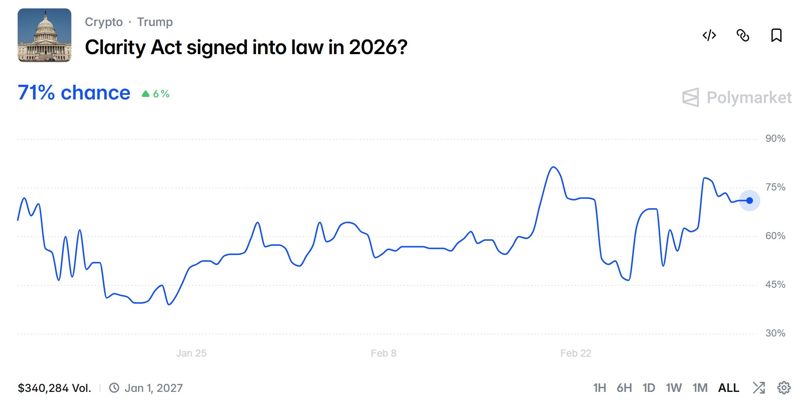
His remarks immediately fueled expectations that the bill would pass. According to NH Investment & Securities, the probability that the Clarity Act will be enacted within this year has climbed to 71%, based on Polymarket data. Hong Sung-uk, a researcher at NH Investment & Securities, analyzed, "Behind President Trump’s criticism of banks and his decision to side with digital assets are multiple motives: his desire to leave a digital-asset legislative achievement within his term, his business interests through World Liberty Financial, and his experience of being sidelined by banks after the 2020 presidential election."
The biggest sticking point blocking passage of the Clarity Act is whether to allow yield-sharing by stablecoin issuers. Traditional banks, including JPMorgan CEO Jamie Dimon, argue that interest-bearing stablecoins should be subject to the same regulations as bank deposits and insist that all forms of interest payments be banned.
The Trump administration, by contrast, contends that stablecoins are not deposits and cannot be subject to bank regulation because their reserves cannot be lent out, and it has been defending the industry’s position. Yang Hyun-kyung, a researcher at iM Securities, stated, "If the Clarity Act passes within this year, regulatory uncertainty over issuance, distribution, and reward structures will ease, which should encourage inflows of institutional capital and greater participation by service providers," adding, "Major institutions such as JPMorgan expect the bill to win final approval in the first half of this year."
Policy expectations are already translating into tangible improvements in supply and demand. Between the 26th of last month and the 4th of this month, U.S. Bitcoin Spot Exchange-Traded Funds (Bitcoin Spot ETFs) saw a total net inflow of $1.37 billion, or about 1.8 trillion won.
Hwan-uk Lee, a researcher at Yuanta Securities Korea, noted, "The digital asset market now appears to have entered a phase where prices are more sensitive to positive news than to negative factors," and added, "This can be interpreted as a strong signal that additional downward pressure from current price levels may not be significant."
[email protected] Kim Mi-hee Reporter