Government to import 7 million U.S. eggs as it pulls out all the stops to curb food prices
- Input
- 2026-03-06 14:31:05
- Updated
- 2026-03-06 14:31:05
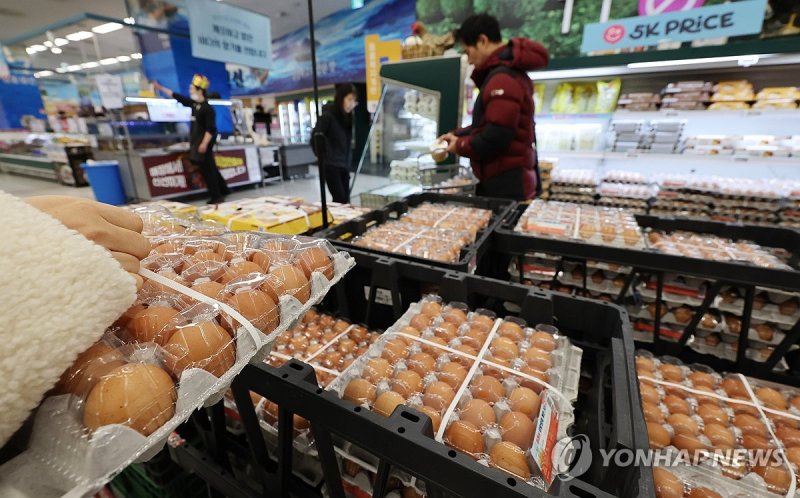
According to Financial News, economic authorities are going all out to rein in food prices for everyday staples such as eggs, mackerel, and pork, whose prices have surged. While continuing government-funded discount campaigns, they are also sharply increasing imports of certain items like eggs and releasing them into the market. At the same time, the government plans to use every available tool to strictly crack down on hoarding, price collusion, stealthy price hikes, unfair trade practices, and market distortions. The Government-wide Task Force for Oil Market Inspection has launched a special investigation into fuel prices and possible collusion at gas stations nationwide.
On the 6th, Lee Hyoung-il, first vice minister at the Ministry of Economy and Finance (MOEF), chaired the third joint session of the Vice Ministers’ Meeting on Prices and the Policy Support Fraud Inspection Team. He said, "Upward pressure on some food prices continues, and volatility in international oil prices has increased recently due to the situation in the Middle East," and called on relevant ministries to "do everything possible to stabilize prices and supply and demand for each item."
In particular, Lee criticized gas stations that have sharply raised consumer prices by taking advantage of the recent turmoil in the Middle East. He said, "The government will make every effort to quickly stabilize petroleum prices through measures such as investigating the actual state of fuel prices and designating maximum retail prices for petroleum products."
At the meeting, officials from the Ministry of Agriculture, Food and Rural Affairs (MAFRA), the Ministry of Oceans and Fisheries (MOF), the Ministry of Trade, Industry and Resources (MOTIR), the Ministry of Data and Statistics (KOSTAT), and other related agencies discussed February consumer price trends, item-by-item price movements for petroleum products, and policy responses.
The government plans to closely monitor supply and demand conditions for petroleum products and to encourage restraint in price hikes so that there are no excessive increases taking advantage of heightened external uncertainty.
In addition, the Ministry of Trade, Industry and Energy of the Republic of Korea and the Korea Fair Trade Commission (KFTC), together with other relevant ministries, are conducting special inspections to eradicate the sale of fake fuel and the distribution of illegal petroleum products.
To stabilize food prices, the government is supporting discounts of up to 50% on major agricultural, livestock, and fishery products such as eggs, mackerel, and dried seaweed. Using producer-funded programs, it is also running discount events of up to 45% for onions and 50% for pork.
In the case of eggs, following the supply of 2.24 million fresh eggs imported from the United States in January and February, the government imported an additional 1.12 million eggs on this day, which will be distributed domestically starting next week. Egg prices in February were 7.3% higher than a year earlier.
To prepare for increased demand from school meal programs in the new semester and the Easter peak season, the government will import an additional 3.59 million eggs in March and April.
On the same day, the government announced that consumer prices in February rose 2% year-on-year. Although inflation has remained in the "2% stability range" for two consecutive months, prices for some agricultural and livestock products and for certain personal services have risen sharply, creating a large gap with the public’s perceived level of inflation.
[email protected] Jung Sang-geun Reporter