February Consumer Prices Up 2%, but Rental Cars Jump 37% and Rice 18%
- Input
- 2026-03-06 11:11:43
- Updated
- 2026-03-06 11:11:43
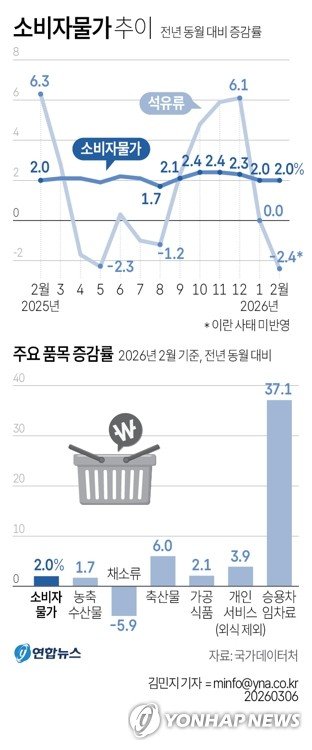
According to Financial News, consumer prices in February were up 2.0% compared with the same month a year earlier, the same rate as in January (2.0%). After a 2.4% increase in October last year, inflation eased and has now stayed at 2.0% for two consecutive months.
However, because travel, accommodation and rental car costs rose steeply, the inflation that households actually feel is far above "2%." Passenger car rental fees, especially rental cars on Jeju Island, surged 37.1%, the highest increase on record. Rice, a staple that represents everyday living costs, rose 17.7% from a year earlier, and pork was up 7.3%. Insurance service fees also jumped 14.9%. The sharp rise in gasoline prices due to the situation in the Middle East is expected to be reflected in next month's inflation. The government views an annual inflation rate of 2.0–2.1% as the stability range.
According to the February consumer price trends released by KOSTAT on the 6th, last month's consumer price index stood at 118.40 (2020=100), up 2.0% from a year earlier. This is the same as in January. The year-on-year increase in consumer prices slowed from 2.4% in October and November last year to 2.3% in December and 2.0% in January.
The core inflation index, which excludes volatile food and energy prices, rose 2.3% year-on-year. The living cost index, which covers items that account for a large share of household spending, increased 1.8%.
The government analyzed that overall inflation was held down by a 1.4% drop in agricultural product prices last month, thanks to Lunar New Year discount programs, the release of stockpiled supplies, and favorable weather conditions.
International oil prices also fell, pushing down domestic prices of petroleum products such as gasoline, diesel and automotive LPG by 2.4% last month. This was the first decline in six months since August (-1.2%) and the largest drop since November 2024 (-5.3%). However, because of a surge in global oil prices triggered by the conflict between the United States and Iran, prices are expected to rise sharply again in March.
Electricity, gas and water rates have been steadily increasing, with tap water charges up 2.3% from a year earlier.
Food prices rose 2.5%, a slower pace than in January (2.8%) but still a relatively large increase. Processed foods such as bread and instant noodles were up 2.1%, and dining-out prices climbed 2.9%.
Lunar New Year discount events, a 2.4% month-on-month cut in flour prices, and investigations into collusion related to essential consumer prices helped slow the pace of increases compared with January's 2.8%. Sugar prices rose just 0.4% last month, narrowing the increase, while flour prices fell 0.6%.
By contrast, prices for everyday items and services rose more sharply, including food and accommodation (3.0%), food and non-alcoholic beverages (2.1%), other goods and services (5.1%), and household goods and housekeeping services (2.5%).
In particular, prices for personal services increased 3.5%, the largest rise since January 2024, when they also climbed 3.5%.
Lee Doo-won, director-general for economic trend statistics at KOSTAT, said, "The increase in personal service prices widened to 3.5% last month from 2.8% in January," and explained, "The main reason was a sharp rise in travel and accommodation charges during the Lunar New Year holidays."
Within the personal services category, passenger car rental fees, led by rental cars on Jeju Island, jumped 37.1%. This is the largest increase since related statistics began in 1995. Overseas package tour prices rose 10.1%, and hotel room rates climbed 12.8%. Insurance service fees increased 14.9%, and private university tuition was up 5.3%.
This surge in service costs was a major factor driving up last month's inflation. The government recently announced a crackdown on price gouging, pledging to immediately suspend the business licenses of restaurants, lodging facilities, rental car companies and taxi operators caught overcharging. Critics, however, say the response has come too late.
Due to higher import prices for raw materials caused by a weak won, and shortages of key components, basic cosmetics rose 9.4% and computers 10.8%. Coffee prices also increased 7.0%. As New Year demand picked up, prices for sporting goods climbed 14%.
Housing rents continued to rise as well, with monthly rents up 1.1% and lump-sum deposit leases (jeonse) up 0.7%.
The fresh food price index fell 2.7% from a year earlier. Prices of tangerines and cabbage dropped more than 20%.
However, egg prices rose 7.3% as shipments declined due to the spread of highly pathogenic avian influenza (AI) and other infectious diseases. Pork prices increased 7.3%, domestic beef 5.6%, and mackerel 9.2%, adding to the burden on ordinary households' dining tables. Overall, livestock product prices rose 6.0% last month, the highest increase in six months since August last year (7.1%).
The upward trend in rice prices, a staple food for Koreans, is also continuing. The government has been increasing rice supply to stabilize prices, but the double-digit year-on-year rise has yet to ease. Min Kyung-shin, head of the price policy division at the Ministry of Economy and Finance (MOEF), said, "Within this month, we will release 100,000 tons of rice into the market through a rental scheme, and depending on market conditions, we plan to supply up to an additional 50,000 tons."
At the same time, the government is closely examining possible collusion and profiteering in fuel prices, taking advantage of the war between the United States and Iran.
Koo Yun-cheol, Deputy Prime Minister and Minister of Economy and Finance, said, "Starting today, a joint government inspection team will visit gas stations nationwide to conduct a full-scale inspection of the outrageous profiteering in petroleum prices such as gasoline," and added, "If we find violations of the law, we will take the toughest possible measures under a zero-tolerance principle."
[email protected] Jung Sang-geun Reporter