Ruling party and government to fully review price ceiling system on petroleum products, push 'Three Foreign Exchange Stabilization Bills'
- Input
- 2026-03-06 10:20:35
- Updated
- 2026-03-06 10:20:35
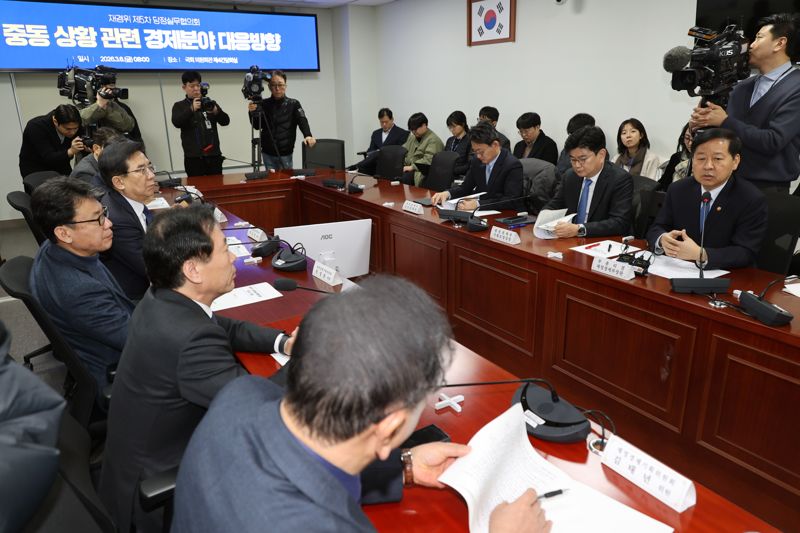
[Financial News] The Democratic Party of Korea and the Ministry of Economy and Finance (MOEF) met on the 6th to discuss how to respond to the impact of the Iran war on the Korean economy. In particular, they began in-depth review of introducing a price ceiling system on petroleum products by fuel type and by region, in order to prevent profiteering by some gas stations that have raised prices for gasoline and other petroleum products since the outbreak of the war involving Iran. They also plan to push ahead with the so-called "Three Foreign Exchange Stabilization Bills" to curb the surging exchange rate.
The ruling party and the government held a working-level meeting at the National Assembly of the Republic of Korea that day to discuss economic response measures to the situation in the Middle East. The main agenda item was the introduction of a price ceiling system on petroleum products.
Jeong Tae-ho, a Democratic Party lawmaker who serves as the party’s secretary on the Planning and Finance Committee of the National Assembly of the Republic of Korea, said, "President Lee Jae-myung has said that the government must respond firmly to attempts to exploit a national crisis for personal gain by raising fuel prices." He added, "If the government informs us of its measures in that regard, the party will also provide support."
In response, Deputy Prime Minister for Economic Affairs and Minister of Economy and Finance Koo Yun-cheol stated, "A joint government task force is visiting gas stations in person to conduct a full inspection of the sudden and outrageous profiteering in prices of gasoline and other petroleum products, and is monitoring the situation, including the circumstances of profiteering and other hoarding." He continued, "If any violations of the law are found this time, we are determined to take the strongest possible measures under a zero-tolerance principle. We will not allow anyone to exploit a national crisis, and in particular people’s livelihoods, to engage in profiteering."
He went on to say, "The Ministry of Trade, Industry and Energy of the Republic of Korea has begun reviewing the designation of maximum prices by fuel type and by region." He added, "If market surveys continue to detect profiteering, we will respond in coordination with the Korea Fair Trade Commission (KFTC) as well. The government expects that the sharp rise in oil prices will normalize in the near term."
After profiteering by some gas stations was detected under the pretext of the Iran war, President Lee Jae-myung and the ruling party–government leadership moved quickly to push for the introduction of a price ceiling system on petroleum products. At a meeting of the State Council of South Korea on the 5th, President Lee said, "There has been no serious disruption to the supply of petroleum products, yet gasoline prices at gas stations have suddenly surged," and ordered officials to "swiftly set realistic maximum prices by region and by type of petroleum product."
Meanwhile, the ruling party and the government are also pushing the so-called Three Foreign Exchange Stabilization Bills to defend against the soaring exchange rate triggered by the Iran war.
Jeong said, "There is an issue with the exchange rate. Three bills aimed at stabilizing the exchange rate have already been submitted to the National Assembly of the Republic of Korea, and the government has requested that the National Assembly handle these bills swiftly."
In response, the Democratic Party of Korea plans to begin full-scale deliberations on the three amendment bills next week, with the goal of bringing them to a plenary session on the 19th.
One of the Three Foreign Exchange Stabilization Bills is an amendment to the Restriction of Special Taxation Act proposed by Jeong. The core of the amendment is to allow personal investors to deduct capital gains tax on overseas stock transactions through a Reshoring Investment Account (RIA). The aim is to bring back funds that were taken out of the country for overseas stock purchases and thereby help stabilize the exchange rate. It is also intended to revitalize the domestic capital market.
An amendment to the Special Rural Development Tax Act is also included among the three bills. This amendment stipulates that the special rural development tax will not be levied on capital gains tax that is reduced under the tax benefits granted to RIAs. The purpose is to ensure efficiency and consistency among different tax incentives.
A third bill is an amendment to the National Pension Act that would allow the National Pension Service (NPS) to issue foreign currency-denominated bonds. The core of the amendment is to expand the ways in which the NPS can secure foreign currency needed for overseas investments. To that end, it specifies measures such as permitting the issuance of foreign currency-denominated bonds, allowing foreign currency borrowing, and promoting the use of foreign exchange swaps (FX swaps).
[email protected] Kim Hyeong-gu Reporter