"Semiconductors Again"... Current Account in January Ranks Fifth All-Time
- Input
- 2026-03-06 09:29:48
- Updated
- 2026-03-06 09:29:48
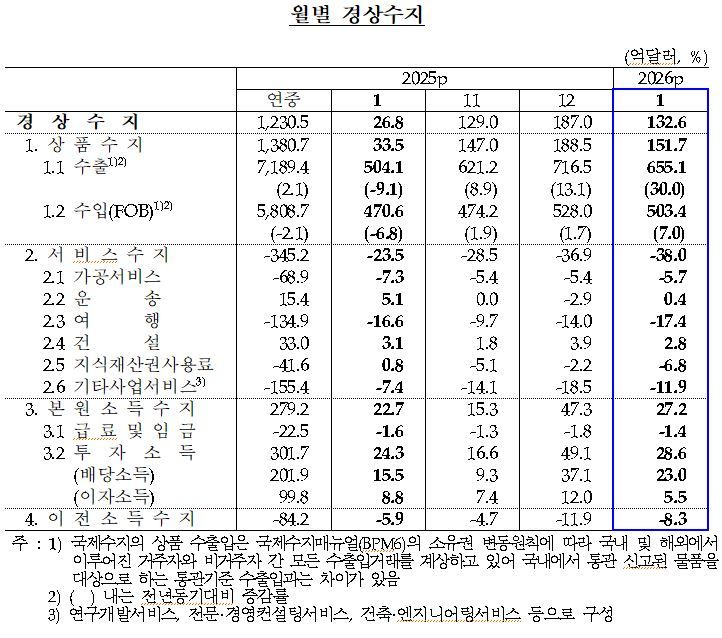
According to the Bank of Korea (BOK) on the 6th, the provisional current account surplus for January 2026 came to 13.26 billion dollars. This represents a decrease of 29.1% (5.44 billion dollars) from December’s 18.7 billion dollars. Even so, in terms of size it is the fifth-largest surplus on record, following June 2024 (13.43 billion dollars). For the month of January alone, it is the largest ever.
In the previous month, buoyant semiconductor exports had pushed the surplus to an all-time high, widening the gap with the second-largest surplus on record (14.22 billion dollars in September 2025) by 4.48 billion dollars.
The current account has remained in surplus for 33 consecutive months. This is the second-longest stretch of surpluses since 2000. Previously, the surplus run had continued for 83 months through March 2019.
The goods balance, which accounts for the largest share of the current account, showed a surplus of 15.17 billion dollars. This is the third-largest surplus on record, though it is 3.68 billion dollars less than the previous month, when the surplus hit a record 18.85 billion dollars. The decline reflects the fading of year-end seasonality, when exports tend to be concentrated.
Exports totaled 65.51 billion dollars, down about 8.6% from December’s 71.65 billion dollars, but up 30.0% from a year earlier. Imports came to 50.34 billion dollars, a decrease of 4.7% from the previous month but an increase of 7.0% year-on-year.
Yoo Sung-uk, Director General of the Financial Statistics Department, Economic Statistics Department, said, "Exports continued to grow as robust information technology (IT) exports persisted and the number of working days increased due to the shift in the Lunar New Year holiday." He added, "Exports expanded mainly in semiconductors and IT equipment, while passenger cars, machinery and precision instruments also grew."
Yoo went on to note, "Imports also increased for the third straight month, as capital goods and consumer goods rose significantly despite falling energy prices."
Regarding the recent surge in international oil and other energy prices following airstrikes on the Islamic Republic of Iran by the United States of America (US) and the State of Israel that began on the 28th of last month, he cautioned, "At this point it is still in the early stages and uncertainty is high, so it is difficult to predict the specific impact."
However, Yoo assessed, "Looking at past cases, when conflicts did not last long, oil prices tended to rise temporarily and then fall, and the impact on the current account was limited." He added, "If the conflict becomes prolonged, though, higher energy prices could push up the value of goods imports and worsen global economic conditions, leading to slower exports and potentially affecting the goods balance."
The services account posted a deficit of 3.8 billion dollars, driven mainly by travel and other business services. Travel (-1.74 billion dollars), other business services (-1.19 billion dollars), charges for the use of intellectual property (-680 million dollars), and manufacturing services (-570 million dollars) all deteriorated. Only construction services, with a surplus of 390 million dollars, remained in positive territory.
The primary income account recorded a surplus of 2.72 billion dollars, led by investment income such as dividend income (2.3 billion dollars) and interest income (550 million dollars), for a total investment income of 2.86 billion dollars. In terms of size, this was about 42.5% smaller than the previous month’s 4.73 billion dollars.
The secondary income account showed a deficit of 830 million dollars.
Direct investment recorded a net increase of 1.7 billion dollars, up 28.8% from December’s 1.32 billion dollars. Outward direct investment by residents rose by 7.04 billion dollars, while inward direct investment by foreigners in Korea increased by 5.34 billion dollars.
Portfolio investment saw a net increase in external assets of 8.78 billion dollars, slightly higher than the 8.69 billion dollars in the previous month. Outward portfolio investment by residents, mainly in equities, increased by 13.46 billion dollars, while inward portfolio investment by foreigners in Korea, centered on bonds, rose by 4.69 billion dollars.
Financial derivatives increased by 1.8 billion dollars, but this was a 29.1% decline from December’s 2.54 billion dollars.
Other investment swung from an increase of 15.66 billion dollars in December to a decrease of 1.82 billion dollars in January. On the asset side, loans fell by 540 million dollars, while on the liability side, other liabilities increased by 1.29 billion dollars.
Reserve assets continued their downward trend, with a reduction of 4.83 billion dollars in January following a decrease of 4.44 billion dollars in the previous month.
[email protected] Kim Tae-il Reporter