"A Door That Opened Only After Death"... What Was Collected at a Solitary Death Site Was a "Broken Safety Net" [Chronicler of the Margins]
- Input
- 2026-03-29 06:00:00
- Updated
- 2026-03-29 06:00:00
Neglected deaths are reported to society in the form of a stench. I joined a specialized cleaning crew at a solitary death site. This report records the reality of labor that goes beyond removing contamination to closing the final chapter of a human life, and it examines the limits of our social safety net. (Editor’s note)
[The Financial News] "The smell is stronger than you might think. Make sure your mask is on tight."
On the 26th of last month, at a semi-basement unit in a multi-family villa in Dongdaemun District, Seoul. The first thing that caught my eye was a low window set almost level with the alley. Below the window, old moisture stains had spread across the concrete wall like blotches. The body had already been removed. The person who spent his final moments in this space was a man in his seventies. The sound of footsteps in the alley seeped faintly through the low window.Specialized cleaning is the work of removing bloodstains, bodily fluids, and the smell of decomposition left at solitary death sites, and of sorting the deceased’s belongings.Unlike ordinary cleaning, it requires special equipment and chemicals, and it blocks sanitary hazards left behind by a neglected death. To document how the final space of someone who died in isolation is cleaned, and to grasp the weight of that labor, I stepped into the site to see and record the reality of these deaths firsthand.
The weight of a "final send-off" carried in a work suit
"You can change into this."
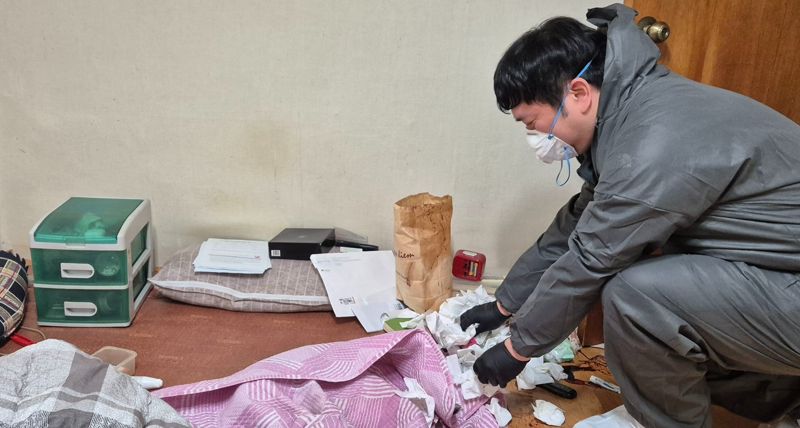
In the narrow entryway, barely wide enough for three or four people to stand, a gear bag was set down. Kim Do-young, head of the specialized cleaning company, took out a gray full-body work suit. I pulled the zipper up to my neck and slipped disposable shoe covers over my shoes. I tightened the elastic bands around my ankles. I put on two layers of gloves and checked that the mask was sealed to my face. The plastic gloves brushed against each other with a dry rustling sound.
"We’ll go into the room now."
Following Kim’s words, I finished getting ready. At the same time, I held a silent moment of respect for the deceased.
When the metal door to the semi-basement room opened, the air trapped inside was pushed out. The moment I stepped over the threshold, the smell seeped through my mask. It was the smell of a space that had not been ventilated for a long time. Dampness and the odors of daily life had settled in the room. Even the thick filter of the mask could not fully block the fishy, heavy stench. It was not just the smell of an old house, but a kind of physical pressure created by the mix of rot and humidity.
Crumpled blankets and cigarette butts: the final traces of a life left in disarray
Kim paused at the doorway and waited for the air inside to flow out. A few seconds later, he slowly stepped into the room.
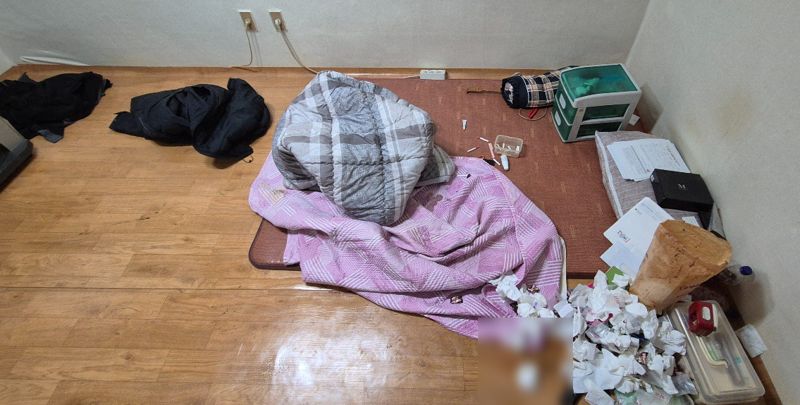
On the floor, a mat and blankets were layered on top of each other. The blankets were crumpled, never fully folded out. Around them, tissues, cigarette butts, and everyday items were scattered.
In the middle of the floor, a darkly discolored mark remained. The stain was concentrated around where the mat had been. The flooring there was darker than the surrounding area, and the surface had risen and roughened. It was the last spot where the deceased had stayed.
We scraped up clumps of tissue and filth stuck to the floor and put them into a bag. Cigarette butts piled in the corners were also gathered into bags one by one. Black bags were laid out beside the floor. Each time a bag rustled, the process of collecting the last hours the deceased had endured alone was repeated.
2,740 won: a final reach toward the world
I paused and looked around the room. The mat, mail, coins, and small household items were still there.
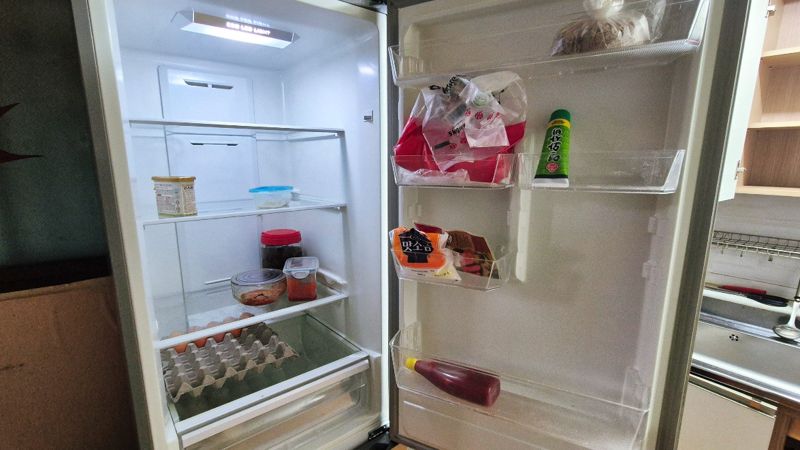
They were traces that someone had once carried on with daily life in this space. Moving toward the wall, I saw a pile of mail. Opened envelopes were mixed with ones still sealed. Next to them, coins were scattered. Several 500-won coins lay among 100-won, 50-won, and 10-won pieces. The total came to 2,740 won.This small amount of money, which he may have held at the very end of his life, might have been his last economic link to the world.I checked the kitchen. Inside the refrigerator, a few eggs and side-dish containers remained.
After one last look around, Kim put the remaining items into bags. When the furniture and belongings were all removed, only the damp air unique to semi-basement rooms was left behind.
No one knew, until the smell seeped beyond the door
The signs of isolation visible in a semi-basement room reveal more than a single person’s story; they show a cross-section of our society. Solitary death is no longer an isolated incident, but a social phenomenon that repeats every year.
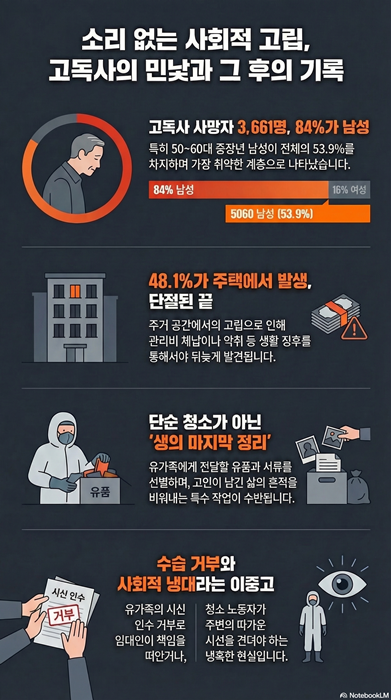
According to the "Survey on Solitary Deaths" released by the Ministry of Health and Welfare in October 2024, there were 3,661 solitary deaths in 2023. That was 102 more than the 3,559 recorded in 2022. By gender, men accounted for 3,053 cases, or about 84% of the total. Men in their 50s and 60s, the middle-aged group, were particularly vulnerable, making up 53.9% of all solitary deaths. This shows that the risk of isolation is concentrated at a stage of life when both economic activity and social networks can weaken at the same time.
Most solitary deaths occurred in private living spaces. Houses accounted for 48.1%, followed by apartments at 21.8%, and studio units and officetels at 20.7%. As a result, many cases are discovered only belatedly, through signs of everyday life such as neighbors’ reports, unpaid maintenance fees, piles of mail, or foul odors. Low windows, unopened letters, and coins left on the floor—like those seen at this site—become traces that reveal long-standing isolation.
Social mourners after death: the doors opened by specialized cleaners
The belongings left behind where a body has been removed are the final records that attest to a person’s life.Specialized cleaning is not just about taking out the trash; it is a process of bringing closure to the deceased’s life.At solitary death sites, the work of organizing the space continues even after the funeral. Specialized cleaning companies often take on this process. Kim explained that the first step is sorting the items. Workers check each object scattered on the floor and separate it into waste, household goods, and documents. Bankbooks and papers are kept separately so they can be passed on to the family.
Sometimes, while working, he receives messages of thanks from bereaved families. Kim showed me his phone screen. Most of the messages read, "If anyone is looking for a cleaning company, I’d like to recommend you," "Thanks to you, we were able to see my father off properly," and "Thank you for your hard work." Kim said that whenever he receives such messages, he feels he should continue doing this work.
Specialized cleaning is not a widely known occupation. Yet it is essential labor in the process of clearing the space left after a solitary death.
For this reason, people in the industry sometimes refer to the site not as a cleaning job but as an organizing job. It is the process of emptying a space where someone once lived. "The most important thing on site is not to throw things away carelessly," Kim explained. "Sometimes family members come looking for items later, so we try to keep anything that can reasonably be preserved."
The work itself also involves brutal visual and olfactory suffering. "For ordinary people, the smells and the sight of contamination can be traumatic or repulsive," Kim said. "But this is, after all, work that I naturally have to do." In the end, what wears him down most is the way society looks at him.He admitted that every time he goes to a site, he becomes acutely aware of the eyes around him.Kim said, "Places like this tend to smell quite strong, and at worse sites, I can’t even go to a restaurant after work." He went on, "I worry about bothering people nearby, so I bring a packed lunch or order delivery and eat at the site. Many people look at us negatively, so there are times when it’s very hard psychologically."
Family breakdown, poverty, social indifference: the cruel structure behind solitary deaths
In its 2023 report "Lonely Deaths: What Are the Roles and Responsibilities of Our Society?", the National Assembly Research Service (NARS) described solitary death as a phenomenon linked to social isolation. The report pointed to the rapid increase in one-person households without social relationships or support systems as a key background factor. As seen at this site, it is not only people in their 70s and older; in recent years, solitary deaths have also been rising among middle-aged adults whose social networks are rapidly shrinking.
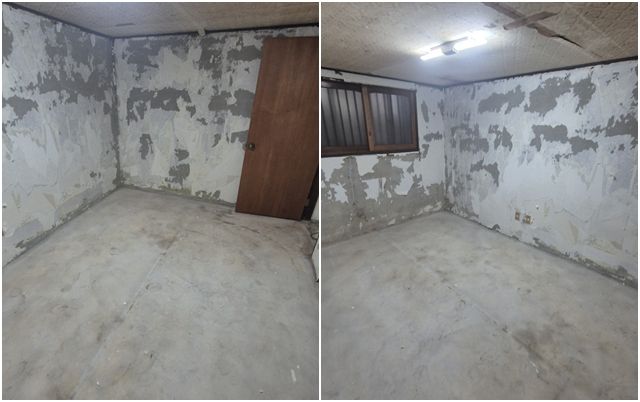
Behind this trend lies a structural flaw: the blind spots in the welfare system.Those at high risk of solitary death typically face a triple burden of economic crisis, deteriorating health, and severed family ties.Yet the current welfare system is largely based on an application principle that requires individuals to actively seek help before it responds. This makes it difficult to identify people who have withdrawn into isolation. Closed living environments such as semi-basements intensify that isolation, and until the smell leaks out beyond the door, public intervention rarely occurs, leading to a pattern of response focused on cleanup after the fact.
A report by the Korea Institute for Health and Social Affairs (KIHASA), "Social Isolation and Loneliness Across the Life Course and Policy Responses," argues that social isolation cannot be viewed solely as a matter of personal disposition or choice. The institute writes in the report that"Social isolation and loneliness should not be seen as problems individuals must overcome on their own, but as social risks that the state needs to manage."it suggested.
In the end, the growing number of specialized cleaning sites is evidence that our society is paying more to erase the traces of the dead than to care for the living.
I record dense stories of life in print. However rough they may sound, I try to capture words gathered directly from the field. From alleys, markets, and someone’s workplace, the records of ordinary days we have passed by will find their way to you, the readers.[Chronicler of the Margins]To receive this series comfortably, please subscribe to the reporter’s page.
hsg@fnnews.com Han Seung-gon Reporter