KOSPI Swings 500 Points in a Day... Market Feels Like a Daily Battlefield [U.S.–Iran War]
- Input
- 2026-03-05 18:36:56
- Updated
- 2026-03-05 18:36:56
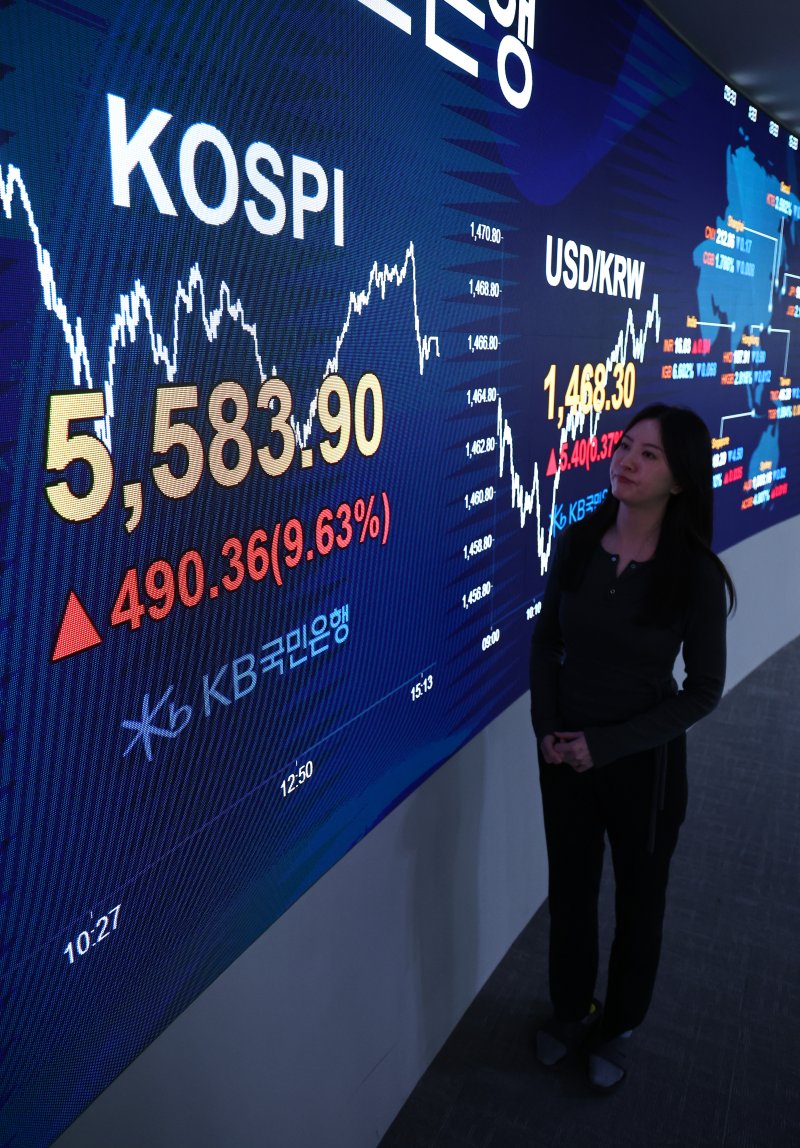
According to the Korea Exchange on the 5th, the KOSPI closed at 5,583.90, up 490.36 points (9.63%) from the previous session. During intraday trading, it climbed as much as 621 points (12.21%), breaking the previous record for the largest single-day gain. The prior record, based on closing prices, was 338.41 points on the 3rd of last month. The day’s gain was more than 280 points higher than that earlier record.
Recently, the domestic stock market has seen repeated sharp swings as concerns over energy supply chains amid rising tensions in the Middle East intersect with volatility in global financial markets. In particular, program trading and passive funds have been rapidly flowing in and out of semiconductor stocks and other large-cap names, greatly widening intraday price ranges.
Market participants note that a sharp rebound has followed the recent steep drop as bargain hunters moved in, but they expect elevated volatility to persist as geopolitical risks remain unresolved. Over the past three trading days, the KOSPI has posted intraday swings of 400 to 600 points, an unusually high level of volatility.
As Middle East risk intensified, investor sentiment deteriorated rapidly. At the same time, buying emerged on perceptions that the sell-off had gone too far, and this push-and-pull has greatly amplified index volatility.
However, the current violent swings are seen more as a short-term shock reflecting excessive fear than as a clear trend reversal. Historical data show that sharp declines occurring when market fear peaks have often served as signals of a bottom instead.
In the KOSPI market, the circuit breaker mechanism has been triggered a total of eight times in history. It has occurred only in limited periods of global financial turmoil, such as the collapse of the dot-com bubble, the September 11 attacks (9/11), the U.S. sovereign credit rating downgrade, and the COVID-19 pandemic. In most of these cases, the circuit breaker mechanism was activated near the market’s psychological bottom and was followed by a rebound. On average, about 32 trading days after a circuit breaker mechanism is triggered, the KOSPI has risen roughly 9.9%, recovering most of its losses. Around 60 trading days later—about three months—the index has typically shown gains approaching 20%. Given these statistics, the securities industry believes that, despite the recent spike in short-term volatility, the medium- to long-term uptrend is likely to remain intact. A global semiconductor boom and improving corporate earnings are continuing to draw in passive funds. An industry official commented, "Geopolitical shocks increase market volatility in the short term," adding, "However, if they do not spill over into financial system risk, their impact tends to fade over time."
[email protected] Reporter Choi Doo-seon Reporter