[Editorial] China Lowers Growth Target for the First Time in Four Years, Korea Must Brace for Economic Fallout
- Input
- 2026-03-05 18:29:25
- Updated
- 2026-03-05 18:29:25
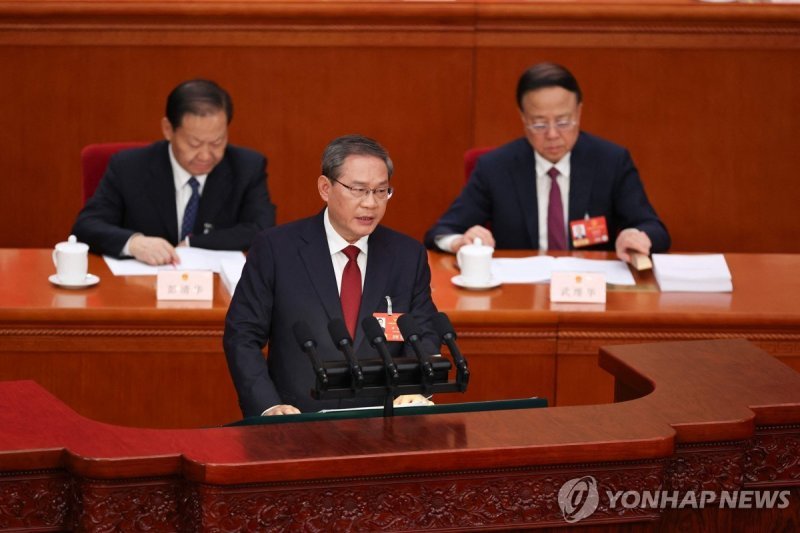
Beijing’s decision to lower this year’s growth target reflects a combination of weak exports, hurt by US tariffs and technology controls, and sluggish domestic demand. Last year, China cut its consumer price inflation target for the first time in 20 years, from 3% to 2%, and it has set the same inflation goal again this year. Because this low price level stems from weak demand, it can hardly be viewed as a positive sign.
China’s economy is currently being dragged down by a prolonged slump in the property market. For several years, large real estate developers have been pushed to the brink of default, triggering warning signals, and concerns over bad debts have yet to be resolved. There are an estimated 80 million unsold or vacant homes in China, which is leading to falling house prices, weaker transactions, and a slowdown in new construction starts. As the property sector accounts for roughly one-quarter of China’s Gross Domestic Product (GDP), the downturn is rippling through jobs and other parts of the economy.
The real estate slump is also dampening consumption within China. As the value of their assets declines, middle-class households are shifting from spending to saving more or paying down debt first. Companies, for their part, are cutting wages and reducing headcount as they hunker down to survive.
China’s economic weakness is a direct negative for the Republic of Korea (ROK) economy. If Chinese companies respond to domestic stagnation by ramping up low-priced exports overseas and engaging in aggressive price competition, this could hurt ROK exports of intermediate goods such as semiconductors and machinery parts.
Falling sales at ROK exporters would lead to cuts in capital expenditure, which in turn would weigh on production and employment in related industries such as machinery, construction, and logistics. As corporate earnings weaken, their capacity to pay wages and bonuses will shrink, eroding household spending power and likely reducing tax revenues, including corporate taxes. If China’s domestic demand slump persists, ROK companies operating there will inevitably see profitability deteriorate due to slower sales and rising inventories.
The structural problems facing China’s economy will not be resolved in the short term. Internal factors such as the property downturn, heavy local government debt, and delayed recovery in consumption are overlapping with external risks like global supply chain realignment and US–China tensions. China’s slowdown is therefore unlikely to be a temporary setback; it could become a medium- to long-term trend.
The challenge is that the ROK economy, which is heavily dependent on trade with China, cannot easily escape this sphere of influence. Given the industrial structure in which exports to China account for a large share, and the reality of ROK companies deeply embedded in the Chinese market, changes in China’s business cycle will continue to affect ROK growth and corporate earnings.
In this environment, companies must work to diversify export markets that are overly concentrated on China, while also shifting their production structures toward stronger technological competitiveness and higher value-added products. The government, for its part, needs to support firms in enhancing their competitiveness and pioneering new emerging markets in line with the global supply chain reconfiguration. As China’s slower growth is likely to become a new normal, it is time for the public and private sectors to cooperate on a medium- to long-term response strategy.