[Editorial] The world says Korea is doing well, but life satisfaction remains at the bottom
- Input
- 2026-03-05 18:29:20
- Updated
- 2026-03-05 18:29:20
From childhood, Koreans are subjected to overheated competition in entrance exams. After graduation, they face an intense struggle to find a job. In middle age, they shoulder the heavy burden of housing costs and supporting their children. Even in old age, many cannot stop working because they lack financial security. It is a harsh life for many Koreans. The causes must be properly diagnosed, and appropriate measures devised for each stage of life.
Life satisfaction is an index that shows how satisfied people feel with their objective living conditions, measured on a scale from 0 to 10. The life satisfaction score of Koreans rose gradually from 6.0 in 2020 to 6.5 in 2022. However, it slipped slightly to 6.4 in 2023 and stayed at the same level last year. This ranks Korea 33rd among the 38 OECD member states. Only a few countries score lower than Korea: the Republic of Türkiye, Greece, Hungary, Colombia and Portugal. The list of countries at the bottom, including Korea, hardly changes from year to year.
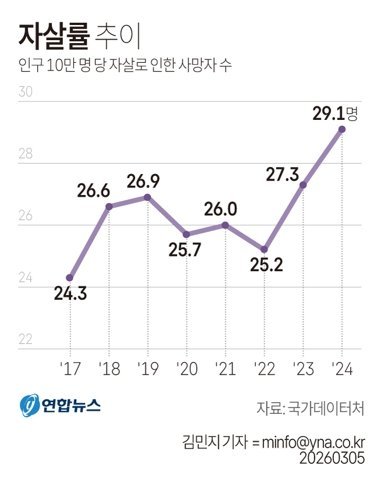
A range of indicators reflecting depression, suicide, employment, poverty and social trust have all worsened. The suicide rate had been declining since 2011, but it began to rise again from 2017 and reached 29.1 deaths per 100,000 people in 2024. That is an increase of 1.8 compared with the previous year. It is also the highest level since 2011, when the rate hit a record high, and the gender gap is striking. The male suicide rate, at 41.8 per 100,000, is more than twice the female rate of 16.6. Compared with other OECD members, Korea’s suicide rate is overwhelmingly the highest. According to KOSTAT, in most other countries the figure is around 10 per 100,000. Abroad, people admire Korea’s prosperity and glamour, fueled by the Korean Wave (Hallyu). Yet many Koreans are living such difficult lives that a significant number choose to end their own. The government needs to respond far more proactively.
Negative emotions such as depression and anxiety have rebounded to levels seen during the COVID-19 pandemic. The employment rate for university graduates rose for three consecutive years through 2023, but turned downward again in 2024. Trust in key institutions such as the government and the National Assembly has remained below 50 percent for three years in a row. It is also noteworthy that the relative poverty rate has climbed to its highest level in five years. This is likely related to the sharp rise in real estate prices concentrated in certain regions.
The number of quality jobs must be increased, and attention must be paid to the neglected corners of society. This is largely the responsibility of the government. Wealth and income polarization could deepen further. Detailed and practical policies are urgently needed to narrow these gaps. Raising life satisfaction is not something individuals can achieve through personal effort alone. Korea must become a genuinely affluent country through structural reforms of its social system. An excessive culture of competition and a distorted social climate that fuels feelings of relative deprivation by constant comparison with others are challenges we all must overcome. Only when inclusiveness and consideration prevail will life satisfaction truly improve.