Institutions and Foreign Investors Bet on a Market Drop: Short-Selling Turnover Hits 3 Trillion Won [U.S.–Iran War]
- Input
- 2026-03-05 18:17:12
- Updated
- 2026-03-05 18:17:12
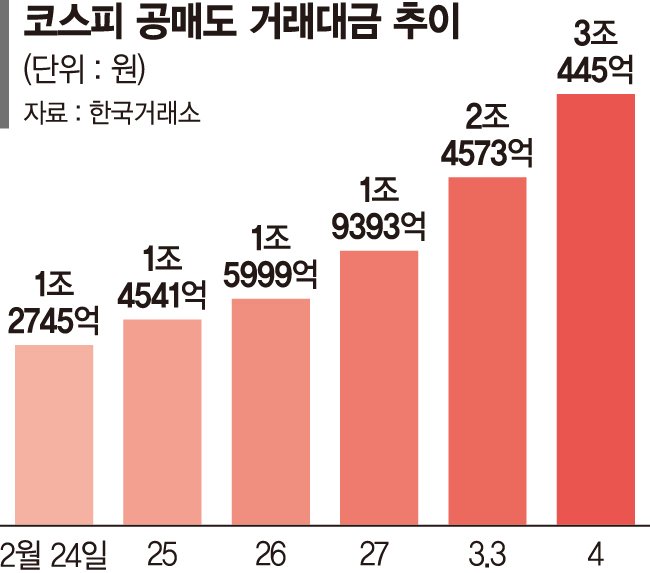
According to the Korea Exchange (KRX) on the 5th, short-selling turnover on the Korea Composite Stock Price Index (KOSPI) market came to 3.0445 trillion won the previous day. This is the highest level since short-selling was fully reinstated at the end of March last year. After reaching 1.9393 trillion won on the 27th of last month, the figure jumped by about 1 trillion won in just two trading sessions, setting a new record.
The surge is largely attributed to weakness in the KOSPI. From the 27th of last month through the previous day, the KOSPI fell for three consecutive sessions, losing a total of 19.24%. On the previous day alone, the index plunged 698.37 points, or 12.06%, a steeper drop than during the September 11 attacks (9/11 attacks) in 2001, when it fell 12.03%.
Institutions and foreign investors are at the center of this bearish positioning. Of the 3.0445 trillion won in short-selling turnover recorded the previous day, foreign investors accounted for 2.025 trillion won and institutions for 989 billion won, together making up the vast majority.
Institutions and foreign investors are also buying the double inverse leveraged ETF, known as a "double inverse ETF," which profits from declines in the KOSPI. Over the past week (from the 26th of last month to the previous day), the KODEX 200 Futures Inverse 2X exchange-traded fund (ETF) saw net inflows of 188.2 billion won. In particular, institutions and foreign investors posted net purchases of 290.1 billion won and 89.1 billion won, respectively.
Even so, analysts do not expect another sharp sell-off in the near term. They say the Middle East risk stemming from the United States’ airstrikes on Iran has already been largely priced in, and that corporate earnings and fundamentals remain intact. The securities lending balance, often viewed as a leading indicator for short-selling, also fell sharply, dropping from 157.9299 trillion won on the 26th of last month to 127.3418 trillion won the previous day—a decline of more than 30 trillion won in just three trading days.
Jung Hae-chang, a researcher at Daishin Securities, said, "The KOSPI on the previous day reflected the worst-case scenario of an 'energy supply chain collapse' as tensions in the Middle East escalated." He added, "However, we believe the worst has already been priced in, and the previous day's low of 5,059.45 on the KOSPI is a level that has shown strong support in the past, excluding the global financial crisis. If the situation eases, we expect a recovery based on valuations and earnings prospects."
[email protected] Reporter Lim Sang-hyuk Reporter