Retail investors bet on a rebound in a whipsaw market... Margin deposits hit record 130 trillion won [U.S.–Iran war]
- Input
- 2026-03-05 18:17:10
- Updated
- 2026-03-05 18:17:10
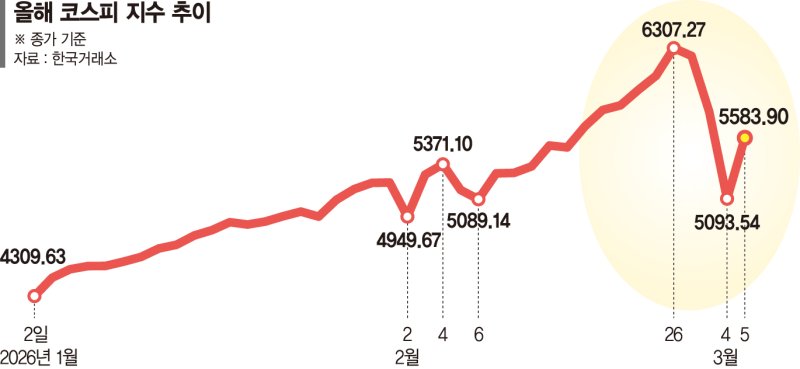
■ Margin deposits and trading value soar
According to the Korea Financial Investment Association (KOFIA) on the 5th, investor margin deposits in the domestic stock market stood at 129.8187 trillion won on the 3rd, up 11.07 trillion won, or 9.32%, from the previous day. This set a new record high. The previous record was set on the 27th of last month at 119.4832 trillion won, and it was broken again just two trading days later.
Investor margin deposits are funds entrusted to brokers by clients to buy stocks and other securities, and are regarded as a key gauge of cash waiting on the sidelines. Generally, a rise in margin deposits signals improving investor sentiment. The figure has climbed steadily from 53 trillion won in March last year to 70 trillion won in August, 100 trillion won in January this year, and over 110 trillion won last month. On the 3rd of this month, when the record was broken, the KOSPI index tumbled 7.24% from the previous day in what was dubbed "Black Tuesday." Samsung Electronics plunged 9.88%, while SK Hynix dropped 11.50%. Even so, investors poured an additional 11 trillion won into their stock accounts.
Trading value on the KOSPI also moved sharply higher. Data from the Korea Exchange (KRX) show that KOSPI trading value on the 4th reached 62.8827 trillion won, setting another all-time high. Average daily trading value on the KOSPI was around 12.6634 trillion won last year, but jumped into the 27 trillion won range in January and surpassed 30 trillion won last month. On the 26th and 27th of last month, daily trading value hit 38.93 trillion won and 54.9393 trillion won, respectively, marking record highs for two consecutive days. Even on the 3rd of this month, when the market plunged, trading value remained in the 50 trillion won range at 52.8005 trillion won, and on the 4th it broke through 60 trillion won.
■ Viewing the drop as a buying opportunity
Retail investors appear to have treated the decline triggered by the war between the United States of America (U.S.) and the Islamic Republic of Iran as a bargain-hunting opportunity. On the 3rd alone, individuals recorded net purchases of 6.8762 trillion won on the KOSPI. They absorbed nearly all of the shares that foreigners and institutions dumped, with net sales of about 5.0353 trillion won and 2.2381 trillion won, respectively. On the same day, individuals bought a combined 4.1807 trillion won worth of just Samsung Electronics (2.6886 trillion won) and SK Hynix (1.4921 trillion won).
In the Exchange-Traded Fund (ETF) market, individuals also stuck to their existing investment stance. According to ETF Check, over the past week retail investors posted net purchases of 1.0762 trillion won in KODEX Leverage ETF, which tracks the KOSPI 200 Index. The product fell 32.26% over the week, but investors effectively averaged down their positions. During the same period, they also bought 745.8 billion won of KODEX KOSDAQ 150 Leverage ETF, which declined 29.09%.
Experts are broadly supportive of retail investors’ bullish bets. They note that although the market slumped sharply on the 3rd and 4th, there is ample room for a technical rebound.
Kim Ji-hyun, a researcher at Daol Investment & Securities, said, "We believe the recent sharp decline was not the result of systemic risk spreading as in the 2008 global financial crisis, but rather due to amplified actual market volatility as assets under management (AUM) in Leveraged Exchange-Traded Funds (Leveraged ETFs) increased and end-of-day rebalancing demand expanded." Kim added, "As futures prices moved into an extremely overvalued zone, net buying flowed into the cash market on the 5th, creating conditions for a technical rebound." Heo Jae-hwan, a researcher at Eugene Investment & Securities, noted, "During the COVID-19 pandemic in 2020, the KOSPI fell 35%, and during the Russo-Ukrainian war and monetary tightening phase in 2022, it dropped 22%." He continued, "A decline in the KOSPI of more than 20% suggests that much of the negative news has already been priced in." He then advised, "From here, it is more likely to become a battle against time rather than a question of further downside. Investors should refrain from additional selling, and it appears more effective to focus on sectors where earnings expectations remain intact, such as semiconductors, energy and power utilities."
[email protected] Han Young-joon Reporter