Deepening Social Isolation: Relative Poverty, Suicide, and Obesity All on the Rise
- Input
- 2026-03-05 12:00:00
- Updated
- 2026-03-05 12:00:00
On the 5th, the Ministry of Data and Statistics (KOSTAT) released its report titled "Quality of Life in Korea 2025." The report tracks quality of life and medium- to long-term trends in Korean society. It is composed of 71 indicators across 11 domains, including employment and wages.
By domain, the relative poverty rate stood at 15.3% in 2024, up 0.4 percentage points from the previous year. The rate had peaked at 18.5% in 2011 and then declined, falling below 15% between 2021 and 2023, before turning upward again. This is lower than the United States of America (18.1% as of 2023) and Japan (15.4%), but higher than the United Kingdom (UK) at 12.6%, Germany at 11.6%, and France at 8.7%.
In particular, the relative poverty rate among people aged 66 and older in Korea is extremely high at 39.8%. As the country enters an era of 10 million seniors due to rapid population aging, poverty among older adults has become a critical challenge that Korean society must address.
Real gross national income (GNI) per capita reached 43.81 million won in 2024, a 3.5% increase, or 1.46 million won, from 42.35 million won the previous year. Since 2017, when economic growth began to stagnate, GNI growth had remained subdued. In 2022, it even declined by 0.3%. It has been rising again since 2023.
The level of social isolation was 33.0% in 2025, unchanged from 2023. It has not returned to the high-20% range seen before COVID-19. The isolation rate was higher for men (35.7%) than for women (30.5%). Compared with 2023, the rate for men rose by 0.5 percentage points, while the rate for women fell by 0.5 percentage points. By age group, people in their 50s had the highest isolation level at 37.2%, an increase of 2.2 percentage points from 2023, the largest jump among all age groups. Participation in social organizations—such as hobby clubs, civic groups, and community associations—which had been increasing after COVID-19, also declined. The participation rate dropped to 52.3% in 2024, down 5.9 percentage points from 58.2% a year earlier. The decrease was particularly sharp among people in their 30s (52.3%) and 40s (52.6%), who are usually the most socially active, with declines of 8 to 9 percentage points from the previous year.
The quality of public health has deteriorated. The obesity rate rose to 38.1% in 2024, up 0.9 percentage points from 37.2% the year before. A KOSTAT official explained, "The obesity rate has climbed back to nearly the same level as in 2020, when it hit a record high of 38.3% due to Coronavirus disease 2019 (COVID-19)." By gender, the rate for men jumped 3.2 percentage points to 48.8%, while the rate for women fell 1.6 percentage points to 26.2%. The increase was especially pronounced among people in their 40s, whose obesity rate surged to 44.1%, up 6.4 percentage points, a much larger rise than in other age groups.
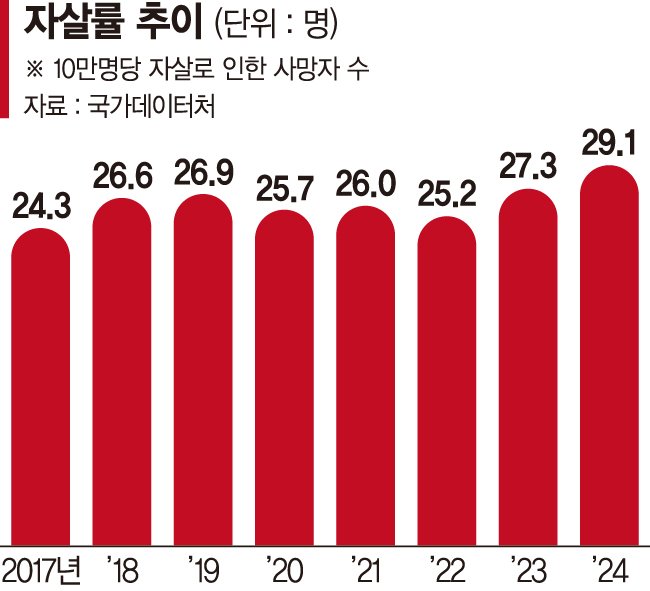
Suicides are also on the rise again. The suicide rate reached 29.1 deaths per 100,000 people in 2024, up from 27.3 in 2023. This is the highest level since 2011, when the rate was 31.7. The rate for men was 41.8 per 100,000, an increase of 3.5 from the previous year, while the rate for women rose by 0.1 to 16.5. By age group, people in their 40s had the highest rate at 4.7, followed by those in their 50s at 4.0 and those in their 30s at 3.9.
Some indicators of quality of life did improve. The employment rate reached 62.9% in 2025, up 0.2 percentage points from 62.7% the previous year. It has been on a steady upward trend since falling from 60.9% in 2019 to 60.1% in 2020. However, the employment rate for university graduates dropped to 69.5% in 2024, down 0.8 percentage points from a year earlier. The share of low-wage workers fell slightly to 16.1% in 2024, a decrease of 0.1 percentage points from the previous year. Even so, Korea’s proportion of low-wage workers in 2023 remained higher than that of Japan (10.4%) and the Organisation for Economic Co-operation and Development (OECD) average of 12.7%.
[email protected] Jeong Sang-geun Reporter