Government Moves to Curb Fuel Prices With Price Ceiling Measure... Koo Yun-cheol Vows to Crack Down on Collusion and Unfair Practices [U.S.–Iran Conflict]
- Input
- 2026-03-05 18:14:02
- Updated
- 2026-03-05 18:14:02
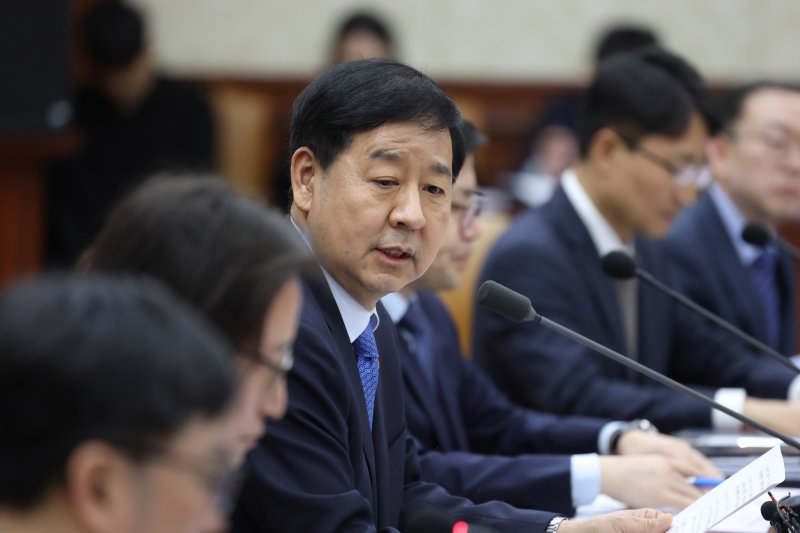
Koo Yun-cheol, Deputy Prime Minister for Economic Affairs and Minister of Economy and Finance (MOEF), presided over the third meeting of the Task Force of Related Ministers for Special Management of Consumer Prices at Government Complex Seoul on the 5th. He stated, “The government will respond thoroughly by using every possible administrative measure, including the designation of maximum prices for petroleum products,” adding, “I ask the Ministry of Trade, Industry and Resources (MOTIR) and other relevant ministries to swiftly review the designation of maximum petroleum sales prices under the Petroleum and Alternative Fuel Business Act.”
The government decided to put the price ceiling option on the table because it believes that in some sectors, including petroleum products, certain players are exploiting what is effectively a national crisis to raise prices excessively for private gain.
According to Opinet, the oil price information system operated by Korea National Oil Corporation (KNOC), the nationwide average retail price of gasoline as of 3 p.m. that day was 1,822 won per liter, up 44.5 won from the previous day. This is the first time in about three years and seven months that the national average gasoline price has exceeded 1,800 won per liter, since August 12, 2022, when it stood at 1,805.9 won. In Seoul, the average gasoline price has already reached 1,882.85 won per liter. Diesel prices are also on the rise: the nationwide average diesel price was 1,811 won per liter, up 82.26 won from the previous day, while the average in Seoul was 1,883.5 won per liter.
Despite the surge in gasoline and diesel prices, the domestic supply situation for petroleum products is assessed as stable. Korea in particular holds more than 200 days’ worth of oil reserves, far exceeding international recommendations. Given that it usually takes two to three weeks for international prices to be fully reflected domestically, it is not yet the point at which global price movements should be exerting a substantial impact on local prices.
In response, the government is operating the Inter-ministerial Task Force for Oil Market Inspection, which brings together MOEF, the Ministry of Trade, Industry and Energy of the Republic of Korea, the Korea Fair Trade Commission (KFTC), the National Tax Service, and local governments. Starting on the 6th, it will also work with the Korea Petroleum Quality & Distribution Authority and the Korean National Police Agency (KNPA) to carry out more than 2,000 special inspections per month.
Joo Byung-ki, chair of the KFTC, said, “The government takes the current situation very seriously, and relevant ministries are working closely together to prevent external geopolitical instability from spilling over into the domestic market.” He added, “Based on the discussions at the task force meeting, we will further strengthen market surveillance to ensure that no market-distorting behavior rides on the back of rising international oil prices.”
Oil refiners and gas station operators are divided over the causes of the price spike and the possible introduction of a price ceiling system.
The Korea Oil Station Association agrees with the government’s goal of stabilizing fuel prices, but argues that the price gap between ordinary gas stations and Economy Gas Stations must be addressed. An Seung-bae, head of the Korea Oil Station Association, said, “Given that ordinary gas stations are already suffering losses due to Economy Gas Stations, we have no reason to oppose the designation of maximum prices,” adding, “Reviving the posted refinery price system, under which oil refining companies publicly announce their supply prices as in the past, could also be an alternative.”
Oil refining companies, on the other hand, are reportedly uncomfortable with the government’s consideration of direct price controls. Since most domestic gas stations are run as independent businesses rather than directly operated by refiners, it is difficult for refiners to control retail prices themselves. An industry official commented, “This price spike is unprecedented, and in some respects it stems not from the refiners but from the pricing decisions of certain gas stations,” and went on, “If a price ceiling system is introduced, the government is supposed to compensate refiners for losses relative to their supply prices, but the key issue is how that compensation mechanism will actually be designed.”
Meanwhile, the Ministry of Trade, Industry and Energy of the Republic of Korea on the same day issued an ‘attention’ level alert under the resource security warning system for crude oil and gas. The resource security warning system has four levels—attention, caution, alert, and serious—and is activated under the Special Act on National Resources Security after comprehensively considering the severity of the crisis, its impact on people’s livelihoods, and its potential ripple effects on the national economy.
[email protected] Seo Young-jun, Koo Ja-yoon, Park Ji-young, Kim Chan-mi Reporter