Semiconductor Investors Shake Off the ‘Iran Shock’... Samsung and SK Hynix Back on the Rise
- Input
- 2026-03-05 18:13:16
- Updated
- 2026-03-05 18:13:16
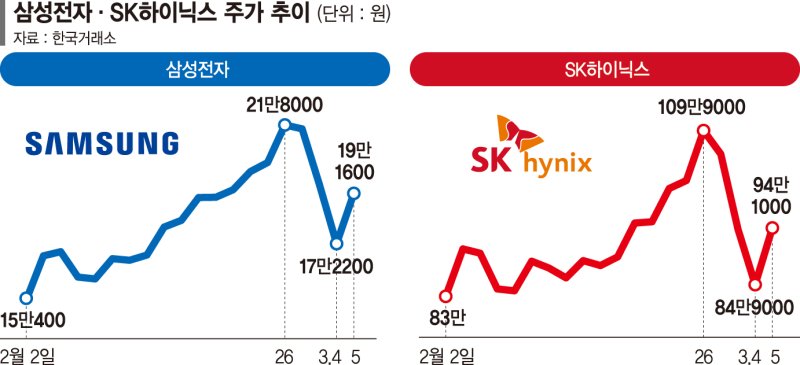
According to the Korea Exchange on the 5th, shares of Samsung Electronics and SK Hynix closed up 11.27% and 10.84%, respectively, on the day. The domestic stock market had tumbled after the United States and Israel carried out airstrikes on the Islamic Republic of Iran. Over the two sessions on the 3rd and 4th, the Korea Composite Stock Price Index (KOSPI) plunged 18.42%, while Samsung Electronics and SK Hynix also slumped 20.46% and 19.98%, respectively.
Despite the sharp drop in Samsung Electronics and SK Hynix shares, many brokerage houses argued that the correction should be seen as a buying opportunity. They stressed that the decline was driven by a Middle East–related shock, not by any deterioration in fundamentals, and that investors should focus on earnings and overall corporate value.
In fact, the spread of Artificial Intelligence (AI) is driving a surge in demand for memory semiconductors, heightening expectations for earnings at Samsung Electronics and SK Hynix. Market research firm TrendForce forecasts that contract prices for standard Dynamic Random Access Memory (DRAM) in the first quarter will jump 90–95% from the previous quarter, while NAND flash memory prices are expected to rise 55–60%.
Notably, semiconductor prices have remained relatively stable despite the so-called ‘Iran shock.’ Even as the KOSPI recorded its largest-ever one-day drop in the previous session, spot DRAM prices were broadly flat: for 16GB chips, DDR5 edged up 0.08%, while DDR4 slipped 0.25%. In the three trading days following the Islamic Republic of Iran’s airstrikes, 16GB DDR5 and DDR4 prices fell only 0.8% and 3.4%, respectively.
Against this backdrop, Mirae Asset Securities interpreted the two-day plunge in Samsung Electronics and SK Hynix shares as a ‘panic sell-off’ triggered by geopolitical risk. The firm kept its target prices for both companies unchanged and advised investors to respond to the share-price decline by buying rather than selling.
Kim Young-geon, an analyst at Mirae Asset Securities, said, “Valuations have suddenly become very cheap, and because memory prices are stable, there is limited room for downward revisions to earnings.” He added, “We expect the tight supply–demand balance in memory to persist over the longer term.” Kim went on to explain, “Supply-chain uncertainty could actually reinforce the trend of building up safety inventories of memory, while at the same time making suppliers more cautious about expanding capital expenditures (CapEx).”
Korea Investment & Securities and Kiwoom Securities have recently raised their target prices for Samsung Electronics and SK Hynix. Korea Investment & Securities lifted its target for Samsung Electronics to 270,000 won and for SK Hynix to 1.5 million won. Kiwoom Securities also raised its targets to 260,000 won and 1.3 million won, respectively.
Chae Min-sook, an analyst at Korea Investment & Securities, noted, “As the supply shortage deepens, price negotiations are effectively turning into competitive bidding among customers for limited volumes.” She continued, “Because price talks for the first quarter have not yet concluded, there is still room for further increases in average selling prices (ASP). Market consensus on ASP growth from the second quarter onward is also continuing to move higher.”
Park Yoo-ak, an analyst at Kiwoom Securities, predicted, “Higher memory prices and profitability are now translating into increased Capital Expenditures (CapEx). On the back of stabilizing supply and demand for standard memory, we are starting to see an inflection point in the cycle where shipment volumes begin to rise.”
[email protected] Reporter Seo Min-ji Reporter