Despite Smooth Progress on Special Act on Investment in the United States, Business Circles Warn of "Tariff Risks on Semiconductors"
- Input
- 2026-03-05 18:11:41
- Updated
- 2026-03-05 18:11:41
■ Semiconductor jitters even after U.S. investment law passes
The Special Committee on the Handling of the Special Act on U.S. Investment said on the 5th that it had resolved most of the contentious issues in the bill review subcommittee. After fine-tuning the details with the government, it plans to pass the bill at a full committee meeting on the 9th.
Until last month, deliberations had been delayed by clashes between the ruling and opposition parties, and key issues remained unresolved. But the process has accelerated as the People Power Party decided to cooperate more constructively, citing the national interest in responding to renewed U.S. tariff hikes.
On the same day, the ruling and opposition parties agreed to establish a US Investment Corporation with paid-in capital of 2 trillion won, to be fully funded by the government. Instead of seeking parliamentary approval for each investment project, the government will make prior reports to the relevant standing committee to improve efficiency. They also decided to set up risk management committees within the Ministry of Trade, Industry and Resources, the Ministry of Economy and Finance, and the US Investment Corporation, creating a triple safety net.
The reason the two sides are cooperating so swiftly despite deep political confrontation is their shared goal of responding to tariffs. Still, business leaders warn that even if the Special Act on Investment in the United States clears the National Assembly, the risk of renewed tariff hikes or new tariffs being imposed will not disappear entirely.
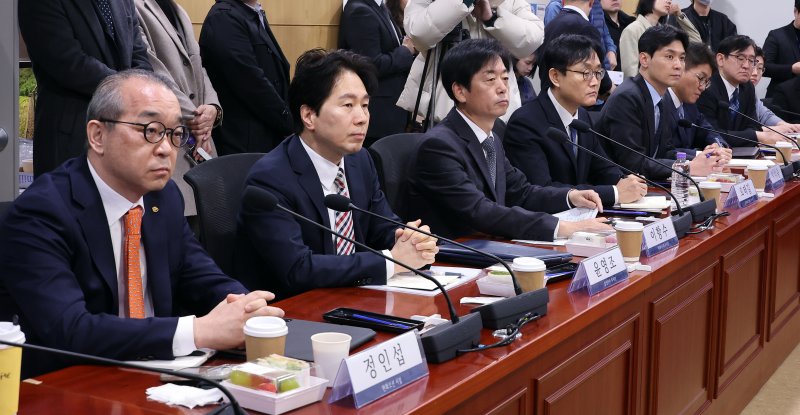
On the same day, business representatives conveyed these concerns at a meeting with Democratic Party lawmakers from the Foreign Affairs and Unification Committee of the National Assembly, the Strategy and Finance Committee of the National Assembly, and the Trade, Industry, Energy, SMEs, and Startups Committee. Participants from the business community included the Federation of Korean Industries, the Korea International Trade Association, Samsung Electronics, Hyundai Motor Company, SK Group, LG Corporation, Hanwha Ocean, HD Hyundai Oilbank, and GS Caltex. Companies are factoring in the possibility that, even after the Special Act on Investment in the United States takes effect, the Trump administration could impose product-specific tariffs on semiconductors as it sees fit. In fact, the U.S. side has been floating the idea of 100% tariffs on semiconductors since last year. In response, the Democratic Party of Korea decided to work with the Lee Jae-myung administration to prepare countermeasures. As a first step, members of the Strategy and Finance Committee of the National Assembly will meet on the 6th with Koo Yun-cheol, Deputy Prime Minister for Economic Affairs and Minister of Finance and Economy, to discuss the issue.
■ Iran-driven power cost burden and data center delays
Separate from the potential risk of U.S. tariffs, the immediate headwind is the uncertainty caused by the war involving the Islamic Republic of Iran. If energy supplies tighten, electricity costs will rise, eroding price competitiveness. In addition, if construction of artificial intelligence data centers in the Middle East is delayed, demand could fall sharply.
To begin with, seven oil tankers carrying the equivalent of three days’ worth of domestic consumption are currently stuck in the Strait of Hormuz. The government has stated that it holds enough reserves of oil, natural gas, and other resources to last 208 days, but business leaders say they need concrete scenarios based on how long instability in the Middle East might persist. In response, the Democratic Party of Korea asked the Ministry of Trade, Industry and Resources to prepare contingency plans under multiple scenarios.
Plans to build 7–8 GW of data center capacity by 2030, centered on the UAE, are also unlikely to proceed without disruption. The business community believes this could significantly reduce semiconductor demand. The Democratic Party of Korea said it would relay these concerns to the government and work on countermeasures.
[email protected] Yoon-ho Kim, Hyung-gu Kim Reporter