KOSPI rebounds after steep plunge; brokerages say "valuation bottom confirmed around 5,000"
- Input
- 2026-03-06 06:00:00
- Updated
- 2026-03-06 06:00:00
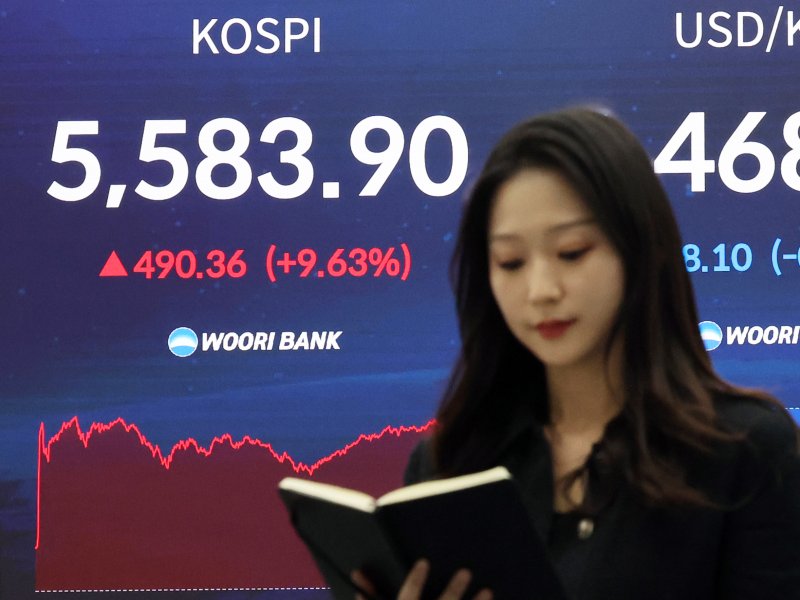
According to Financial News, the Korea Composite Stock Price Index (KOSPI), which had tumbled on heightened geopolitical tensions in the Middle East, staged a sharp rebound as bargain hunters moved in. Analysts say that during the recent sell-off, the KOSPI fell toward the 5,000 level, confirming what they view as the lower bound of its valuation range. However, they also note that the market’s next move will largely depend on whether the war drags on and how international oil prices behave.
According to the Korea Exchange on the 5th, the KOSPI closed at 5,583.90, up 490.36 points (9.63%) from the previous session. The index opened at 5,250.92, up 3.09%, and at one point during the session climbed to 5,715.30, marking an intraday gain of more than 12%. The KOSDAQ also finished higher, jumping 137.97 points (14.10%) to 1,116.41.
In recent days, the domestic stock market has seen sharp swings as geopolitical tensions in the Middle East intensified. The KOSPI slid from the 6,307 level on the 26th of last month to around 5,093 on the 4th of this month, a drop of about 19%. The rapid decline severely dented investor sentiment, but on this day, perceptions that the sell-off had been overdone drew in bargain buying, helping the index recoup part of its losses.
On the KOSPI, individual investors were net buyers of 2.2513 trillion won, driving the rebound in the index. Foreign investors and institutions, by contrast, were net sellers of 420.7 billion won and 1.909 trillion won, respectively. Large-cap semiconductor stocks, which had borne the brunt of foreign selling during the recent slump, also bounced sharply. Samsung Electronics rose 11.27%, while SK Hynix gained 10.84%.
Market participants also believe the rally partly reflects expectations that the conflict in the Middle East may not quickly escalate into a full-scale war. Foreign media reported that the Islamic Republic of Iran’s intelligence authorities, through a third country, attempted back-channel contact with the Central Intelligence Agency (CIA) of the United States and proposed talks on conditions for ending the conflict.
Brokerages point to the potential duration of the war as the key variable in the current situation. If the conflict becomes protracted, rising international oil prices could fuel inflation and intensify upward pressure on interest rates, weighing on equities. The Republic of Korea (ROK), in particular, is highly dependent on energy imports, making its market relatively sensitive to risks stemming from the Middle East.
At the same time, some analysts argue that much of the geopolitical risk has already been priced in, as the KOSPI slid toward the 5,000 level, roughly where its forward price-to-earnings ratio stands at about 8 times, during the recent decline. If the war remains a short-lived clash rather than a prolonged conflict, brokerages see a higher likelihood of the market entering a period of volatility followed by gradual stabilization, rather than suffering another steep leg down.
Jung Hae-chang, a researcher at Daishin Securities, said, "By drawing up a plan at the State Council to expand the market stabilization program to 100 trillion won if the situation drags on, the government has helped put a floor under investor sentiment." He added, "In the sharp sell-off the previous day, we confirmed support around the 5,000 level, where the forward price-to-book ratio is near 0.8 times, and we believe this support zone has already factored in a worst-case scenario, including the triggering of the circuit breaker mechanism."
[email protected] Bae Han-geul Reporter